The Balkanization Of The Middle East

Shlomo Avineri speculates about shifting borders post-Arab Spring:

 Most international borders in the Middle East and North Africa were drawn by imperial powers – Britain, France, and Italy – either after World War I and the breakup of the Ottoman Empire (the Sykes-Picot agreements), or, as in Libya and Sudan, earlier. But in no case did these borders correspond with local popular will, or with ethnic or historical boundaries. In other words, none of these countries, except Egypt, had ever been a discrete political entity. Until recently, their rulers had a common interest in keeping this Pandora’s Box of borders tightly sealed. That has changed, and we see the region’s imperially imposed frontiers being called into question.

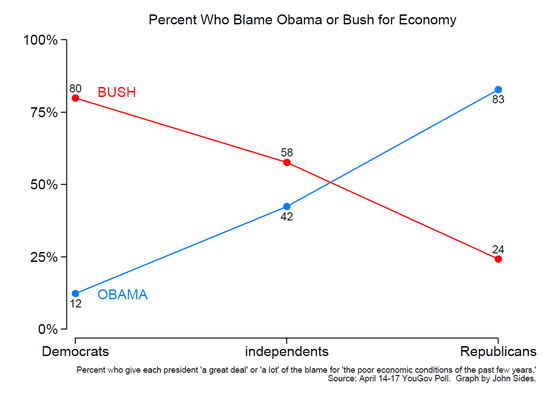
Blame For The Economy

Splits along parties lines:

Bush_Obama_Partisan

John Sides estimates what would happen if Obama and Bush were blamed equally:

First, Obama’s job approval would decline by about 11 points.  Second, his poll standing relative to Romney’s would decline by 3 points.  Both of these declines are statistically significant and substantively important. To be sure, this exercise is purely hypothetical. Life isn’t a laboratory, and we can’t replay Obama’s first 3 years and have voters blame him less or more than they do in reality.  Nevertheless, Obama’s lead in the blame game appears to be helping him in the horserace.

Why Are Democrats So Useless At Persuasion? Ctd

Dreher jumps in to the discussion:

The point here is surely not to deride empiricism. Heaven knows conservatism could stand to quit leading with its heart and start thinking more empirically about the world as it is, not the world as they wish it to be. The point, if I’m reading [Williams and Sullivan] correctly, is that too many leading voices on the left give themselves over to wonkiness, and presume that their moral convictions are widely shared, such that the only reason anybody could disagree with them is through ignorance (willful or not), or malice.

Eli Zaretsky looks to the Dems' left flank for moral inspiration:

What drives American history forward, then, are not horse-swaps, “grand bargains,” and “pragmatic” compromises between centrist liberals and centrist rightists but rather a struggle between the Center and the Left over the meaning of equality. The implications for understanding America today are clear.

Obama’s first term disappointed not only because his pursuit of a center-right dialogue was still-born and vacuous, but also because it wound up empowering the Right. The immediate and welcoming response to Occupy Wall Street demonstrated how much Americans have missed the presence of a leftist voice; it was as if we had been waiting for someone to raise the question of equality again. We need the spirit of Occupy Wall Street to speak not only to our moment of national crisis but also to inspire a permanent radical presence in American life, one that builds on the egalitarian tradition at the core of our identity. Only a genuinely independent, radical Left can revitalize centrist politics and relegate the extreme Right to the marginal place it has historically occupied.


The Cosplay Counselor

3753398297_63ea867515_b

In the newly launched Pacific Standard, Spencer Ackerman profiles Robin Rosenberg, a psychologist who tends to people pretending to be superheroes:

Her unconventional career choice is based on two related hunches. First, superhero fans, used to viewing their idols as allegories for the good (or bad) life, are actually hungry for psychological insight. Second, those allegories provide a prism to introduce and popularize psychology. By studying the origin myths of those heroes — the youthful trauma that transformed Bruce Wayne into Batman; the physical assault that made a billionaire playboy into Iron Man — Rosenberg figures she can help comics fans explore their own motivations. And, perhaps, help people caricatured as maladjusted find their own heroism.

(Photo by Flickr user Parka)

Pick Your Electoral Poison

Patrick Caldwell sorts potential Romney veeps into two categories:

On one side, nearly every possibility with extensive Washington experience has some ties to the Bush era, whether that's Portman's stint at the Office of Management and Budget, Bobby Jindal's experience at Health and Human Services, or a former Florida Governor whose last name will instantly propel the Bush years into the spotlight. On the other hand, the second set of options carry their own liabilities. These are the young fresh-faced politicians from the class of 2010, Marco Rubio or Nikki Haley, for example. They don't carry as much baggage, but they also lack experience and vetting, a prime consideration among Republicans as the memory of the Sarah Palin debacle casts a pale over the decision.

The Rise Of The “Brogrammer”

Tasneem Raja reports on brogramming, "a term that seeks to recast the geek identity with a competitive frat-house flavor":

The phenomenon has drawn media coverage and generated a Facebook page, a satirical Twitter persona, and YouTube videos demonstrating the Natty Light-loving, popped-collar-donning lifestyle. Some developers insist that it's all just a big joke and doesn't represent any actual streak in tech culture. But apparently it's real enough for social-media analytics company Klout: The high-flying Silicon Valley startup came under fire last month for displaying a recruitment poster at a Stanford career fair that asked: "Want to bro down and crush code? Klout is hiring."

Stretching The Limits Of Free Speech, Ctd

A reader makes a common but essential point:

Regarding your take on the Tarek Mehanna case, the trouble I have with comparisons to WWII examples is this war against al-Qaeda has almost nothing in common with WWII, or other wars for that matter.  This isn’t a war involving global powers battling for supremacy.  This is a war against an ideology, and I don’t see how that can be won militarily.  We use our military to chase al-Qaeda from one country to the next in hopes of eliminating them for good.  There is almost no end in sight to this vicious cycle, and in the process we see our liberties and freedoms slowly erode away.

An expert weighs in:

One of the problems with casually throwing around a term like "treason" (as your question seems to do and as Bill Maher most certainly did in the wake of the Al-Awlaki killing) is that it has a specific legal definition and Constitutional restrictions on how defendants may be convicted of treason. As a former federal prosecutor, I can tell you that "treason" is not simply sympathizing with the enemy, advocating for the enemy, or translating the enemy’s vile propaganda (all things Mehanna seemed to do). 

Treason in the Constitution is defined as "levying War against [the United States], or adhering to their Enemies, giving them Aid and Comfort."   There are whole bodies of case law defining those terms.   Even if you can define the acts of Mehanna and Al-Awlaki as treason (and you may have an argument there), the Constitution puts another roadblock in the way, "No Person shall be convicted of Treason unless on the Testimony of two Witnesses to the same overt Act, or on Confession in open Court."  The government could not live up to that burden.   So instead, it prosecuted Mehanna for translating speech. 

For Awlaki, it went even further when it summarily killed him.  The Constitution, in a republic of laws, is non-negotiable.  It will not do to convict people of exercising their constitutional rights to speech (assuming Mehanna was not acting at the direction of Al Qaeda) or due process (in the case of Al-Awlaki) – and then justifying the constitutional intrusion by saying, "well, they were guilty of ‘treason’ anyway." If they are guilty of treason, follow the Constitution and convict them of it under the due process of law.  There are quite simply no shortcuts to Constitutional governance.

Another:

Just a quick note on your earlier reader email in regards to Tarek Mehanna, mentioning Axis propagandists. I'm not familiar with most of the cases there, but citing 200px-Iva_Toguri_mug_shotjustice of prosecuting propagandists. She refused to renounce her American citiizenship when stuck in Japan after the war broke out, risked her life to smuggle food to Allied POWs, and was selected as an announcer for Radio Tokyo by Allied POWs forced to run English-language propaganda, possibly as a bid to subvert Japanese aims by offering transparently absurd taunts and comedy sketches and mostly playing American music for US sailors far from home. Her prosecution was driven by post-war anti-Japanese sentiment, in which the key witnesses were later shown to have perjured themselves under threats from the FBI. She was ultimately pardoned by Gerald Ford. All this is covered fairly well on the wikipedia link above.

Not sure how much relevance this has to the Mehanna case, but I always cringe when I hear Tokyo Rose being presented as an emblematic traitor propagandist when, if anything, she was quite the opposite.
Morning-After Myths

The emergency contraceptive pill is not an abortifacient:

Part of the reason people get confused about emergency contraception and abortion is because lots of people are confused about the basic biology of pregnancy: specifically, that it doesn’t necessarily happen instantaneously and that sperm can live in the body for several days, during which time a woman can ovulate and an egg can potentially be fertilized and implant. Regular use of hormonal contraception prevents ovulation and the chance for fertilization; emergency contraception essentially works the same way except that it’s taken after sex, by which point ovulation may have already happened. But according to recent studies, there is no evidence that taking emergency contraception after ovulation and fertilization will stop the egg from implanting.