Month: April 2012
Palin Guest-Co-Hosting The Today Show?
I assume it's an April Fool's, right? It couldn't be that NBC is so desperate for ratings it has to find an unhinged, delusional, inarticulate know-nothing to guest-host its show just to leverage red America against blue? They didn't do it just to make a point about Katie Couric's lonely interview with the woman who wanted to know where "North Africa" was? They haven't just picked an active partisan fanatic who could still play a role in the current election season as a sign that they are a news organization, have they?
I mean: NBC News isn't just a total whore with no pretensions to actual journalism, right?
Santorum’s Pick-And-Choose Catholicism
How the theocon negotiates glaring contradictions between his faith and politics:
[T]here are moral issues where I have differed from the US Conference of Catholic Bishops and even the pope — welfare reform, the war in Afghanistan and Iraq, and some immigration policies. While all of these issues have profound moral underpinnings none of them involve moral absolutes. War is not always unjust; government aid is not always just or loving. The bishops and I may disagree on such prudential matters, but as with all people of good will with whom I disagree, I have an obligation to them and my country to listen to their perspective and perform a healthy reexamination of my own position.
No mention of torture or the death penalty or balancing the budget entirely on the working poor and middle class, while actually cutting taxes on the already successful. David Gibson complicates Santorum's distinctions:
Many of the teachings [Santorum] categorizes as optional are fairly non-negotiable, and the teachings he holds out as absolute (namely opposition to abortion rights, though I imagine he would include gay marriage) are less absolute than he would like: the church doesn’t back the so-called personhood laws, for example, and even overturning Roe wouldn’t end legalized abortion in states … [T]he understandable preference for absolute clarity winds up obscuring with false certainty, and it can certainly wind up overshadowing too many other “hard teachings” that may indeed be more in the realm of prudential policy judgments but which nonetheless can’t be dismissed as easily as Rick Santorum does.
Tablet vs Beinart
It's a classic review in the Washington Post, Ground Zero for Greater Israel fanatics. Let's check off all the ad hominem memes to discredit the book: it's about Peter, not Israel; it isn't tough enough on the Palestinians; Israel's just fine occupying the West Bank for ever; there's no such thing as the Israel Lobby whatsoever. I.e. nothing to see here, folks, just
disillusioned Jewish summer camp alumni, NPR listeners and other beautiful souls who want the Holy Land to be a better place but do not have the time or ability to study the issues, learn the languages or talk to the people on both sides whose hearts have been broken over and over again by prophets making phony promises.
So the complexity bullshit rises again! And the one thing I've learned to search for in scathing reviews of The Crisis of Zionism is any actual defense of continuing to build Jewish settlements on occupied land, making a two-state solution increasingly impossible. To this Alana Newhouse has no real response. And yet this is the core question of the book.
That tells you something: better to dismiss Peter Beinart than face up to the truths he is telling us.
The Evolution Of The Anti-Science Party

A new study in the American Sociological Review examined how conservative trust of science has declined over the years. The problem is more pronounced among the educated:
Conservatives with high school degrees, bachelor’s degrees, and graduate degrees all experienced greater distrust in science over time and these declines are statistically significant. In addition, a comparison of predicted probabilities indicates that conservatives with college degrees decline more quickly than those with only a high school degree.
One possible explanation:
"In the past, the scientific community was viewed as concerned primarily with macro structural matters such as winning the space race," Gauchat said. "Today, conservatives perceive the scientific community as more focused on regulatory matters such as stopping industry from producing too much carbon dioxide."
Kevin Drum wonders why moderates are also skeptical of science:
Until recently, moderates trusted science significantly less than either liberals or conservatives. Is this because moderates have always viewed science as a politicized enterprise, something they're especially sensitive about? Or because moderates are just generally less engaged with elite institutions? Or because moderates have a higher overall degree of skepticism about everything than either liberals or conservatives? It's a mystery.
Nick Gillespie has doubts about the study:
Note the wording of the question, which stresses attitudes toward "the people running these institutions." It doesn't ask whether you think science has changed. It's specifically asking about the folks wearing literal and figurative lab coats who are running joints like the National Science Foundation, testifying before Congress, appearing on The Tonight Show while forecasting famine up the ying-yang and praising coercive population control measures, and who often end up being totally wrong about everything.
The Trouble With Overgenerosity
Bestselling author Elizabeth Gilbert used her newfound wealth to pay off friends' debts and even bought them a few houses. Not a good idea:
I swept into their lives with my big fat checkbook, and I erased years of obstacles for them overnight — but sometimes, in the process, I also accidentally erased years of dignity.
Sometimes, by interrupting his biographical narrative so jarringly, I denied a friend the opportunity to learn his own vital life lesson at his own pace. In other words, just when I believed I was operating as a dream-facilitator, I was actually turning into a destiny disruptor. Even worse, sometimes my over-giving left friends feeling shamed and laid bare. Sometimes, for instance, "lack of money" hadn't been a friend's problem in the first place: Maybe her real problem had been lack of confidence or organization or motivation. Maybe by erasing her money problems, all I'd done was suddenly expose her other problems.
If Louis CK Were A 25-Year-Old Girl
That's Emily Nussbaum's characterization of the young auteur Lena Dunham, star of the upcoming series "Girls":
Like Dunham, [Louis CK] writes, edits, directs, and stars as a character based on him. Of course, Louie is a recently divorced middle-aged comic with two kids; [Dunham's "Girls" character] Hannah is a twentysomething memoirist hooking up in Brooklyn. Yet the two share many qualities: They’re Mr. Magoos of the dating world, stumbling into mortification, then exploiting it as material. Each exposes an imperfect body for slapstick and self-assertion. These characters are sensitive solipsists, artists struggling through a period of confused limbo, prone to fits of self-pity—although the fictional personae are far less driven, hardworking, and ambitious than their creators.
Has the slacker finally gone female?
Think of popular culture's great slackers – Bill, Ted, "Dude" Lebowski, the many schlubs of Judd Apatow's movies – and you realise that what unites them is not just their use of the word "dude": it's that they are all dudes.
On screen and on page, slackerdom has forever been a curiously male preserve, as if the glorification of idleness and a cheerfully non-aspirational attitude were dependent on an extra chromosome. This might be the year that changes that. Right now, a welter of films, books and TV shows from both sides of the Atlantic is yielding a new cultural archetype: the girl slacker. The version of twentysomething womanhood being reflected back at us in 2012 isn't dressed in Louboutins, busy ball-breaking in boardrooms: she's eating cereal, in her pants, in her parents' basement.
The History Of Tanning
Its popularity can be traced to Coco Chanel:
Prior to the designer’s rise to prominence, clothes covered so much of women’s form that a body tan was impossible, and a tan on the face and hands signified what it still does in developing nations: that the tanned person is an outdoor laborer, most likely of low social status.
Lily-white skin remained a sign of a lady even after industrialization, but legend has it that when Chanel was accidentally sunburned during a trip to the Riviera and developed a tan shortly thereafter, her new hue took fire as a symbol of all she herself embodied: modernism, luxury, and independence. The episode "coincided" with a shift in the medical approach to sunlight, as the medical field went from regarding the sun as dangerous to seeing it as a cure-all within a span of 30 years.
The Power Of None/Other
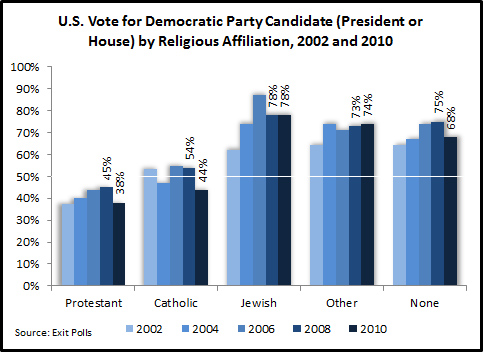
President Obama could lose both the Catholic and Protestant vote to the Republican nominee and still win re-election, thanks to the "None/Other vote." A definition:
"Nones" are people without a religious affiliation (this does not mean they are an atheist or agnostic… they may even consider themselves to be religious or spiritual—just not connected to any religious group). "Others" are a survey research catch-all category of people who have non-Christian religious affiliations.
Their voting power:
Twenty years ago the combined None/Other vote amounted to less than 10 percent of the population and the voting electorate. Today, the None/Other population percentage has risen to 22 percent (… and is expected to continue to grow in the future).
Drivers vs Cyclists, Ctd
A reader writes:
I have a problem with this explanation: "most rule-breaking by bicyclists is the result of poor design." I lived in NYC for 20+ years and I'm currently living in San Francisco, and I can tell you the reason for bike problems is that there really are no rules for bicyclists. As a pedestrian I've nearly been killed in NYC by a bike going the wrong way down a one-way street. Or just recently in SF in the SOMA district, I saw a woman nearly hit as a bike sped along the sidewalk around a corner and never slowed down. Bikes are not supposed to be going fast on sidewalks in city, right?
It's not about bike lanes; it's about people thinking they own the streets and sidewalks because they're on a bike.
Don't get me wrong, I'm a bike rider myself, but again, I was nearly knocked down by a speed cyclist around the seaport in Manhattan on my bike. The thing about bike riding is that there are no rules, really, and that's part of the beauty, the freedom. But as they become more prevalent in car traffic and pedestrian traffic, it's really becoming a problem. Like I said, I'm an urban dwelling bike rider myself, and I'm appalled at the bike riding behavior going on.
Another writes:
I live in one of the more bike friendly cities you'll find – Madison, WI. There are designated bike lanes on most major roads, criss-crossing the city. There are even city streets being named "bike boulevards," on which bikes are given equal access to lanes as cars. For a bike commuter like me, it's great. And yet, despite there being no real necessity to be a "road warrior type" to pedal around this city, you still see countless jerks run stop signs, barrel down sidewalks, cut in front of cars, turn in front of traffic without indicating, etc.
Why? Who knows, other than certain cyclists just seem to feel that since they are on a bike, either the rules of the road don't apply them, or they are so morally superior to those driving cars that they are entitled to scoff at those rules. Now, the vast majority of cyclists here are respectful and rule abiding. But, as with drivers, it only takes a minority of bozos to give the non-bozos a bad name.
 The Dish