A Blind Man At The Drive-Thru

Google Car user #0000000001:

The big picture:

Steve Mahan is 95 percent blind. And yet he was able to get into a car and drive apre-programmed route from his California home to a Taco Bell restaurant. Mahan was driving a Google autonomous car.  For people like Mahan, who are visually impaired, this technology is liberating in a pretty fundamental way. It gives him the freedom of mobility, and the ability to be independent. While it will take a few more years for these vehicles to be widely available to the public, the video [above] gives us a glimpse of what the future will be like. 

Walter Russell Mead uses the breakthrough to bash high-speed rail:

Why drive to a train station, park, pay for a ticket, wait, hop on a train, sit for a while, then hop back in a car or other train when you get close to your destination, when you can just take a nap while your self-driving car carries you safely—and directly—to your destination?

The Drugs You Don’t Need

Are sometimes prescribed in place of good bedside manner:

When sick people come into a doctor's office, part of what they are looking for is psychological wellness. They want to feel like somebody has listened to them and is doing something to treat their illness. Sometimes, that means they ask their doctor for antibiotics, even if antibiotics aren't the right thing to treat what they have.

Dike Drummond offers advice to doctors on how to deal with inappropriate requests for antibiotics.

A Universe Of Our Own Making

5227842611_e65fa83134_b

It's right in front of you:

People treat the digital universe as some sort of metaphor, just a cute word for all these products. The universe of Apple, the universe of Google, the universe of Facebook, that these collectively constitute the digital universe, and we can only see it in human terms and what does this do for us? We're missing a tremendous opportunity. We're asleep at the switch because it's not a metaphor. In 1945 we actually did create a new universe. This is a universe of numbers with a life of their own, that we only see in terms of what those numbers can do for us. Can they record this interview? Can they play our music? Can they order our books on Amazon? If you cross the mirror in the other direction, there really is a universe of self-reproducing digital code. When I last checked, it was growing by five trillion bits per second. And that's not just a metaphor for something else. It actually is. It's a physical reality. 

(Image by Creativity103)

Are We At Peak IQ?

Maybe:

The rate of increase varies between nations, but on average, IQ scores have risen by three points per decade. But in Britain, research has found a reversal of this trend. This has also been the case in other nations, including Norway and Denmark (research is not extensive, but the implication is that declines may be occurring more widely).

A study in 2009 led by James Flynn himself and published in Economics & Human Biology compared IQ scores obtained by British teenagers in 1980 and 2008, using the same test. The average had declined by two points on average, but by as much as six points among teenagers in the top half of the IQ scale, a fall that wiped out the previous two decades of gains in that group. This added weight to a 2005 study on a sample of 500,000 young Danish men, tested between 1959 and 2004, showing that performance peaked in the late 1990s but then declined to pre-1991 levels. These findings conform with a pattern suggesting that the rise in IQ is slowing, and in some cases, going into reverse.

Scott Adams proposes a new measure of intelligence that takes into account the internet:

Now suppose you compare two people who have the same I.Q. scores, and both have blazing fast Internet connections, but one person is great at searching for information on the Internet, and interpreting it, and the other isn't so good. Now which of the two people is smarter? I would argue that the person who has the better Internet skills is effectively smarter, and possibly by a wide margin. Internet access means nothing if you don't know how to use it.

Quote For Passion Sunday

The_Deserter

"We are fated to kill and be killed because we know no other way to live, but through the forgiveness made possible by the cross of Jesus we are no longer condemned to kill. A people have been created who refuse to resort to the sword, that they and those they love might survive. They seek not to survive, but to live in the light of Christ’s resurrection. The sacrifices of war are no longer necessary. We can now live free of the necessity of violence and killing. War and the sacrifices of war have come to an end. War has been abolished," – Stanley Hauerwas, cited in a dismissive review in First Things, which focuses on the impracticality of living Hauerwas's doctrine in the real and dangerous world we actually inhabit.

Which is to say: it uses Hauerwas's difficult prescriptions to ignore his spiritual diagnosis. Which is a shame, because Hauerwas is putting his finger on something both true and discomfiting — the way American wars are viewed by many as "redemptive" and the way patriotism becomes a form of piety. War, for Hauerwas, "is America's altar." It sure seems to have continued that way.

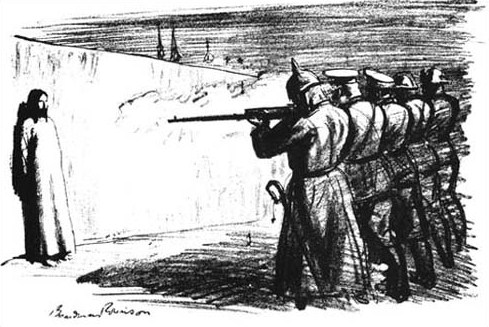
(Photo: The Deserter by Boardman Robinson. Anti-war cartoon depicting Jesus facing a firing squad made up of soldiers from five different European countries. At that time the US had not yet entered the war. First published in The Masses in 1916.)

Knowing And Mystery

From a review of Marilynne Robinson's new collection of essays:

The scientific exploration of the apophatic—the dizzying study of 'dark matter, dark energy, the unexpressed dimensions proposed by string theory, the imponderable strangeness described by quantum theory'—is seen as a partner of religious devotion. After all, 'to say that the universe is extremely large, and that the forces that eventuate in star clusters and galaxies are very formidable indeed, seems deficient—qualitatively and aesthetically inadequate to its subject.' The stronger language of 'God' and 'the soul' and 'the miraculous' is required.

Along these lines, Robinson offers some notes on a theory of fiction, a poetics. Fiction, done well, is an effort to participate in this religious attention to 'the integrity and mystery of other lives.' …

Whatever else these new essays are—and they are many wonderful and interesting things—they are Robinson's determination not to diminish mystery, not to make foolishness of the world or the human person by forcing theories to limit our wonder at God, the human brain and mind, the cosmos. The essays are tonic for our adoration-starved religious and scientific cultures, bracing in their critique and hope-giving in the alternative way of seeing that they open up for us.

Face Of The Day

Portrait-1

Paper artist Ryuta Iida collaborated with artist Yoshihisa Tanaka for their series, Misunderstanding Focus. Their process may surprise you:

At first glance it looks as though a photograph has been printed numerous times, layered and cut into a sort of sculptural topography, which would indeed be amazing enough, but Nerhol took things a bit further. The numerous portraits are actually different, photographed over a period of three minutes as the subject tried to sit motionless, the idea being that it’s impossible to ever truly be still as our center of gravity shifts and our muscles are tense. The portraits are actually a layered lime-lapse representing several minutes in the subjects life and then cut like an onion to show slices of time, similar to the trunk of a tree. What a brilliant idea.

How Free Will Is Like Your Birthday

Brian Earp and John Bargh think we should celebrate the decisions we have made even if free will doesn't exist:

It seems that people do not possess a consistent belief in free will so much as they strongly wish to take credit for the good things they are and do (regardless of whether they caused them), and to distance themselves from the bad things (even if they caused them). Evidently, the belief in free will is not principled, but socially strategic in nature. So what, then, if one’s will is not ‘free’ of internal causation?

It is still your will and my will and each is unique: a confluence of genetic heritage, early absorption of local cultural norms and values, and particular individual life experiences. After all, one can claim personal ownership of one’s will just as much as one claims ownership of one’s name, eye color, and birthday, and be as proud of one’s will and its products as one is proud of the exploits of great-great-Grandma the pioneer, even though one’s ‘free will’ played no role in any of these.

Who Preaches Religious Tolerance?

Egyptian_Christian

Earlier this month, the senior cleric in the Saudi religious hierarchy, Abdulaziz Al al-Sheikh, issued a fatwa calling on the faithful to destroy all churches in the Arabian peninsula. Walter Russell Mead contrasts Islam and Christianity:

Christians, especially in countries like the United States where the ideal of religious liberty has been an important element of Christian teaching for centuries, believe that the rise of religious tolerance in the Christian world is one of the signs that Christianity is true: believers are becoming more like Christ in his infinite compassion and profound respect and love of every human soul despite error and sin. Moreover they see the spread of tolerance and the repudiation of false ideals like “holy wars” (such as the Crusades, fought not only against Muslims but against heretics inside the Christian world) as signs that God is working in human history to bring us to a greater light and deeper understanding.

For many Muslims, however, the rise of tolerance in Christianity looks less like maturity and self confidence than like the senescence of a religion in decline. Christianity, these critics say, is losing its hold on the western mind. The rise in religious tolerance is the result of necessity — the churches are weak, the believers indifferent, and so Christians no longer have the inner conviction to stand up for their faith.

Clifford D. May piles on:

Churches have been burned or bombed in Egypt, Iraq, Nigeria, Pakistan, Indonesia, and the Philippines. … [T]he U.S. Commission on International Religious Freedom (USCIRF) released its 14th annual report identifying the world’s worst persecutors. Of the 16 countries named, twelve have Muslim majorities or pluralities.

(Photo: An Egyptian Coptic Christian mourns during Sunday mass on January 2, 2011 at the Al-Qiddissine (The Saints) church in Alexandria which was targeted on New Year's Eve by a car bomb attack in which 21 people were killed. By Mohammed Abed/AFP/Getty Images)
Maybe Franzen’s Wrong

140112108

And maybe we don't actually need to read stories to make sense of our world. Maybe they are part of our problem:

Like God, the self requires a story; it is the account of how each of us accrues and sheds attributes over seventy or eighty years—youth, vigor, job, spouse, success, failure—while remaining, at some deep level, myself, my soul. One of the accomplishments of the novel, which as we know blossomed with the consolidation of Western individualism, has been to reinforce this ingenious invention, to have us believe more and more strongly in this sovereign self whose essential identity remains unchanged by all vicissitudes…

This is all perfectly respectable. But do we actually need this intensification of self that novels provide? Do we need it more than ever before?

I suspect not. If we asked the question of, for example, a Buddhist priest, he or she would probably tell us that it is precisely this illusion of selfhood that makes so many in the West unhappy. We are in thrall to the narrative of selves that do not really exist in the way we imagine, a fabrication in which most novel-writing connives. Schopenhauer would have agreed. He spoke of people 'deluded into an absolutely false view of life by reading novels,' something that 'generally has the most harmful effect on their whole lives.' Like the Buddhist priest, he would have preferred silence or the school of experience, or the kind of myth or fable that did not invite excited identification with an author alter ego.

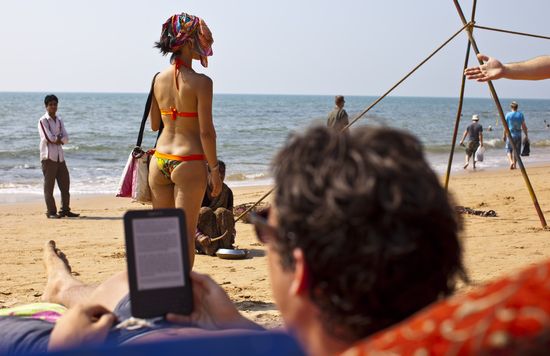
(Photo: A tourist reads a book with an Amazon e-reader Kindle at the sandy beach of Anjuna on February 1, 2012 in Goa, India. By EyesWideOpen/Getty Images.)