Surrendering On Marriage

Marriage equality opponent Daniel McCarthy waves the white flag:

For the better part of 2,000 years the meaning of marriage was stable because the authority of Christianity was constant. In an age when the Church no longer supplies the institutional framework for family life, the definition of marriage has become radically uncertain. Into this fluid environment—in which individualism or atomism is once again rising to the fore, as in the Roman Empire—the new fact of homosexuality was gradually introduced. The result, same-sex marriage, has shocked conservatives. But this innovation has moved so far so quickly only because it is not at all out of step with the institutions and ideas of our time.

The whole piece is worth reading because it is an unflinching conservative reckoning with the forces of modernity. Much of its core argument I made in the third chapter of "EdmundBurke1771subject of how to integrate them was not a long-term conservative proposition; and the alternative – more religiously-based repression against a minority rapidly gaining acceptance – was reactionary and spiteful. The point was simply that marriage was the obvious conservative solution: bring gays into this architectonic institution under the Burkean banner of conservative reform. That's what I tried to argue for on conservative and libertarian grounds. Sadly, the neocons and theocons decided to ratchet conservative policy back to the 1950s. It was Bill Kristol who attempted to bring reparative therapy into the conservative mainstream in response to our progress in integration. It was as disgusting a move as it was utterly cynical.
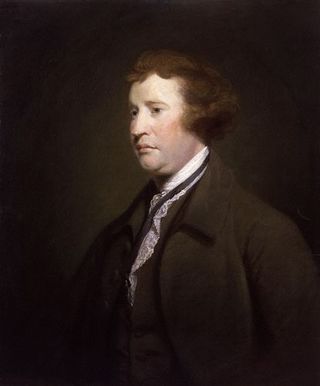
How a reform that "is not at all out of step with the institutions and ideas of our time", in McCarthy's words, should shock "conservatives" is an interesting insight into the intellectual collapse of the right. Reforming institutions to keep them in step with reality is Burke's definition of conservatism. That's why the real social conservatives are not those intent on marginalizing fast-integrating gay people, but those managing that integration by harnessing it to existing institutions, that strengthen the family, encourage responsibility, teach sacrifice and keep the welfare state at bay. A truly conservative party would be pushing marriage equality, as the Tories are in Britain. What the GOP is, in stark contrast, is not a conservative party governing a modern society. It's a radical fundamentalist and anti-government religious movement, dedicated to a core rejection of almost everything modernity brings but money.

(Painting: Edmund Burke.)

Can The GOP Moderate On Immigration?

A couple days ago, Anderson Cooper tried to make sense of Romney's positions on immigration:

As Anderson mentions, Rubio is flirting with a watered-down version of the Dream Act. The WaPo claims that this "puts Obama in a box." Adam Serwer helps Obama escape said box:

All Obama has to do is endorse the Rubio option as a stopgap measure, say it's the best that can be done for now, and tell Congress to get to work. At that point, the GOP will fling it into a black hole of obstruction, from which neither hope nor light can escape.

Similarly, Tomasky doubts that Romney can make inroads with Latino voters:

Romney is just sooooo white. Even whiter than the Osmonds. Bush wasn’t that white. He came from a state where these days you can’t help but know some Latinos, and he spoke him a little esspanyole, even. But Romney? He fired some guys working on his lawn because he couldn’t afford the political liability of employing them, as he openly admitted at one of those GOP debates. Aside from that—well, I admit I’m no more up on the latest salsa artists than Mitt is, but do you think that guy has ever listened to one Tito Puente record in his life? Has he ever known a Latino person, outside of those who clean his houses and trim his lawns? It’s quite possible that he does. But he sure doesn’t look like he does.

What Can We Do For Syria?

Pray that the UN plan works. Marc Lynch explains why arming the opposition is a bad idea:

[Arming the Syrian opposition] is often presented as the least intrusive path.  But in fact it might be the worst of all the options. Providing arms to the opposition would not likely allow it to prevail over the Syrian military.  The regime would likely discard whatever restraint it has thus far shown in order to avoid outside intervention. What is more, the Syrian opposition remains fragmented, disorganized and highly localized. Providing weapons will privilege favored groups within the opposition, discredit advocates of non-military strategies, and likely lead to ever more expansive goals.

It could further frighten Syrians who  continue to support the regime out of fear for their own future, and make them less likely to switch sides.  Arming the FSA is a recipe for protracted, violent and regionalized conflict. It would be foolish to assume that an insurgency once launched can be easily controlled. It should also be sobering that the best example offered of historical success of such a strategy is the American support to the Afghan jihad against the Soviet Union, which led to the collapse of the Afghan state, the rise of the Taliban, and the evolution of al-Qaeda.

The Ad I Waited Years To See, Ctd

That remarkable British ad for marriage equality in which a returning soldier arrives to a boyfriend who proposes marriage on the runway just happened for real in San Diego:

Luggage in tow, Guerrero emerged with a smile on his face. Upon seeing Huston, Guerrero dropped his bags; aimed a kiss toward Huston’s lips; and opened his arms to his boyfriend's waiting embrace. The time and distance of 10 months’ separation evaporated in a public show of affection that less than a year ago would have been cause for court martial.

After a few minutes of emotional holding and kissing, Huston went anxiously down on one knee; looked up at Guerrero, who was dressed from head to toe in military fatigues; and produced an engagement ring and the time-honored phrase, “Will you marry me?” Huston’s mild tremble, a result of hours and days of anticipation about this day, was quickly quieted by the one word every hopeful fiancé wants to hear: “Yes.”

Know hope.

Cannabis, Obama, And The Rule Of Law

On medical marijuana, Obama says he can't ask the DOJ to "Ignore completely a federal law that’s on the books." Greenwald asks why not:

The same person who directed the DOJ to shield torturers and illegal government eavesdroppers from criminal investigation, and who voted to retroactively immunize the nation’s largest telecom giants when they got caught enabling criminal spying on Americans, and whose DOJ has failed to indict a single Wall Street executive in connection with the 2008 financial crisis or mortgage fraud scandal, suddenly discovers the imperatives of The Rule of Law when it comes to those, in accordance with state law, providing medical marijuana to sick people with a prescription.

To be fair to Obama, he specifically said the policy was against those abusing the medical marijuana law to sell illegally. And some blame can be attached to the disorderly way in which medical marijana laws have been enforced.

But Glenn is absolutely right in one clear respect: if you do not enforce the rule of law on torture, when your own executive branch officials have brazenly broken domestic and international Kush-trichome-closeuplaw, on what possible grounds do you take a stand on federal enforcement of federal law against state enforcement of state law on medical marijuana? Weak, Mr president. Weak.

I'm glad Rolling Stone asked that question. But the question I'd like to ask Obama is: why do you think alcohol should be legal and cannabis not? So far, I've failed to find anyone who can make a credible argument on those grounds for prohibition of pot. Maybe the president is the one genius who has a coherent answer.

Or maybe he just reeks of fear.

Can Obama Win Arizona?

Yes, but it's unlikely to make a difference:

[If Obama] does win Arizona it will probably be superfluous, since in all likelihood he’ll already have won states like Ohio, Colorado and Virginia that are closer to the tipping point. The situation is analogous to Mitt Romney winning a state like New Jersey, which is also plausible if Mr. Romney wins the election by several points nationally. But that doesn’t make New Jersey a swing state — it’s just extra spoils for the winner.