The Mormon Card, Ctd

Screen shot 2012-04-27 at 11.14.02 AM

A reader writes:

As a believing, practicing Mormon AND Democrat, I would argue that most Democrats aren't biased against Mormons per se – any more than some within the Democratic tent are biased against ALL organized religion (as Peter Beinart pointed out).  I think the real issue is the LDS church has become, like it or not, strongly and predictibly affiliated with the Republican party (thanks to the political evangelicism of Ezra Taft Benson and others). So essentially these polls are saying, "as Democrat … would you consider voting for a Republican?" It isn't religious bias or bigotry as much as political self-interest that causes many to pause and say "NO". 

Obviously, I am oversimplifying things, but it exposes the dangers any religion faces when it or its members become too closely aligned with the platform of ANY political party.

Another writes:

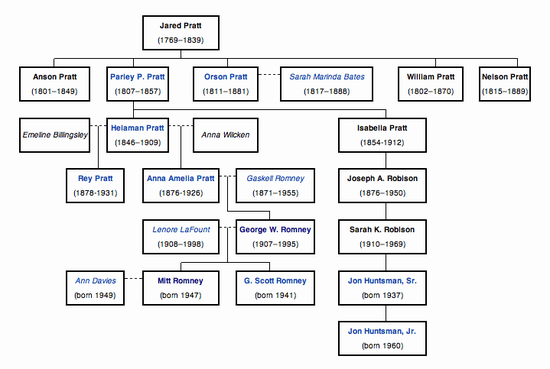
A long-time Mormon reader here. I feel one small correction is necessary in the post about Romney's Mormon roots, specifically mentioning that he is descended from Parley P. Pratt (or Big P3, as my friends and I called him growing up). You wrote, "Romney really is LDS monarchy, his family going back deep into the heart of the religion's history." Now, Romney is a rather high-profile LDS figure, but calling him "LDS monarchy" is a bit much, and it likely has little (or nothing) to do with his ancestry.

I won't say that being descended from church leaders has nothing to do with leadership positions in the church (it definitely did in the early days of the church, and may happen sometimes these days), but because so many were polygamist and had so many children, so many people are descended from those early leaders.

That includes myself: I have several high-ranking ancestors who are mentioned in the Doctrine and Covenants (a canonized collection of Joseph Smith's revelations), but have never once thought of myself as "LDS Monarchy." Romney's high status in the church is from his leadership positions (Bishop and Stake President), as previously noted by others, and not because of his pedigree.

Another notes:

Parley Pratt is also Jon Huntsman's great-great-great-grandfather. I guess that kind of thing happens when you have 266 grandchildren

Tucker’s Last Call?

Pareene is expanding his annual Hack List to longer pieces throughout the year. From his thorough takedown of The Daily Caller's frontman:

In many ways Tucker Carlson’s a better symbol of the pathetic state of what passes for conservative journalism than even Glenn Beck or the late Andrew Breitbart, to name two of his contemporaries with a much larger following. Glenn Beck started as a no-account shock jock and is now a no-account Internet show host. Breitbart at least went from Drudge lackey to successful right-wing media mogul. Carlson, though, began his career in the most respectable fashion possible and has spent the ensuing decades gradually lowering himself into the gutter. His story illustrates why we can’t have a responsible or at least slightly less hysterical conservative media.

His description of the execrable Daily Caller is priceless:

a catalog of sleazy traffic-baiting aggregated Web garbage (“Top 10: Most beautiful ‘most beautiful’ women [SLIDESHOW]“), ancient relics of online commentary with nowhere else left to publish (Ann Coulter, Mickey Kaus), and overblown scandal-mongering headlines that promise much more than they can deliver. In other words it is like a mean-spirited parody of a conservative version of the pre-AOL Huffington Post, with a healthy dose, recently, of attention-grabbing race baiting.

GDP Reax: It Could Have Been Worse

GDP_1980

Ryan Avent puts today's report in context:

Americans continue to hope for a real recovery. During the first three years after the 1981-82 recession, the economy grew above 3% in 11 of 12 quarters and at greater than 5% in 7 of 12. Eleven quarters into this recovery, the economy has managed 3% or better only four times and has yet to reach 4%. But America's underlying fundamentals look increasingly strong. A gridlocked Congress and an inflation-averse Federal Reserve may try to gum up the works. But this morning's disappointing number is by no means a reason for despair.

Mark Perry points out that a decrease in government spending significantly lowered the GDP number:

Perhaps today's GDP report is actually better than what is being reported, as the private sector of the U.S. economy grows at a rate slightly above the historical average, and twice the average rate since 2000.  

Daniel Gross takes a closer look at government spending:

So in 2011, declines in government consumption sapped economic growth by .44 percentage points. But in the first quarter of 2012, contraction in the government sector took a bigger bite out of growth—subtracting .6 percentage points from the growth rate. And it's not because Republicans in Congress pushed through tough cuts in social spending. No, a decline in defense spending accounted for most of that reduction.

Jared Bernstein's quick take:

2.2% is about the trend growth rate for the economy right now, and so you could look at this and say "steady as she goes."  That’s not how I see it.  The trend is what you want to return to after you’ve made up your losses, which we have yet to do.  Coming out of such a deep trough as we experienced in the great recession, we need a number of consecutive growth quarters well above trend.  Then we can be content to settle back into trend growth.

Harm Bandholz is encouraged by consumer spending:

Private consumption rose at the fastest pace since late 2010, “financed” by a sizeable decline in the savings rate. More than a third of that pick-up was attributable to surging car sales. In addition residential investment jumped by almost 20%, the most since 2Q10, probably supported by the unusually mild winter weather. While we expected consumer spending and residential investment to be the main growth drivers at the beginning of the year, their contributions were even larger than we anticipated.

David Semmons differs:

I think this is not a good report, the much stronger print from the consumer will fade as the income growth isn’t there to support it

Brad Plumer notes that GDP reports are often revised significantly:

Advance estimates of GDP growth are very frequently wrong. On average, the study [from the Federal Reserve Bank of St. Louis] found, the GDP numbers got revised by 0.5 percent and 0.54 percent on the second and third passes. And when all ofthe numbers since 2007 were redone in July 2011, the corrections got even bigger.

Derek Thompson makes related points about revisions:

Overall, 2.2% is neither great, nor bad, nor, perhaps, meaningful. It could be revised up to 3% or down below 2% in the next few months. No matter what, it could always [be] worse.  We could be Europe.

(Chart from Calculated Risk)

Von Hoffmanns All Round! Ctd

A reader quotes me:

A friend told me last night over a Jager that I romanticized politics. I'm not sure I do. But predictions and narratives and personalities are integral to readable political journalism. It is a theater at times, and the performances require aesthetic and human judgments as well as technical and policy ones.

I don't know that you romanticise politics as a whole. But you do need your dragons to slay. There are many topics in which you are measured and consistent, pleased with incremental progress and able to recognise setbacks and their significance.

But when you recognise a dragon – a person you perceive to be a dangerous threat to the ideals you hold dear or to the body politic – well, you tend to kick the spurs in and charge, sword in one hand, lance in the other and the shield of common sense left behind. Palin is one; Hillary Clinton another, for large bits of the '90s and portions of the '08 campaign. Radical Islam was another, in the wake of 9/11. I wouldn't quite call it pure romance.

You are far more cognizant of the flaws in your heroes than the virtues of your enemies, and you seem to admit of other, neutral persons or institutions to which you attitude can be mixed and measured (the Church is your curate's egg of the moment). But for your dragons – there seems to be no madness they might not drive us, no annihilation they might not wreak, and thus any attack is permitted to defend against their depredations. Having a dragon to destroy seems to give you the vim needed to run your treadmill everyday. You can't quite work Robot Romney into one – he's too sane and bland, and it seems to depress you. I think that was part of your soft spot for Santorum – now there was an authentic nutter who could be counted on to breathe fire when provoked.

That's always been about the size of it, to me. Me with my PhD in Knowing Fuck All About Psychology. But nobody loves reading you for your cold logic, Andrew. All your fans are fans of your passion. Vim-less political writers all turn into Tom Friedman after a while, and thanks be praised, there's never a worry of that with you.

Bahrain’s Revolution Slogs On

GT_BAHRAIN_120426

Caitlin Fitzgerald breaks down the fight between the monarchy and protestors. Exum focuses on American interests:

[T]he United States remains heavily dependent on its military presence in Bahrain to both deter Iran and guard the sea commons in and out of the Persian Gulf. Coordination and partnership with the regime is thus necessary. But the United States knows that the continued political repression and disenfranchisement of Bahrain's Shiite majority can only lead to disaster down the road, perhaps resulting in a radicalized opposition hostile to a United States seen as having been complicit in the crimes of the current regime.  So U.S. policymakers walk a tightrope.

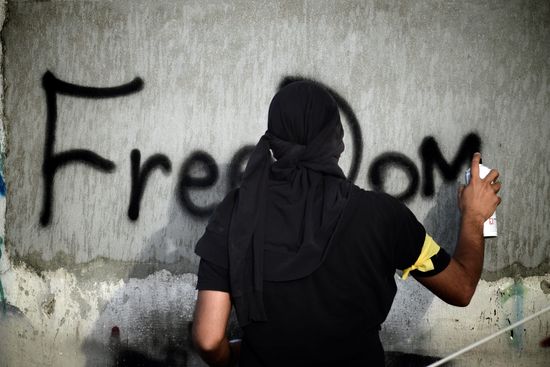
(Photo: A Bahraini Shiite Muslim sprays the word 'Freedom' on a wall during a rally to show their solidarity with Abdul Hadi al-Khawaja, a prisoner who began his hunger strike 74 days ago, in the village of Jidhafs, West Manama on April 24, 2012.  By STR/AFP/Getty Images.)

Quote For The Day

"We have tourists that just want to have a smoke. If they’re not going to get it, they will ask Dutch people who actually have a pass for the coffee shop to buy it. Or they fall in hands of the illegal street sellers," – Michael Veling, 56, owner of the 420 Cafe in Amsterdam and chairman of the Dutch Union of Cannabis Retailers.

A judge has just upheld a law that will prevent foreigners from buying marijuana in Holland.

What’s It Like To Get A Medically Unnecessary Transvaginal Ultrasound?

Ask Megan Carpentier:

It was vigorously uncomfortable — more than a typical pelvic exam, with which most women are very familiar. In part, it’s more uncomfortable because the technician has Wand-Ultrasound2to press the wand directly against the areas she wants to get an image of — your uterus, Fallopian tubes and ovaries — so there’s more movement and more direct contact with pressure-sensitive areas of your body; you’re also not lying flat on your back to facilitate access to the upper reaches of your vagina; and you’re being penetrated with a longer, rigid object than is used in a regular pelvic exam. … If I had been pregnant (which I knew I was not), the exam might have lasted longer as she looked to rule out an ectopic pregnancy and locate the miniscule gestational sac.

It was not, however, like being raped, despite all the furor-generating headlines and "Doonesbury" cartoons that were printed. It was uncomfortable to the point of being painful, emotionally triggering (and undoubtedly is moreso for victims of rape or incest or any woman in the midst of an already-emotional experience) and something that no government should force its citizens to undergo to make a political point. 

Texas, Oklahoma and North Carolina mandate these procedures for women seeking abortions. (Virginia and Pennsylvania's efforts to implement similar laws were thwarted in recent months – though Virginia will still require a regular ultrasound.) One pro-choice woman is trying to tune out some of the new regulations: 

Although it’s the transvaginal ultrasound laws that get all the attention, the true cutting edge of abortion restrictions is currently in place only in Texas, which not only mandates ultrasounds before abortion but also compels the woman to listen to a description of the sonogram and to a fetal heartbeat. (An attempt to get the law struck down on First Amendment grounds  — both the woman’s and the doctor’s right not to be forced by the state to submit to ideological speech — has so far failed, and the law is currently being enforced.) … [Denise] Paolucci had an idea. She’d just been offered an iPod at the dentist’s office to drown out the drill – why not have the same for women having abortions? She decided to solicit donations to buy iPods for all of the Planned Parenthoods in Texas that provide abortions so that women who don’t want to hear the state-sponsored script can have another option.

Previous Dish coverage of the Virginia bill here

America’s Sleep Deficit

Is enormous:

Short sleep duration (average ≤6 hours per 24-hour period) was reported by 30.0% of employed U.S. adults (approximately 40.6 million workers) 

Why this matters:

Sleep deprivation not only lowers productivity, but is also associated with accidents (a fifth of all vehicle accidents were linked to drowsy driving), and adverse health effects, such as heart disease and obesity.