What British Austerity?

British_Spending

Alex Massie delivers a reality check:

It is certainly hard to make any case arguing that Cameron and George Osborne are succeeding at present but their failure can scarcely be attributed to austerity measures that have barely been implemented. For that matter, using the British experience as a kind of proxy for the American argument over government spending is a fool's mission (or, if you prefer, deliberately deceitful) since the British and American situations are rather different and, indeed, so different that you might even expect people such as Joe Klein to appreciate that fact.

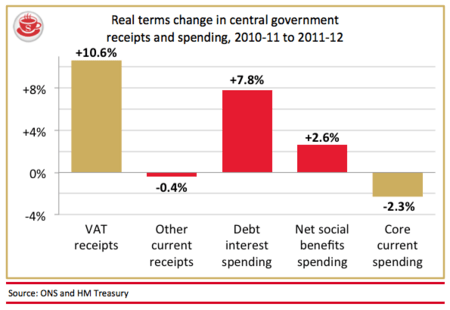
I mentioned that the bigger spending cuts have not really taken hold yet. But the graph above shows the impact of a hike in the sales tax of 10.6 percent and a reduction in core spending of 2.3 percent. What you have here is a big contraction in demand – via higher taxes and lower spending – and it hasn't made a real dent on the debt because of the impact on growth. Ryan Avent considers several views on Britain's slowdown. Bottom line:

In my view, British fiscal policy has not been ideal. Britain faced very little bond-market pressure and could easily have afforded to pursue a slower fiscal-consolidation route. It would have made (and would still make) more economic sense to devote the marginal budget dollar to improving the climate for lending to small businesses, or to investment in education and research, or to infrastructure spending rather than to deficit reduction. The Bank of England has been too conservative in addressing bank-financing troubles associated with the euro crisis; indeed, the ECB has handled the issue far better. And Britain's economy does seem to face substantially greater structural problems than America's. Structural reforms might well have been a better target for the Cameron government than budget cuts.

Ryan sees a chance that the government may just about pull off the balancing act of fiscal consolidation and economic growth. But it's a very delicate balancing act, especially with the Euro-Zone in such teetering turmoil. My earlier thoughts here.

“We All Hate Our Women,” Ctd

After Mona Eltahawy's essay, this is simply jaw-dropping:

Egyptian husbands will soon be legally allowed to have sex with their dead wives – for up to six hours after their death. The controversial new law is part of a raft of measures being introduced by the Islamist-dominated parliament. It will also see the minimum age of marriage lowered to 14 and the ridding of women's rights of getting education and employment. Egypt's National Council for Women is campaigning against the changes, saying that 'marginalising and undermining the status of women would negatively affect the country's human development'.

One wonders: what part of Islam requires fucking your dead wife? Or is that what so much of modern fundamentalism is: a sick, new, totally invented justification for the control of others' lives and bodies and dignity?

Back To The (Bush-Cheney) Future

An excerpt from Rubio's "Bush-Cheney on steroids" foreign policy speech delivered at Brookings yesterday:

I always start by reminding people that what happens all over the world is our business. Every aspect of lives is directly impacted by global events. The security of our cities is connected to the security of small hamlets in Afghanistan, Pakistan, Yemen and Somalia. … I disagree with voices in my own party who argue we should not engage at all. Who warn we should heed the words of John Quincy Adams not to go "abroad, in search of monsters to destroy". I disagree because all around us we see the human face of America’s influence in the world. It actually begins with not just our government, but our people. Millions of people have been the catalyst of democratic change in their own countries. But they never would have been able to connect with each other if an American had not invented Twitter.

So why aren't these technological tools not more effective than military occupation of places we will never understand or control? Michael Brendan Dougherty calls it the "most hawkish foreign policy speech since Woodrow Wilson": 

This is a prescription for endless war. It is also patently untrue. Not even the Soviets could bring peace to all the small hamlets of Afghanistan, and we haven't been able to do it either, despite being vastly more sophisticated, wealthier, and spending much longer in that nation. If our security depends on the safety of villages in Pakistan, a basket-case nation in Asia that has received an enormous amount of American aid and protection since World War II, we can never consider ourselves safe. 

But that is the point. If that is your criterion for safety, you have to have a permanent global hegemony and a massive military (afforded by more borrowing from China or slashing medical aid to the old and the poor). Rubio also failed to mention Iraq. Surprise! The Iraq war never happened. It was an illusion. Getting a Shiite soft autocrat in power, alongside the man who killed more Americans than any single actor, Moqtada al Sadr, is a success! It only cost around a trillion dollars, killed and maimed thousands of young Americans and created a sectarian bloodbath that took up to 100,000 lives. What's not to like?

Even Friedersdorf is taken aback by the total denial of anything that happened between 2003 – 2011. Joshua Keating interpreted the speech as unexpectedly "bipartisan" in nature. Ryan Lizza is in the same ballpark:

Everything about the speech was meant to send a message of bipartisanship. He was accompanied by Joe Lieberman, the hawkish ex-Democrat, and introduced by Brookings President Strobe Talbott, deputy secretary of state in the Clinton administration. He began by noting that he often partners with Democrats in the Senate, and he name-checked Bob Kagan, the author and foreign policy thinker most famous these days for being mentioned by Barack Obama as his major influence.

Lieberman is not bipartisan on foreign policy. He's a neocon fanatic, as is Kagan. Larison notes

Rubio’s nods to multilateralism in the speech were mostly perfunctory. His impatience with the multilateral response in Libya was obvious, and his insistence that more can and should be done by the U.S. in Syria puts him clearly at odds with what Obama has been doing. His comments on U.S. policies toward Russia, eastern Europe, and Latin America could have been penned by a Romney campaign staffer, and his alarmism over Iran is typical of what we have heard from most of the Republican presidential field.

Which is to say: neoconservatism has never gone away, it remains unreconstructed in the minds of many, and the Iraq war and endless drain in Afghanistan has taught the GOP nothing but to do more of it, everywhere.

Dissent Of The Day

A reader writes:

I think you and yours – political bloggers and print pundits – chose many months ago to pretend that there was actually a race for the GOP nomination. People as intelligent as yourself had to know from the start that it would be Romney. Yet you floated Perry, Huntsman, Bachmann, Gingrich, Santorum et al. as fresh flavors of the month and tried to make readers think there was a contest, largely in order to drive page views and readership.

I agree that politics "is a theater at times." And, yes, "the performances require aesthetic and human judgments…" But to say that does not justify attempting to inject artificial suspense into a situation that does not warrant it.

That Romney would be the GOP nominee was obvious from the start to anyone who did not have something to gain by pretending otherwise. The reason this bothers me is it's a manifestation of the same need-for-novelty syndrome that allowed Palin to flourish in 2008.

Like sportswriters, political pundits have to puff up the sense of dramatic competition. If you look back on all the graphs of polls you posted on Daily Dish that purported to handicap a horse race that never was, you might wish your focus had been less narrow.

Having said that, I freely admit that you know your audience and I don't. Obviously, what you do works, as it should. It's just that I hate to see you join with the attempt to make Obama v Romney a race in which there's any doubt about the outcome. Obama will win by a considerably wider margin than he did in 2008. It's done and dusted. Those who willfully ignore that fact for the sake of creating the faux-suspense that boosts daily page views only cheapen themselves in the long run.

Yglesias Award Nominee

"The Fatal Flaw in the Study – There was no way to judge the credibility of subject reports of change in sexual orientation. I offered several (unconvincing) reasons why it was reasonable to assume that the subject’s reports of change were credible and not self-deception or outright lying. But the simple fact is that there was no way to determine if the subject’s accounts of change were valid.

I believe I owe the gay community an apology for my study making unproven claims of the efficacy of reparative therapy. I also apologize to any gay person who wasted time and energy undergoing some form of reparative therapy because they believed that I had proven that reparative therapy works with some “highly motivated” individuals," – Robert Spitzer, Emeritus Professor of Psychiatry, Columbia University.

I tackle the claims of reparative therapy at some length in the second essay in my book, "Love Undetectable."