Fined For Not Voting

How some countries boost turnout:

Down Under, if one does not show up, even to cast a ballot for "none of the above," a fine of roughly $15 is imposed. The result has been turnout of 90 percent or more. High turnout is nice in and of itself. But Australian politicians of all stripes say that the main impact has been to turn the campaign, the issues and the discourse away from the extremes and toward the persuadable voters in the middle. After all, the pols know that both party bases will be there, with predictable results — and that what they need to do is persuade the persuadables. 

The Daily Wrap

Today on the Dish, Andrew debuted his new theories of Palin, tracked the "anti-abortion frenzy" in the state legislatures, found the ad he'd been waiting for, discovered Obama was a dishead, and waited for the VFYWhite House. We ran down Romney's poor primary showings, debated Romney and Obama on foreign policy, pointed to an area of agreement between the two candidates, and listened to Obama slow jam the news. Ad War Update here.

Andrew also reexplained his position on stimulus and debt in light of the UK's double-dip, watched the fighting surrounding the Murdoch scandal in Britain, compared the IDF's Chief of Staff to neoconservatives on Iran, and defended his claim that (right now) more violence was comitted in the name of Islam than the other monotheistic religions. We read a polemic on misogyny in the Arab world (follow-up here), delved into the history of negotiations with Iran, learned about Chinese "forumers," watched Germany attempt to neuter Mein Kampf by republishing it, and saw foreign bureaus dwindle away. Genesis didn't support anti-gay interpretations and the Vatican reembraced ant-Semites.

We also debated the importance of inequality, wondered if California would nix the death penalty, celebrated trial and error policymaking in America, understood Netflix as a utility, and examined whether lunch breaks were good for workers. Dogs altered our evolution, fertility mattered to animals, and humans created new baby rituals. Twitter ruined TV, title sequences impressed, and catchphrases didn't. Physics beat a ticket, "trashcam" photos wowed, and a Russian copyrighted his beard. Ask Spencer Ackerman Anything here, Quote for the Day here, Von Hoffman Nominee here, Yglesias Nominee here, VFYW here, MHB here, and FOTD here.

Z.B.

“We All Hate Our Women” Ctd

Tom Dale isn't satisfied with Mona Eltahawy's explanation for misogyny in the Arab world:

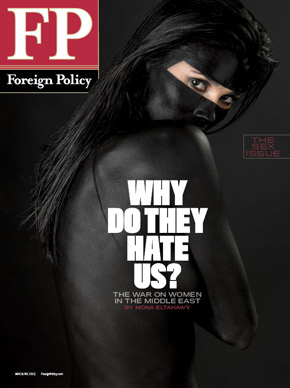
FP_CoverMona identifies hatred – pure, transhistorical, misogynistic hatred – as the cause of women's oppression in the Arab world.  This hatred itself, el Tahawy explains in terms  of men's desire to control women's sexuality.  Even if this explanation wasn't largely circular, which it arguably is, hatred is a woefully insufficient lens through which to understand the problem.  Why is sexism stronger in some places and times than others?  Why does it take specific forms?  And aren't there some things about women's oppression which can't be explained by hatred, even as there are things that can? 

Samia Errazzouki nods:

The entire article is framed in a way that portrays Arab women as helpless, and in need of rescue and protection. It’s a convenient narrative for Foreign Policy’s mostly Western-based readership. This is not to say that there are indeed injustices committed against women in the region, that women in the region certainly are victims of a patriarchal society, and that institutionalized oppression has marginalized, killed, and oppressed women in the region. This is not the issue.

The issue is framing and presenting women in the region as a monolith and pitting their struggles against the backdrop of an argument which points to "hate."

Naheed Mustafa focuses on the use of the cover image to frame the piece:

Nekkid Burqa Woman is, in fact, so common that she doesn't even shock or provoke anymore. Her image simply elicits, in the language of the Internet, a "ReallyForeign Policy? Really?" The covered-yet-naked-yet-covered Unknown Brown Woman is all over the place. You can find her on book covers and in movie trailers. You'll see her used in making the case for war and you'll see her used in making the case for jihad. The image, in fact, works against the essay. It belies the nuance and the breadth of the writing by reducing the subject to one easily consumable image — an image that doesn't even speak to the kind of women Eltahawy is writing about.

Shadi Hamid worries about proposed solutions:

In Egypt, women were at the frontlines of revolt. But when it came time to cast their votes, the majority of Egyptian women voted for parties that do not believe in "gender equality" as most Westerners would understand the term. Presumably, men did not force them to do so. The fact of the matter is that Arab women, throughout the region, are exercising their moral and political agency, but not necessarily in the ways we might expect.

A Trial-And-Error Society

Eric Posner reviews Jim Manzi's new book, Uncontrolled:

[Manzi argues] that we should approach social problems with a bias for the status quo; those who seek to change it carry the burden of persuasion. Once a problem is identified, we should try out our ideas on a small scale before implementing them across society—except in those instances where an immediate all-or-nothing decision is called for, as occurs during wars and economic crises. Meanwhile we should encourage variation across society, so that ideas can be tried out in different conditions, and proposals will bubble up from below. Manzi thus embraces federalism, and argues that we should permit states (and smaller-scale localities) to experiment with different policies.

Ad War Update

The RNC gets sanctimonious: 

Matt Lewis still worries that Obama is too cool. Allahpundit complicates the contrast: 

Supposedly, [Romney]’s already considering an appearance on SNL. The only reason he might not do it is if, per this ad, he and his team decide to try to use Obama’s likability advantage against him by portraying him as frivolous and disengaged. That’s hard to do with an incumbent, though; voters see Obama at work in one format or another virtually every day. 

Obama's Super PAC joins forces with the League of Conservation Voters to tie Romney to big oil: 

As usual, Alex Burns has more:

That message lines up with the Obama campaign’s recent TV ads, casting Romney as a puppet of energy barons that have anted up heavily for Republican outside groups. It amplifies Democratic efforts both to paint Romney as a friend of big-money interests, and to preempt a Republican attempt to pin the White House with blame for high fuel prices. The partnership between Priorities and LCV is worth watching, since working together on initiatives of common interest is one way that Democratic-aligned independent groups could help compensate for the financial advantage of their GOP counterparts.

Previous Ad War Updates: Apr 24Apr 23Apr 18Apr 17Apr 16Apr 13Apr 11Apr 10Apr 9Apr 5Apr 4Apr 3Apr 2Mar 30Mar 27Mar 26Mar 23Mar 22Mar 21Mar 20Mar 19Mar 16Mar 15Mar 14Mar 13Mar 12Mar 9Mar 8Mar 7Mar 6Mar 5Mar 2Mar 1Feb 29Feb 28Feb 27Feb 23Feb 22Feb 21, Feb 17, Feb 16, Feb 15, Feb 14, Feb 13, Feb 9, Feb 8, Feb 7, Feb 6, Feb 3, Feb 2, Feb 1, Jan 30, Jan 29, Jan 27, Jan 26, Jan 25, Jan 24, Jan 22, Jan 20, Jan 19, Jan 18, Jan 17, Jan 16 and Jan 12.
The Decline Of The Catchphrase

They aren't so catchy anymore:

The only genres where catchphrases legitimately flourish are sports and reality competitions, where each show has its own. "The tribe has spoken. It’s time for you to go." Top Chef has "Pack your knives and go," Top Design had "See you later, decorator," and The Apprentice, of course, has "You’re fired." Generally, there’s a limit of one slogan per show; in recent cycles of Project Runway, Tim Gunn has eased up on his use of "Make it work," giving Heidi Klum’s "Auf Wiedersehen" more room to shine.

On the science of catchphrases here.

Why Do Pundits Make Predictions?

Demand:

Knowing how dangerous predictions can be has led me to be careful about tossing them around willy-nilly, but I've also noticed something else: People like predictions. When I've made an emphatic one, it tends to get more links and tweets. Whenever I see friends or relatives whom I haven't seen in a while, or meet someone who finds out what I do for a living, invariably I get asked what I think the outcome of the moment's political conflict is going to be.

Jonathan Bernstein, on the other hand, defends his Pawlenty postings. Kevin Drum's view:

[P]redictions stir the pot, and unusual predictions stir the pot even more. This — controversy, provocation, contrarianism — is the coin of the realm for political pundits. 

My belief that Palin would run was debunked – and in its debunking, helped me think some more about her.

I have two working theories, in so far as I think about this farcical fabulist at all any more. The first is that she really is a grifter, who knew when to cash in. The second is that she is an attention-monger and destiny-seeker who realized, especially after the McGinniss book, that she didn't have enough talent or brains to overcome the tsunami of gossip, scandal and investigation into her real life that a run for the presidency would bring. So she took the money and run. In some ways, I actually thought she was more sincere than that. And more delusional. But the cynics were right.

A friend told me last night over a Jager that I romanticized politics. I'm not sure I do. But predictions and narratives and personalities are integral to readable political journalism. It is a theater at times, and the performances require aesthetic and human judgments as well as technical and policy ones.

The Art Of The Title Sequence

The Walking Dead gets the '80s sitcom treatment:

Forrest Wickman flags a more serious examination of the intro:

PBS Arts’ Off Book series looks at a few of the greatest title sequences of recent years, speaking with the designers behind such iconic title sequences as those for Se7enBlue ValentineZombieland, and—a Slate favorite—Mad Men. I’d be happy to look back at any of these great sequences any time, but even more interesting is hearing the designers talk about their subtle touches. For Zombieland, for example, it was important that the font be inconspicuous, so that viewers focused on how the characters interacted with the titles.