A handy guide to denial.
Month: April 2012
What Can We Do For Syria? Ctd
Jonas Renz goes point-by-point with Mark Lynch on intervention in Syria:
While I agree arming the opposition would raise the level of violence in the short term, I find surprising that [Lynch] draws the conclusion it may not increase the likelihood of regime collapse. This assertion contradicts the view of Adm. John Stavridis who testified that arming the rebels would help the opposition to push Assad from power.
Assad’s crackdown involves for the most part Soviet ear helicopter and 40 year-old APCs and tanks. How could one deny modern anti-tank and air-defence equipment would make a significant difference? What would be the impact on Assad troops’ morale if their casualties, which are minimal so far, mount? Could rebels carve out a safe-haven on their own in Idlib where the terrain gives them an advantage for their guerilla operations? Would Assad need to deploy more troops and armor against a well-armed insurgency? What would that mean for his resources, funding and command&control capacities? [Lynch] seems to ignore to ignore these questions and the testimony of military commanders altogether stating that not even the likelihood of ousting Assad would improve if rebels were armed.
America’s Safe House In Beijing
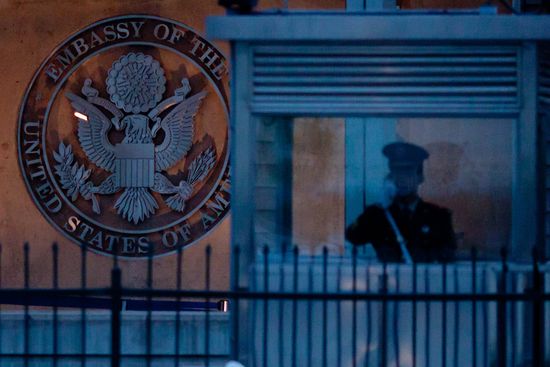
Chen Guangcheng, a high-profile Chinese dissident under house arrest for opposing forced abortions and sterilizations, escaped and is hiding out in the US Embassy. Jonathan Watts predicts significant consequences:
The key question raised by Chen's escape – and the US-China negotiations said to be taking place about his future – is whether the Chinese authorities will choose to clamp down harder or to change. That debate has the potential to split the party as it did in 1989, when student protests in Tiananmen Square prompted a face-off between reformers and hardliners in the politburo.
Max Fisher lays out the stakes for Obama:
If Chen Guangcheng is still locked up in an American diplomatic office, he poses a remarkable challenge to President Obama, one that asks how U.S. foreign policy under his leadership balances American ideals with American interests, whether he is able to achieve both, and, if not, which he will privilege. Obama's foreign policy team, and possibly Obama himself, face a question that is about more than just the fate of this one lawyer, or even about the U.S.-China relationship. It's about the role that America plays in the world, what we do with all the military and economic power at our fingertips.
Fallows' assessment:
Chen Guangcheng has obvious and well-founded reasons to fear persecution in his own country for his political views. His request for political asylum would seem to fit exactly the standards for which such asylum was designed. … So the U.S. needs to be shrewd, diplomatic, mindful of its whole strategic relationship with China, and so on in considering its next steps. But on the question of whether to grant asylum, if indeed asylum is what Chen turn out to want, based on everything we know now the only choice is to say Yes.
Walter Russell Mead zooms out:
This has been a terrible spring for the home team in Beijing, and the Burma story is a significant part of a chain of events that, perhaps someday soon, may impact the conventional wisdom that sees a surging China challenging the US for global leadership. The daring and dramatic flight of the blind Christian human rights activist Chen Guangcheng from house arrest to the safety of the US Embassy in Beijing could not have come at a more neuralgic time for China’s embattled leaders.
(Photo: A paramilitary guard stands in a booth outside the US embassy in Beijing on April 28, 2012. By Ed Jones/AFP/Getty Images.)
Mental Health Break
A tribute to perseverance:
(Hat tip: Devour)
Question Of The Day
"How do you take spiritual direction from a church that seems to be losing its soul?" – Maureen Dowd.
“Wonk King Of The Republicans”
Chait puts Paul Ryan under the microscope:
To find a parallel to the way Ryan has so thoroughly seized control of the Republican agenda and identity, you have to go back at least to Gingrich in his nineties heyday, or possibly to Reagan. Yet Gingrich and Reagan rose to the national scene while cultivating an image as radicals—it was their battle scars, inflicted by the mainstream political Establishment, that lent them the credibility to speak for the conservative base. Ryan, by contrast, has achieved something much stranger: He has ascended to his present position aloft a chorus of acclaim from the corners of the Establishment that once greeted Gingrich and Reagan with loathing. He is the only politician revered as much by the mainstream media as by the tea party. By some measure, he’s the most popular guy in Washington.
North Carolina’s Amendment One
It's losing support but still likely to pass:
Misconceptions have frustrated opponents ever since the measure was approved by the Republican-controlled general assembly last fall. PPP has consistently found that large percentages of North Carolinians are unaware of what ultimate passage of the amendment would actually mean. Many believe that it would simply outlaw same-sex marriage, unaware that it would also deny legal recognition to all civil unions and domestic partnerships. [Jeremy Kennedy, campaign manager for the Coalition to Protect NC Families,] said the campaign has emphasized that gay marriage — already illegal under North Carolina law — will be unaffected by either outcome.
Ads against the amendment, like the new spot above on domestic violence, ignore gay rights issues completely. Have we learned nothing? On a related note, Suzy Khimm reports on "why the Violence Against Women Act is a LGBT issue":
Even in New York City, [domestic violence victim] Yali gives talks to social workers who say they had "no idea that this happens in lesbian relationships as well," she says. "But it happens between two women, two men, a man and a woman…it doesn’t look a certain way."
Now some members of Congress are trying to expand the scope of the Violence Against Women’s Act — which first passed in 1994 — to include greater support for LGBT victims, immigrants, and Native American women. … But the proposed changes to VAWA have drawn fierce opposition from Republicans, who accuse of Democrats of using the issue to fire up the base in a big election year. House Republicans are pushing their own version of VAWA without the new provisions aiding LGBT, immigrant, and Native American victims of domestic abuse.
The View From Your Window

Palm Springs, California, 4.45 pm
“You’re 21, Not 6”
Buzz Bissinger reflects on raising his severely brain-damaged son, Zach:
It is strange to love someone so much who is still so fundamentally mysterious. “Strange” is a lousy word. It is the most terrible pain of my life. As much as I try to engage Zach, I also run from this challenge. I run out of guilt. I run because he was robbed and I feel I was robbed. I run because of my shame.
But whatever happens with Zach, I know I cannot think in terms of my best interests, even if I think they are also in his best interests. Zach will be where and who he will be.
Because he needs to be. Because he wants to be. Because as famed physician Oliver Sacks said, all children, whatever the impairment, are propelled by the need to make themselves whole. They may not get there, and they may need massive guidance, but they must forever try.
Update from a reader:
I've known Zach for about 15 years and now see him once or twice a week. He never fails to say hello and ask me how I am. But he also wants to know whether I have driven my car to work that day or taken the train, and once he finds out that information, he asks either what floor of the garage I'm on, or which of the two train stations near my house I've used. He asked me one time years ago which train station I use, and he remembers. All this information – from the dozens of people he must ask during the course of a day – he seems to be cataloging.
He remembers my birthday every year. He asked me my birthdate once on the day we met and then promptly told me what day of the week that was. And after meeting my daughter four or five years ago, he now sends me an email on her bithday every year. My daughter – elementary school age – delights in seeing Zach a few times a year and reminds me each year when Zach's birthday approaches.
Ben-Zion Netanyahu 1910 – 2012
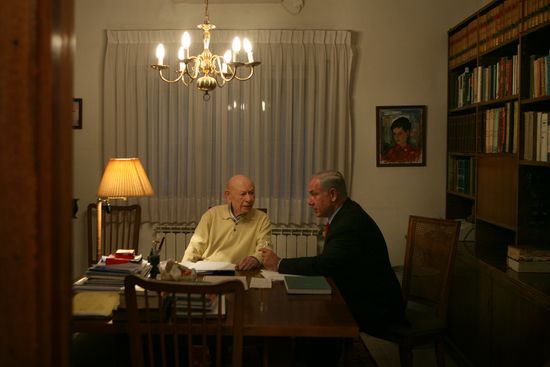
The historian and father of the current Israeli prime minister, Binyamin Netanyahu, died today. Jeffrey Goldberg eulogizes him:
He was the hardest of the hard — a man for whom compromise was anathema — but he was all too often tragically correct about the nature of what he called "Jew hatred".
Neo-fascist Israeli foreign minister Avigdor Lieberman goes further:
“Anyone who ever spoke with him could not help but be impressed by his precise ideological stances.”
One of the best aspects of Peter Beinart's must-read new book is his exploration of the thought of this man, Ben-Zion. He never conceded any partition of land in Palestine with the Palestinians. As early as 1944, his Zionews argued that "the partition of the land was an utter impossibility." He was so far right even Menachem Begin called him a rightwing extremist – when Netanyahu opposed the land-for-peace deal with Egypt. Netanyahu also called the Oslo Accords "the beginning of the end of the Jewish state." As recently as 2009, he wanted a reinvasion of Gaza:
"We should conquer any disputed territory in the land of Israel. Conquer and hold it, even if it brings us years of war … You don't return land."
Ben Zion's newspaper in the 1940s editorially backed the physical transfer of resistant Arabs out of Israel "to one of the rich and underpopulated Arab territories in the Middle East, preferably to Iraq". As recently as 2009, he uttered the following words:
"The Jews and the Arabs are like two goats facing each other on a narrow bridge. One must jump into the river … [The Arabs] won't be able to face the war with us, which will include withhholding food from Arab cities, preventing education, terminating electrical power and more. They won't be able to exist and they will run away from here."
Another beaut:
"The tendency toward conflict is the essence of the Arab. He is an enemy by essence. His personality won't allow him any compromise or agreement. It doesn't matter what kind of resistance he will meet. His existence is one of perpetual war."
His work on the racial aspects of the Inquisition was, by all accounts, a real act of scholarship. And his insistence on the ubiquitous and eternal toxin of anti-Semitism is necessary – even vital, as it resurges today. He also lost a son in the heroic raid on Entebbe airport, to free a hundred hostages. He had reason to be bitter, vigilant and angry.
But he also appears as someone who tragically could not forget – let alone forgive – and who became a Zionist in the least liberal sense: prepared to crush or forcibly transfer or starve populations of a rival people because of their racial and cultural "essence" – and fully comfortable with the idea of collective punishment of Arab women and children as a tool in the for-ever war aganst the enemy.
You can call this, as Jeffrey does, "the hardest of the hard". And Israel exists in a very hard environment, and the anti-Semitism that consumed Netanyahu also burned millions in ovens at the heart of "civilized Europe" and is still real and violent in the Middle East. You can see in Ben Zion the pain and tragedy and evil in all of this – and try to forgive. Or you can simply sigh with Auden in his observation of what
“I and the public know
What all schoolchildren learn,
Those to whom evil is done
Do evil in return.”
(Photo: In this handout photo, Benjamin Netanyahu (R), head of the right-wing Likud party, confers with his father Ben Zion Netanyahu in his father's house February 8, 2009 in Jerusalem. By Michal Fattal/Likud via Getty Images.)
 The Dish