Gingrich Bets Everything On Delaware?

It's a matter of convenience

[I]t is the smallness of Delaware, and its proximity to Washington DC, that makes it attractive to Gingrich.  No plane tickets are required; the former Speaker can ride Amtrak from his home in Virginia — that's how he is getting there for a campaign event Monday — and can easily drive from place to place.  "It's a state where we can get around," says Gingrich spokesman R.C. Hammond.  "It matches our budget, if you will."

Ed Morrissey is puzzled

Assuming Romney gets to 850 tomorrow, he’ll need less than 300 delegates to get the nomination secured. Besides Texas, where he will pick up at least 100 delegates even if he loses the state, there are 292 delegates at stake in upcoming proportional primaries, and Romney will win at least half of those, if not most. Add that to the winner-take-all contests in California (172, by CD), New Jersey (50), and Utah (40), and Gingrich doesn’t have a prayer of stopping Romney, win or no win in Delaware.  The only people who can’t do this math are on Team Gingrich.

Video Games As Art, Ctd

Many readers pounce on this post:

"Blow intends to shake up this juvenile hegemony with The Witness, a single-player exploration-puzzle game set on a mysterious abandoned island." Replace "The Witness" with "Myst" and it's 1993 all over again.

Another:

I thought you might like to see a response to the Atlantic article from a journalist and writer more familiar with the history of the medium, Leigh Alexander. She notes the problems with Taylor Clark's characterization of Jonathan Blow's place in the world of games, but she also celebrates that it "does entertain a lavish fascination with the game developer as simultaneously an architect and a storyteller, the designer of an experience that — here, this is important — can also be personal self-expression."

Another:

Clark's argument against video games as art is incredibly weak and narrow-minded, in my opinion.

The blockbuster game is not art, therefore no game is art … is the weakest argument in journalism. It is akin to viewing a Michael Bay movie and declaring that movies are not art, or watching a couple hours of MTV and then claiming music is not art. A good journalist or critic should know you never look to the most commercialized aspects of something to judge whether or not it's art.

Where is the mention of the Mass Effect franchise and its amazing 100+ hour, cohesive sci-fi narrative – which has, more than once, been labelled the Star Wars of the video game generation? (It even allowed the players to form a homosexual relationship; in the testosterone-driven world of video games, that is a major step forward for gay rights.)

What about The Elder Scrolls: Skyrim, which unleashes the player in a gorgeous, impeccably detailed fantasy realm measuring 46 square miles (real-world square miles) in size? Players are given minimal direction and allowed to craft their own fantasy story playing the role of hero, villain, thief, highwayman, or whatever they choose.

What of games like Portal with nearly no action or token explosions but instead artfully designed puzzles to be solved and hysterical scripting of a final enemy that keeps the player interested just for the sake of hearing the next joke or punchline? Not that the game itself is lacking; it's one of the most critically acclaimed games of all time.

Where is the talk of high-art independent titles like From Dust, which tasks the player with playing God and solving increasingly complex physics-based puzzles to save his or her loyal followers from certain doom at the hands of natural disasters?

You can't ignore all of the most artistic offerings of an industry and then declare it a wasteland.

Another:

Yes, Blow's Braid was excellent. But there's already a movement underway in the independent gaming community for truly artistic video games. For example, the artistically beautiful and immersive adventure game Botanicula - from the team Amanita Design of the equally ambitious Machinarum - is already doing well and receiving very good reviews.

Also worth looking into is the layered paper style of And Yet it Moves by gaming shop Broken Rules (which won many independent gaming awards), the photographic surrealism in Trauma, the ultra-popular iOS game Osmos that creatively merges physics and design, and many more.

Plus, it'd be silly not to mention Bethesda's Skyrim, which has an entire hand-drawn world with focus down to the minute detail of ants-on-logs, and many plots and sub-plots that almost feel like you're reading a novel (with many novelettes). It'd be hard to argue that's not art - depicting a fantasy realm with a deep and rich story and spending years crafting it all.

Video games have always been art, just as programming is art.  Now the graphics technology is simply caught up enough for it to resemble more traditional forms.

One more:

A game that came out on the Playstation 3 last month, Journey, is worth mentioning. I've been playing video games since the 1980s and I've never played anything that embodied the "game as art" concept as well as Journey. The music is fantastic and the art is stunning, but what really ties it together and makes it transcendent is your participation. It's the sum total that makes it art. It couldn't have been amazing as just a soundtrack, or as a movie telling the same story. It shows how games can represent a unique art form.

Taylor Clark acknowledges Myst and Skyrim and some other things mentioned by readers; read his whole piece here. In the following excerpt, Clark shares his interpretation of Blow's opus, Braid (previewed in the above Youtube):

"But I think what has frustrated you about people’s interpretations of Braid is that the atom bomb itself is a metaphor for a certain kind of knowledge," I continued. "You’ve been chasing some deep form of understanding all your life, and what I think you’ve found is that questing after that knowledge brings alienation with it. The further you’ve gone down that road, the further it’s taken you from other people. So the knowledge is ultimately destructive to your life, just like the atom bomb was—it’s a kind of truth that has a cataclysmic impact. You thought chasing that knowledge would make you happy, but like Tim, part of you eventually wished you could turn back time and do things over again."
Factories Of The Future

The Economist foresees them: 

Factories used to move to low-wage countries to curb labour costs. But labour costs are growing less and less important: a $499 first-generation iPad included only about $33 of manufacturing labour, of which the final assembly in China accounted for just $8. Offshore production is increasingly moving back to rich countries not because Chinese wages are rising, but because companies now want to be closer to their customers so that they can respond more quickly to changes in demand. And some products are so sophisticated that it helps to have the people who design them and the people who make them in the same place. 

Creepy Ad Watch

Copyranter cowers:

The ad, part of the Louisville mayor's Healthy Hometown initiative, aims to—not scare the living crap out of African-American moms—but to boost breastfeeding among them. If it achieves that goal, I will eat my words (washed down with cow's milk). Sometimes with this job, the only thing to say is: What were people thinking?

Especially since the ad addresses a real problem:

According to the Centers for Disease Control, African American women initiated breastfeeding at much lower rates than Caucasian women and other women of color.  

Only 60% of African American babies have even been given breast milk, compared to 77% for Caucasians, 81% for Latinos, and 83% for Asian Americans.  This gap between African American mothers and other ethnic groups widens even more as babies get older.   At six months, only 28% of African Americans were exclusively breastfeeding compared to 45% of Caucasians, 46% of Latinos and 56% of Asian Americans. …

Research shows definitive benefits for infants who breastfed.  Compared to their formula-fed peers, children who are breastfed have fewer incidents of upper respiratory infections, diarrhea, sudden infant death syndrome, obesity, type 1 and 2 diabetes, asthma, and childhood leukemia. Additionally, women who breastfeed have a reduced risk of breast cancer, ovarian cancer, type 2 diabetes, and postpartum depression.

Update from a reader, who is also creeped out:

It's the TEETH.  

The photoshopped talking mouth has a full set of TEETH. Anybody who has breastfed a baby knows that it's easier before the teeth come in.  The idea of a little cutie with a full set of adult choppers is truly creepy.

What’s So Special About Manufacturing?

Nothing, according to Gary Becker: 

President Obama, in his State of the Union address, advocated special tax breaks and support for the manufacturing sector. I do not see any more convincing case for subsidies to manufacturing than there was for the special treatment of agriculture during the long decline in farm employment. Most of the arguments made in support of privileges for manufacturing could be made for services and other sectors of the economy.  

Richard Posner seconds him:

Employment in agriculture has plummeted, leading to anxieties spurred by agricultural companies about the decline of the “family farm” and the loss of the imagined virtues of the independent farmer, to combat which agriculture continues to be heavily subsidized. The subsidies are widely recognized to be a pure social waste, and the same would be true of subsidizing manufacturing. Like manufacturing, American agriculture is thriving with its historically small labor force. 

Ad War Update

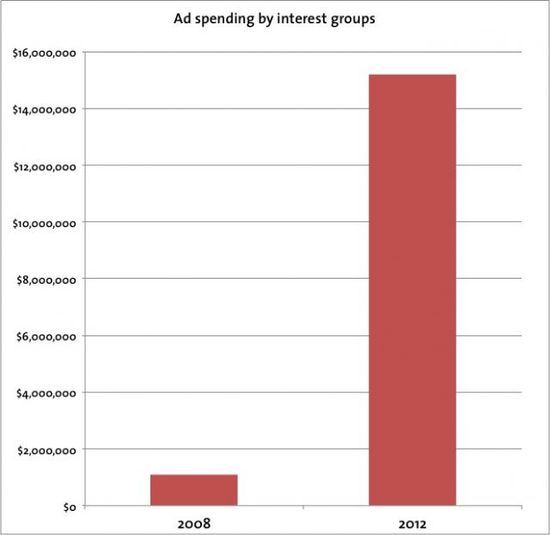
Outside groups are dominating general election spending, driven mostly by oil and gas interests:

Adspending2008-2012.preview

Chart via Jaeah Lee, who notes that 5 out of 7 general election ads airing in swing states deal with energy issues. Meanwhile, the RNC accuses Obama of selling out: 

And the DNC marks Giuliani's ringing endorsement of Romney: 

Previous Ad War Updates: Apr 18Apr 17Apr 16Apr 13Apr 11Apr 10Apr 9Apr 5Apr 4Apr 3Apr 2Mar 30Mar 27Mar 26Mar 23Mar 22Mar 21Mar 20Mar 19Mar 16Mar 15Mar 14Mar 13Mar 12Mar 9Mar 8Mar 7Mar 6Mar 5Mar 2Mar 1Feb 29Feb 28Feb 27Feb 23Feb 22Feb 21, Feb 17, Feb 16, Feb 15, Feb 14, Feb 13, Feb 9, Feb 8, Feb 7, Feb 6, Feb 3, Feb 2, Feb 1, Jan 30, Jan 29, Jan 27, Jan 26, Jan 25, Jan 24, Jan 22, Jan 20, Jan 19, Jan 18, Jan 17, Jan 16 and Jan 12.

The Least Walkable Cities, Ctd

A reader writes:

Perhaps the unwalkable cities are where they are not because of conservatives or agriculture, but because those cities are in areas with very hot climates. One can bundle up to stay warm to walk in cold climates, but there is little one can do to stay cool in hot ones while walking. Thus, one may walk in reasonable comfort in Cincinnati during the winter, but walking in Houston or New Orleans in the summer is nothing but misery, if not deadly (heatstroke). Driving, even without air conditioning, is mostly shaded and has a breeze.

Another writes:

The author of the article on walkable cities seems to have missed a few critical points.  More walkable cities tend to have at least one of two characteristics: They are usually older cities that experienced large amounts of growth before WWII and they tend to have physical boundaries that demand more dense growth (lakes, oceans, bays, mountains).

Why are Houston, Phoenix and Dallas so unwalkable? Because the majority of their growth has taken place after WWII, at the height of our car-oriented culture, and because they have no physical boundaries to force residents to go dense. The South's agricultural history has no direct effect – it's just correlative with the fact that the South is largely flat and open, providing for unobstructed sprawl, which is exactly the kind of growth we've seen in the considerably more liberal mid-west since WWII.

That the author thinks nothing of comparing Cambridge, MA, Berkeley, CA and Patterson, NJ to Clarksville, TN and Palm Bay, FL exposes the lack of thought here. The first three are all part of large metropolitan areas (all connected to their urban cores by rail and other transit), while the latter two are essentially in the middle of nowhere. It's apples and oranges. I'm sure he could find a correlative effect between more conservative-minded thinking and suburban-style living, but this data doesn't do that.

Another:

I am completely and totally in favor of making the places we live more walkable; hell, I'm currently fighting with local government in my town for better sidewalk coverage.  But this is one of those issues where progress will be just incredibly slow, in large part because the United States is just so damn big.  Wikipedia says that we're 179th out of 242 in total population density, but this actually understates the case, because a number of countries below us on the list have large expanses of uninhabitable land.  In terms of ratio of population to arable land, we're rated 205 of 233.

Land is like any other desirable product: if there's a lot of it available, it'll be cheap and people will use it like crazy.  Sure, better government policies can help the problem, and things will improve long-term as fuel prices increase.  But right now people have roots down, most of which are still based on how the world used to be.  This is going to change only slowly.

The Daily Wrap

6a00d83451c45669e20168ea9908a8970c-550wi

Today on the Dish, Andrew decried European austerity as counterproductive (follow-ups here and here), compared Sarkozy to Romney, blasted the international rot created by American torture, saw a sort-of hopeful sign on the NYT's coverage of the subject, defended his position on Tarek Mehanna and Anwar al-Awlaki, blasted the reaction to Peter Beinart in America, and put Arizona in play for Obama. We learned the press didn't really love Obama, delved into the real voting gaps the polling suggested exist, and set Romney's approach to his religion against Obama's. Soldiers got married (a lot), the draft likely wasn't a barrier to war, and drones were the future of airwar.

Andrew also celebrated Philip Larkin's poetry, worried about the effect of aggregation on young journalists, pushed back against search engine optimization, recounted a friend's story of "being a complete ass" (reader responses here), and reupped the poll for Ask Maggie Gallagher Anything. We debated donating to the US government, discovered a place without minimum wage, explored one idea for employing the young, and wondered how long we'd live for. Pesticides killed bees, the weather affected our views on climate change but probably didn't change our decision to bike, certain personalities might be more inclined to use drugs, music likely wasn't innate, and fingerprinting failed. Readers continued pondering the makeup of consciousness and discussed the Resurrection. Love bore fruit, women liked eye candy too, Napoloen wasn't short, and the outhouse moved indoors. Ask Spencer Ackerman Anything here, Quote for the Day here, VFYW here, MHB here, and FOTD here.

Z.B.

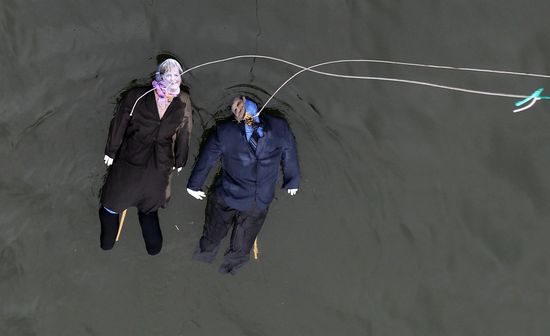
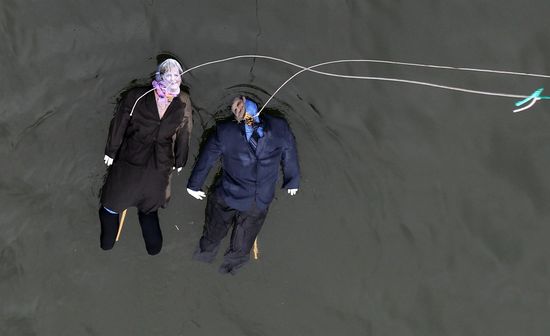
(Photo: Dummies wearing masks representing German Chancellor Angela Merkel and French President Nicolas Sarkozy thrown into the Meuse river by CSC Christian union members during an action entitled 'Merkosy' on February 29th, 2012. The CSC protests against the European policies of Sarkozy and Merkel. By Michael Krakowski/AFP/Getty Images.)