And not helping in defusing a "war on women":

There's more here. Rachel Maddow seems a particular obsession:
“Forced to watch #msnbc on gym tv. The Rachel Maddow commercials can't possibly attract any viewers, aside from Bieber fans #DeadRinger”
And not helping in defusing a "war on women":
There's more here. Rachel Maddow seems a particular obsession:
“Forced to watch #msnbc on gym tv. The Rachel Maddow commercials can't possibly attract any viewers, aside from Bieber fans #DeadRinger”
Dan Savage lauds the story and applies its underlying moral to another incurable STI:
I’ve said this for years to my friends with HIV: When you disclose your HIV status you’re telling the dude one thing he needs to know about you—and the way the dude reacts tells you everything you need to know about him. Disclosing an STI can help a person find good, kind, considerate and thoughtful partners in a pile that includes so many unkind, paranoid, irrational and phobic assholes. It’s a superpower.
A reader shares his own experience with herpes:
In 1977 I began dating a woman who told me she had had some virus infection but that it was cured. As a horny young dude I paid little attention, as I was clearly more interested in getting laid than worrying about her health, or my own. And besides, having gone through the earlier ’70s with Clap and Crabs, catching something else was just an inconvenience – or so I thought at the time. My first outbreak made me sicker than hell.
I went to the emergency room, and when the doctor had me pull down my pants and he looked at my genitals covered with sores, he recoiled. He had not seen such a thing before. I was devastated when I learned there was no “cure” and thought my life, or at least my sex life, was over. In the pre-HIV days, of course, this was the worst thing that had come along (though I am not suggesting any type of equivalence).
I remember having an outbreak at least once a month, probably spurred on by the fact that once I had it I continued to have sex with the same woman, and I think we kept trigger outbreaks with each other (though I don’t know if that was a medical fact or my own perception).
Over time, the number of outbreaks reduced, but it became part of my “life” as far as dating was concerned. Shamefully, I wouldn’t tell someone who was a one-night stand, but I fessed up to any woman who appeared to possibly be a long-term love interest. No one ever said go away, but my own shame and fear of rejection simply changed my relationships and sure put a crimp in my lifestyle.
One woman whom I dated caught the disease from me, and although I had told her, I still felt like I let her down, and she did too. I went through two marriage since then, not because of herpes, and my current wife of 13 years knows, and knew about before I put her at risk, and she has not caught it. I have learned that there are symptoms that occur just prior to the sores.
I still get a couple of outbreaks a year, which seem related to stress, and we just don’t do it while I’m active, though I realize that that is no guarantee, and so does she. Love conquers all things, I suppose. At times I still wonder what I missed out on as a result, because there were times when things might have happened that I didn’t let happen, and so forth.
So yes, one learns to live with herpes, and I’m sure there are a lot of people who have had to do that. But as one doctor told me, because it isn’t life threatening, there has been less interest in finding a real cure. Compared to what you live with, Andrew, it is a nothing-burger, but devastating nonetheless.
A heart attack killed Andrew Breitbart and nothing else.
The Internet has become a fount of entrepreneurial alchemy:
Never before has it been so easy to obtain the instructions, the precursor molecules, and the manufacturing capabilities to produce exotic, unregulated compounds on a mass scale—or print out crude recipes for drugs you can make yourself. … The consumers experimenting with these unregulated chemical concoctions may inhabit different worlds—the gym, the rave, and the crash house, respectively—but the drugs themselves are often produced with precursors purchased from the same places and derived from recipes traded on many of the same websites. They also carry some of the same risks.

You have until noon on Tuesday to guess it. City and/or state first, then country. Please put the location in the subject heading, along with any description within the email. If no one guesses the exact location, proximity counts. Be sure to email entries to VFYWcontest@gmail.com. Winner gets a free The View From Your Window book. Have at it.
Adam Gopnik theorizes that American culture is most nostalgic about the decade 40 years prior, what he dubs the "Golden Forty-Year Rule." Gopnik looks ahead to the 2050s, when the Obama era will be characterized:
A small, attentive child, in a stroller on some Brooklyn playground or Minneapolis street, is already recording the stray images and sounds of this era: Michelle’s upper arms, the baritone crooning sound of NPR, people sipping lattes (which a later decade will know as poison) at 10 A.M.—manners as strange and beautiful as smoking in restaurants and drinking Scotch at 3 P.M. seem to us. A series or a movie must already be simmering in her head, with its characters showing off their iPads and staring at their flat screens: absurdly antiquated and dated, they will seem, but so touching in their aspiration to the absolutely modern. Forty years from now, we’ll know, at last, how we looked and sounded and made love, and who we really were.
Kottke differs:
Maybe we've reached Peak Nostalgia and in an effort to find more and more nostalgia for an ever-increasing audience, culturemakers are mining more from those eras outside of the appointed 40-year era and as a result, pop culture is feeling more timeless, echoing all eras, until it becomes a culture that can't draw upon anything but itself.
Linda Holmes muses:
For an individual, nostalgia is a function of memory. But for a culture, nostalgia is a kind of travel. It is about somewhere else, somewhere different but vaguely recognizable, another place to look at the sunset. If we were really looking for a time when things felt easier, after all, we wouldn't love times of war and social upheaval; we'd be making shows about the dot-com boom. But we don't, because it isn't different enough yet. It has to be elsewhere; it cannot be here, because we cannot be here, not always, not every day.
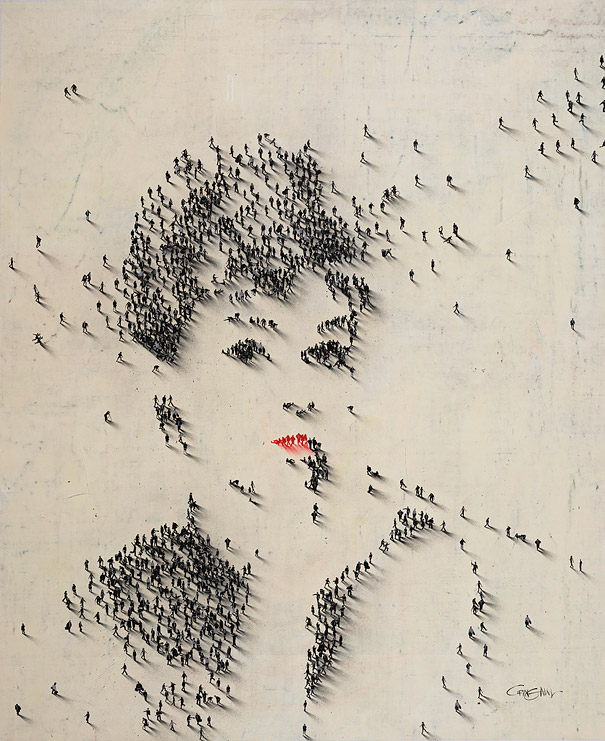
Some background:
American artist Craig Alan creates unique portraits of pop-culture icons using people as pixels. Some of his famous pieces include Marilyn Monroe, John F. Kennedy and the Statue of Liberty, but probably the most incredible one is the portrait of Audrey Hepburn from Breakfast At Tiffany’s.
Colossal rounds up more large-scale artwork featuring people as pixels.
David Sirota finds evidence to think so:
Pew has found that younger evangelicals are less devoutly committed to the Republican Party and its Tea Party-inspired agenda than older evangelicals. Additionally, surveys show a near majority of evangelicals agree with liberals that the tax system is unfair and that the wealthy aren’t paying their fair share. Meanwhile, the organization Faith in Public Life has highlighted new academic research showing that even in America there is growing "correlation between increased Bible reading and support for progressive views, including abolishing the death penalty, seeking economic justice, and reducing material consumption."
I wish "reducing material consumption" were not now regarded as somehow lefty. I always thought thrift and conservation were conservative values. But this is yet another battle I seem destined to lose.

He had cataracts:
After years of failed treatments, he agreed at age 82 to have the lens of his left eye completely removed. Light could now stream through the opening unimpeded. Monet could now see familiar colors again. And he could also see colors he had never seen before. Monet began to see–and to paint–in ultraviolet.
That effect is on display in Monet’s 1922-1924 series "The House Seen From the Rose Garden":
The paintings above are of the same scene. The red and yellow version is painted as seen through his left eye, limited to the wavelengths allowed by his cataract. The painting on the right is deep blue and violet, as seen through an eye with no lens. Who can imagine how those colors appeared to his eye while being mixed on his palette?
 The Dish