Sixty-six percent of 18 to 34-year-old women rate their career high on their list of life priorities, compared with 59 percent of young men. This figure hasn't really "reversed," but it has shifted markedly in the past 15 years—in 1997, only 56 percent of young women felt the same way, compared to 58 percent of men.Today's young women aren't planning to make any sacrifices on the home front, either—they're prioritizing their personal lives, too. The amount of young women who say that having a successful marriage is one of the most important things in their lives has risen nine percentage points since 1997, from 28 to 37 percent. For young men, that stat is trending in the opposite direction—from 35 percent in 1997 to 29 percent now. More young women than men care about being a good parent—59 percent, compared to 47 percent of their male counterparts.
It looks like young women are more likely to be thinking consciously about their priorities, period.
Month: April 2012
The Sartorial Superpower
Jason Diamond reviews Barry Singer's Churchill Style: The Art of Being Winston Churchill:
While Churchill’s style suggests fine suits with bow ties, John Bull hats, and expensive cigars, his greatest sartorial triumph was the zip-up, all-in-one “siren suit,” which
Singer’s book points out was conceived and designed by Churchill before World War II. The suits, which looked like a cross between a child’s onesie and the boiler suits worn by bricklayers, were made by the tailors Turnbell & Asser and came in several different colors and fabrics. While the suits did make the prime minister look like he was gearing up for an air raid, they may have also been the single most comfortable article of clothing worn by a world leader while commanding an army in the history of modern warfare. …
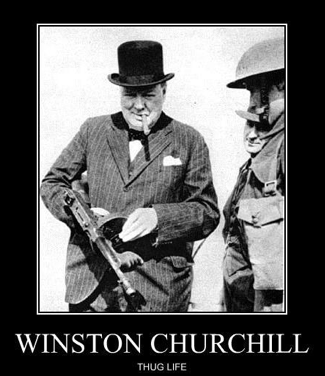
Churchill bore witness to several significant moments in fashion, making him a particularly smart man when it came to the evolution of dress. He was born into the Victorian era, came of age in Edwardian times, lived and fought during both world wars and ruled well into the atomic age. "He didn’t adhere to the stodgy view of political sartorial style," Singer points out; instead, Churchill was a man who both thought and dressed in a tenor all his own, and in doing so, was one of the last truly stylish men belonging to an England lost long ago.
(Graphic by Very Demotivational)
The Outpouring In Egypt
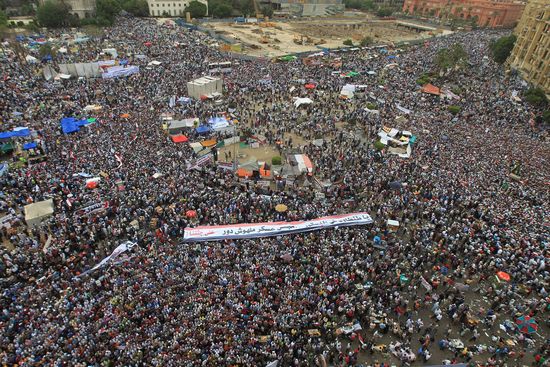
Yesterday brought massive protests against military rule. Thanassis Cambanis worries about another sort of threat:
Who decided to disqualify three presidential front-runners? Who shut down the constitutional process that had been convened, however poorly, by the freely and fairly elected parliament? On what grounds? In both instances, a group of essentially anonymous and unaccountable bureaucrats radically transformed the political landscape, citing reasons at best opaque and at worst nonsensical, deploying jargon and legalese to set the parameters of Egypt’s future state. We have no idea, really, who these officials are, whose interests they serve, whether they are acting in good faith, as independent decision-makers, or at someone else’s behest.
Mahmoud Salem focuses on the weakness of the Egyptian press:
The press became a battlefield of conflicting false accounts and exaggerations, truth was the first casualty, and all credibility went out of the window. We suddenly lived in a Huxley-ian world where there was no truth, only narrative, and the people got flooded with such conflicting information that they either believed what they wanted to believe (whether it was "The revolutionaries are foreign agents" or "Mubarak still rules us"), or tuned out completely from the entire process and stopped paying attention to any of the current events or caring about their outcome.
Walter Russell Mead is glum.
(Photo: Egyptians hold a huge national flag bearing a slogan that read in Arabic 'Hey Tantawi, the army has no role in the constitution' as thousands rally in Cairo's Tahrir Square on April 20, 2012 to protest against the ruling military and hold-overs from the former ruling government ahead of the presidential election to be held at the end of May. By Khaled Desouki/AFP/Getty Images.)
The Weekly Wrap
Friday on the Dish, Andrew paused the blog to attend Hitch's memorial, wrote a eulogy of sorts for his old friend, posted a poem for the occasion, and defended American voter ignorance. We invited you to Ask Maggie Gallagher anything, found the relationship between Romney and the institutional GOP super awkward, examined the case for an all-white ticket, forecasted an independent Gary Johnson run's impact on the race, decided Mitt's plasticity was dangerous, doubted the religious right would last forever, and looked at the religious influence on American warmaking. Norwegians rebounded without fear after the Utoya terrorist attack, Africans turned up their noses at European barbarism, drones couldn't beat manned fighters, and the military tried out robot psychologists.
Andrew blasted DC's ridiculous marijuana laws, and also opposed settlement boycotts on practical grounds and capital punishment on principled ones. A new video game pushed the boundaries of the form, almost all bars used games from the same company, Google wasn't a trend-tracking panacea, about 30 percent of the Internet was for porn, and "Facebook girlfriends" ran you 5 bucks. We looked at half-way legalization of prostitution, tracked the pidgeonholing of gay comedy, and continued debate on the male contraceptive RISUG. Chimps killed for sex and pesticides killed bees. Global attitudes on God varied, stuttering had no upside, a pot dealer spilled trade secrets, 420's hidden history came to light, and a reader put two and two together on MHB timing. Ask Jennifer Rubin Anything here, VFYW here, MHB here, and FOTD here.

Thursday on the Dish, Andrew damned Richard Nixon for giving us today's GOP, discussed the politics of Roe v. Wade with Douthat, debated Obama and the Buffett Rule with readers, discovered Romney's appointment of an openly gay Republican as his national security spokesman, dressed Mitt down over dressage (reader corrective here), and dozed off at the Republican nomination. We situated Romney on the extreme end of the Afghanistan drawdown debate, cast doubt on the idea that his unfavorables would sink him, bet on minorities turning out for Obama again, explained the partisan gender gap by reference to "big government," and chuckled at Obama photoshops. Ad War Update here.
Andrew also explained how our choices determine who we are, issued a disclosure addendum to the "Nepotism Watch" on Chelsea Clinton, crossed his fingers over Iran negotiations, and went another round on imperial war and atrocity. We hoped Iran's nuclear program might follow history and collapse on its own, listened to readers on divergences between Israel and America and Jennifer Rubin, checked on an alternative to the war on drugs, and explored the causes behind the drop in American gun ownership. S&M wasn't intrinsically anti-feminist, a sex life with herpes wasn't all bad, legal prostitution had a mixed record, and male contraception celebration was premature. We continued discussing the character of consciousness, found that self-control was likely finite, and pondered good religion. The notion of "Facebook loneliness" got complicated, cell phone spam annoyed, bicycles used oil, tiny houses came in vogue, and prospective employers gave resumes only cursory examination. Ask Jennifer Rubin Anything here, Quote for the Day here, VFYW here, MHB here, and FOTD here.

Hua Hin, Thailand, 12 pm
Wednesday on the Dish, Andrew lauded Poland's investigation into Bush-era torture, feared Romney would make the same grave mistakes as his Republican predecessor on foreign policy, chatted with Ross Douthat about whether Romney was a Christian, and heaved at the current election news cycle. We used science to predict a wave of muck from now till November, found the party bases unified around their candidates, figured out just how badly Romney could lose among women and minorities Romney could lose and still win, determined that GOP-leaning cities were the least walkable, and wondered what Herman Cain was up to (hint: making money). Deficits seemed in important ways beside the point, Mormon women stayed home, and candidates lacked beards.
Andrew also blasted an "intellectually challenged" bishop, responded to readers on tax reform and religion on the Dish, got disgusted by some picture from Afghanistan, and previewed the right-wing backlash if Iran makes a nuclear deal. We debated the differences between Iran and Iraq (re: Jennifer Rubin's Ask Anything video on same), pushed the limits of free speech on a terrorism case, debated the "humor" in Text from Drone, and situated our infrastructure well ahead of China's. The moral intelligence of a calf's mother astonished, veganism was marginally healthy, and trees were good for cities. People struggled to catch cabs, criminal justice fees rankled, an autism epidemic may have began, humanity got lucky, and robots appeared to be next. We rubbished the cohabitation effect, speculated about growing old alone, pinned romcoms to fairy tales, and profiled WebMD addiction. Ask Jennifer Rubin Anything here, Malkin Award Nominee here, Hathos Alert here, Quotes for the Day here and here, VFYW here, MHB here, and FOTD here.
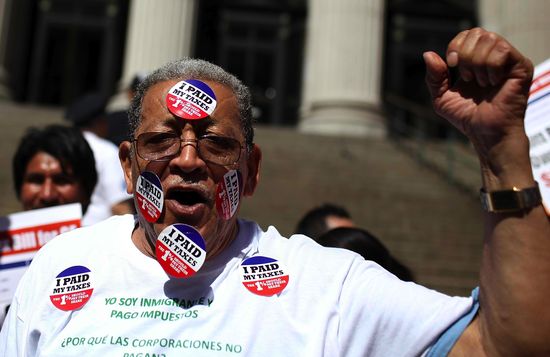
By Justin Sullivan/Getty Images
Tuesday on the Dish, Andrew defended his view of the race's importance, aired more thoughts on Palin's viability, took Obama to task on the deficit and taxes, checked on the reality of government spending and the need for tax hikes, and labelled tax breaks "fundamentally unfair." Relatedly, since it was tax day, we gave you tips on filing, explained why the IRS didn't calculate them for you, and looked at dangerous tax loans. We also posted some rules for reading polling data, put Arizona on Obama's radar, wondered if Romney really could make a centrist move, broke down the fundamentally cautious character of modern campaigns, met the "teavangelical" candidate for Congress, listened to readers on Jennifer Rubin and W.'s biggest mistake, traced the individual mandate back to George Washington, questioned whether the Secret Service had gotten out of control, and read Biden's lips (badly). Ad War Updates here and here.
Andrew also shared his (highly positive) childhood history with IQ measurement, lost faith in a two-state solution, and reexamined the Iran strike countdown. Bibi was vulnerable in the upcoming election and Iran attacked filmmaking. We debated S&M and feminism, spotlighted an extraordinarily effective form of birth control, continued the gyms and health discussion, put the George Zimmerman trial in a broader context, and noted some nepotism. Idealist depictions of politics went out of style, music had extraordinary powers, science decoded old book smell, and blogs prospered. Ask Jennifer Rubin Anything here, Hewitt Award Nominee here, Chart of the Day here, VFYW Contest Winner here, VFYW here, MHB here, and FOTD here.
Monday on the Dish, Andrew came back from his staycation, declared this election's highest stakes to be in foreign policy, disapproved of Obama's new tone, and bet Palin could have beaten Romney. We wondered if Obama and Romney were actually close, puzzled over Mitt's Republican DREAM Act and secret tax plan (here and here), and examined Communist witchunting as a fundraising tactic. The NRA sounded crazy and the recession might have been much worse.
Andrew also blasted Bill Donohue's nastiness about adopted children, noted some encouraging statistics about Newsweek, and went after the NYT review of The Crisis of Zionism. We also teased out the implications of the weekend attacks in Afghanistan, worried about Central America's reaction to the war on drugs, and assesed the UN's success (or failure). GDP didn't measure everything important, Italy had crazy gangs and a crazier ex-Prime Minister, Google Earth saved a life in India, and medical tourism might help save US health care. Ackerman's Ask Anything questions stayed up, Wilkinson switched focus to fiction, and Hari chatted with Greenwald.
We also listened to readers on The Dish and religion, took in a poetry review from 1939, and pondered the character of consciousness. Writing changed when done by hand, speech impediments differed in different contexts, a disability scarred one reader's love life, hot real estate agents moved property, and kids languished in juvie. Readers debated filming books and Tupac lived. Smart phones spread, lie detectors failed, and aluminum used to be more valuable than gold. A cardboard arcade warmed our hearts and pot wine was a thing. Ask Jennifer Rubin Anything here, Quotes for the Day here, here, and here, Headline of the Day here, FOTD here, MHB here, and VFYW here.
– Z.B.
Email Of The Day
A reader writes:
Bit embarrassed that as a longtime reader, I just put together the consistent post time of your Mental Health Break. Thanks for the extra giggle today.
Dispatch From A Pot Dealer
A part-time one at least:
On an eighth, I believe I make about $18. And if you factor in the amount of time it takes me to package and deliver that, you’re looking at no more than 15 to 30 minutes per transaction. So at worst, I’m making $18-a-half-hour. Realistically, the majority of that work is [chuckles] driving. It kind of goes back to that old adage "time is money" and that was a hard lesson for me to learn because when I used to sell from my house, I’d have people come over and I would be a generous person and offer to smoke weed with them out of my own supply or maybe they’d want to load a bowl out of what they just bought. And so they’d end up staying for an hour. And while it was fun, it tied up an hour of my time that I could have been doing any number of other things.
So, learning that the quicker the you make a transaction, the more money you’re making was a valuable lesson for me.
Face Of The Day

A protester in Amsterdam on April 20 smokes marijuana during a demonstration against new government legislation calling for the creation of a 'weed pass' and the stopping of the substance's sale to foreigners. Several hundred pro-cannabis demonstrators lit up joints in central Amsterdam today in the most public display yet against the Dutch government's plan to stop the drug's sale to tourists. Pot-friendly protesters 'flash-mobbed' in front of the capital's Muziektheater, a venue announced only an hour before on social media sites. By Evert Elzinga/AFP/Getty Images.
The Hitch Has Landed
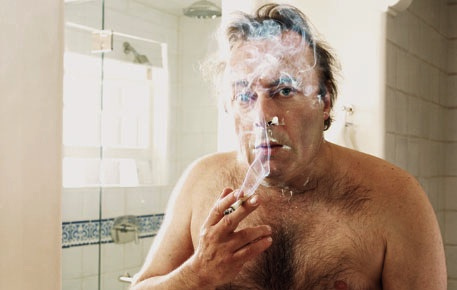
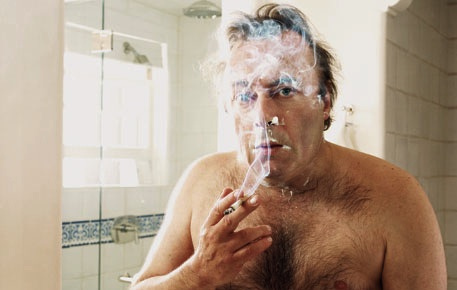
I was honored to be an usher at my old friend's Memorial Service today in New York, and frankly relieved not to read anything because the quality of the presentations – from James Fenton's astonishing opening poem to Martin Amis's brilliantly brief eulogy of Christopher in all his contradictory genius – were close to flawless.
The evangelical scientist Francis Collins played piano; Peter Hitchens read from Saint Paul; but most of the material was Hitch's writing itself. And it was some of his most vivid, powerful prose. I particularly admired his evisceration of Bill Clinton, a reminder of what a complete tool that man  was, and his heart-breaking take-down of the North Korean totalitarian dynasty.
I remain in awe of his energy, his human force, his impatience with cant, his great gift of insult, his inimitable courage, his deep enjoyment of living. And two things surprised.
Amis spoke of Christopher's private struggle with his embrace of the Iraq war. He never recanted as I did. Indeed, one of our more heated recent chats was over his enthusiasm for a new war against Iran. But the idea that he did not feel the pain of isolation, of misjudgment, that this humane man was immune to the suffering that this horrifying war entailed for so many innocents, and took no personal responsibility for it, is untrue. He told Martin that in the period when the war was at its worst, he was in a "world of pain." Being a contrary public writer, being prepared to lose friends over principle, challenging one's own "side", and forever braced for battle, takes a toll. Hitch bore it with great aplomb. That does not mean he had nothing to bear.
And then his last words. As he lay dying, he asked for a pen and paper and tried to write on it. After a while, he finished, held it up, looked at it and saw that it was an illegible assemblage of scribbled, meaningless hieroglyphics. "What's the use?" he said to Steve Wasserman. Then he dozed a little, and then roused himself and uttered a couple of words that were close to inaudible. Steve asked him to repeat them. There were two:
"Capitalism."
"Downfall."
In his end was his beginning.
I've been very down lately, and I feared a Memorial Service would not help much. But as we walked outside afterwards to the hilarious tune of the Internationale, I felt fortified, re-energized, inspired, almost buoyant. There is no competition, as Eliot noted. But there is always the struggle to expose lies, dispense with cant, tell the truth and just bloody well get on with it.
Of course, I do not believe Hitch has disappeared from reality. But even if he has, his example raises all our standards, and begs for us to follow him in slaying sacred cows with wit and merciless accuracy. He inspired love in so many for one reason. He was true to himself, and he loved the world. And what was so truly moving about his final years – especially in his campaign against religion – was how much, how overwhelmingly, so many who never even met him loved him, and I mean loved him, back.
4/20 In Washington

The perfectly named Carol Joynt celebrates the joy of marijuana on today's festive occasion in her city – and mine – of DC. It may not be Portland, but Prohibition hasn't worked here just as it hasn't worked anywhere else. In fact, DC may be one of the least noticed 4/20 cities in America, right under the Christianist Congressional noses. But that, of course, is the rub. Living in a city which remains a colony run by white men from rural states, a city where there is less democracy than in Baghdad, means that self-government in such matters is regarded as anathema. Nonetheless, we did finally pass a medical marijuana law that should come into effect in August.
But because the City Council is so terrified of their colonial Congressional masters, the law will be so restrictive almost no one will be able to participate – it's almost a reverse parody of what has happened in, say, Colorado. The hypocrisy, cant and thuggery is thick even by Washington standards, as this Washingtonian cover-story revealed. And small businesses that simply sell hemp products and water pipes and other paraphernalia – like the profitable, job-creating Capitol Hemp stores – have been brutally raided by thuggish cops and now forced now into extinction. They sold no pot. You can read an interview with the owners by Carol here.
I became friends with the owners and regard the raids as an outrage. And the medical marijuana law seems to have been pre-emptively sabotaged by the DC City Council and their cowardice. Adam Eidenger notes:
The distributors who get licenses from the city are going to fail. I hope I'm wrong. But the economics of this city and the limitations on quantity and the absurd fees are setting it up to fail. The license fees are three times what they charge for liquor licenses.
Part of this is pure racism, part cowardice from our elected city leaders, and part pure irrationalism, like the entire anti-marijuana apparatus, now essentially a way to target minorities for arrest as in Bloomberg's New York City.
I know I sound cranky on this. But I believe in personal liberty and I believe the sick should not be prevented from trying anything they want to make themselves better. These things are not worth giggling about. They are worth fighting for. I watched a generation of my peers die who desperately needed relief from nausea and couldn't get it. And all of this – all of it – is driven by pure fear and hatred of the idea of anyone else actually bypassing the pharmaceutical lobby, reducing liquor sales, or even, God forbid, enjoying an evening at home.
We need a new vote on total legalization in the district. And we need to take the Puritans in the Congress face on.
America’s Holy Wars
Michael Kimmage reviews Andrew Preston's Sword of the Spirit, Shield of Faith: Religion in American War and Diplomacy:
Seeking to explain why "U.S. foreign policy has often acquired the tenor of a moral crusade," Preston first turns his attention to the seventeenth century. Avidly Protestant, "the American colonies never underwent a counterreformation," he observes, and they waged almost continuous war against enemies deemed theologically other—i.e. Catholics and Native Americans. These Christian soldiers prided themselves on fighting holy wars, regularly fitting themselves into Old Testament patterns, the New World’s Israelites imbued with "a consistent belief in America as a chosen nation and in Americans as a chosen people."
 The Dish