What Is Consciousness Made Of? Ctd

A reader writes:

I have to point out that Manzotti's explanation for consciousness, and his comparison of it to viewing a rainbow, is tautological. He posits a viewer of the rainbow in a particular time and place for consciousness to arise, but who is this viewer of consciousness, other than consciousness itself? He requires there to be a conscious observer for consciousness to arise, which means that consciousness must be prior to any set of conditions, and not the result of their fortuitous confluence.

This is why the non-dual traditions of Hinduism say that the observing consciousness is, if examined directly, the ultimate reality upon which all things depend, including our very sense of self, rather than, as Western science tries to demonstrate, a consequence of conditional phenomena such as the brain and nervous system. Attempts such as these by Mazotti to reduce consciousness to an effect, however complex, always fail because they at some point still must posit an observer of these effects, and this leads us back to the notion that it is consciousness that is fundamental to existence, not the seemingly objective conditions we can observe.

One is always brought back to the fundamental question, "Who is the observer?", or really, "Who am I?", which is the central focus of Hindu non-dualism, for the very simple reason that it is the only question that continually demands we resolve the contradictions of our own experiential self-existence without resort to tautologies.

Another writes:

If you're really interested in different theories of consciousness, I highly recommend the book Power Vs. Force: The Hidden Determinants of Human Behavior by David R. Hawkins.  I don't know if you'll find yourself agreeing with his premise, but I suspect you would find the ideas he presents very stimulating. 

Bicycles Run On Gasoline

Indirectly:

The sad thing is, is that just as agencies such as the Portland Bureau of Transportation (PBOT) start to achieve success in turning people from their cars to their bikes, they also start to suffer a funding crunch. Because, as Jonathan Maus points out in an article on BikePortland, much of the funding for transportation agencies comes from, yes, you guessed it, the gas tax. Unfortunately or fortunately, In Portland, and in other parts of the Northwest, driving has continually fallen in recent years. That means less money for bike lanes, and less money for routine things like fixing pot holes, and less money for big-ticket projects, too.

What Matters On A Resume?

Recruiters-looking-at-resumes-625x625

The basics, according to a new study:

Most job seekers think recruiters spend 4 to 5 minutes reviewing a resume. The truth: recruiters spend about 6 seconds before they make the initial "fit/no fit" decision.

How to prioritize:

During evaluations, eye tracking software was employed, and they found that the recruiters spent about six seconds on a resume looking for six main things: name, current company and title, previous company and title, previous position start and end dates, current position start and end dates, and eduction. After that, it was a crapshoot.

(Image from an eye-tracking study of recruiters by TheLadder's)

Why Do Women Vote Democrat?

Talbot eyes the gender gap:

The reason women are more likely to vote Democratic has less to do with what we generally consider women’s issues than Democrats seem to think. But the real reason means that Republicans will find it difficult to close the gender gap: women tend to support big government.

"For more than a decade, women have been more likely than men to favor an active role for government," said a Pew Research Center report released in March. "And recent surveys show that higher percentages of women than men say that government should do more for the poor, children, and the elderly." Women advocate strengthening government regulation, especially on health, the environment, and food and workplace safety, much more than men do.

The Most Strapped Citizenry


The award belongs, of course, to the US. But, as the Dish has noted, gun ownership among Americans is declining. Jill Lepore has a lenghty examination of the trend:

Men are far more likely to own guns than women are, but the rate of gun ownership among men fell from one in two in 1980 to one in three in 2010, while, in that same stretch of time, the rate among women remained one in ten. What may have held that rate steady in an age of decline was the aggressive marketing of handguns to women for self-defense, which is how a great many guns are marketed. Gun ownership is higher among whites than among blacks, higher in the country than in the city, and higher among older people than among younger people. One reason that gun ownership is declining, nationwide, might be that high-school shooting clubs and rifle ranges at summer camps are no longer common.

The Scourge Of Cellphone Spam

It grew from 2.2 billion messages in 2009 to 4.5 billion messages in 2011. What the future may hold:

[P]erhaps mobile spam will be held down to the level of a minor annoyance for most. But there’s also a possibility the problem will get much worse before it gets better. For a grim picture of the future, one has only to look to China, where unlimited text plans have been widely available much longer. By some estimates, a third of all text messages in China today are spam.

The Man On Horseback, Ctd

Many readers are echoing this one:

I get the point about Romney's riches and his disconnect from the suffering of many in the nation. But I have to say I also saw in that video a Romney I haven't seen in the debates, interviews, or stump speeches: a relaxed Romney who seemed human. Except for the old Massachusetts governor videos, this is by far the most I've ever liked Mitt. He may own several super expensive animals, but to hear him talk about his wife (and the whole family) as having been through the ringer and needing some down time might help him connect with normal human concerns.

Another writes:

A lot of people in red states have horses, like horses, and like people who like horses. I think the 3000 square foot basement with a car elevator is far less appealing, far more troublesome, than being married to someone who feels rejuvenated by riding on a horse, even if it is dressage.

Several readers in horse country back up that perspective. One from Oklahoma:

Perhaps you haven't spent much time in the great swath of flyover country, but owning horses is not necessarily a rich person's lifestyle. Horse ownership cuts across all socio-economic levels here in my state.

My wife competes in eventing (dressage is one of the three disciplines), and just in our small circle, there are doctors, veterinarians, college professors, high school teachers, police officers, and nurses.  In the past, we have also belonged to riding clubs where members range from wealthy to dirt poor. 

Now, I suppose that you could point out that his wife rides an Austrian Warmblood, a breed that can be quite pricey. However, I doubt even you would say the same about a presidential candidate who owns Quarter Horses and whose wife competes in barrel racing, cutting, or reining.  But guess what?  A top flight Quarter Horse can cost every bit as much a fancy warmblood imported from Europe.

So horse ownership is open to many, not just the blue bloods.  In my opinion, the biggest barrier to horse ownership is access to cheap land.  Live somewhere where land is affordable and horse ownership is available to many.

Another reader:

I lived in England as a kid and learned to associate horseback riding with the aristocracy, as you did.  My daughter, growing up in New Haven, CT, begged for riding lessons and I reflexively put her off, figuring it was out of our league.

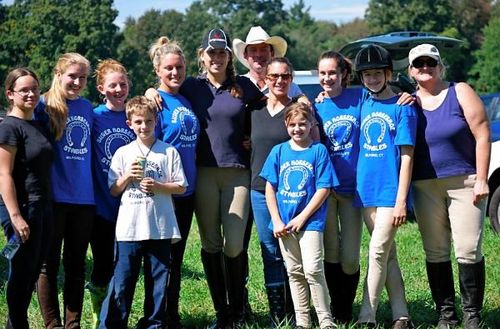
Imagine my surprise, when I actually looked into it, to discover that weekly riding lessons were quite affordable ($20 per week in the 1990s) and that the local stables were entirely free of any kind of snob associations.  All my daughters have taken riding lessons.  Instructional stables offer Western, English and dressage.  Most of the kids taking lessons were working-class or petty bourgeois – your basic Girl-Scout types – who would also be taking dance lessons and maybe singing in the school choir or hoping for a part in the school musical. The most ambitious girls saved their baby-sitting money and bought their own horses.

So with the wide open spaces in many sprawling American suburbs, even owning a horse is not necessarily a sign of aristocratic pretensions. Just to give you an idea: there's nothing that screams "posh" about this picture from the web site of my daughters' equestrian stable:
Nothing-posh

Finally, for a woman with multiple sclerosis, five sons, and a high-powered husband, I imagine riding is highly therapeutic for Ann Romney.  For all of Mitt's obvious tin ear on class issues, this one, I think, is not the slam dunk you think it is.

Another points out that "the top hat is part of the 'uniform' for the international levels. I stick to a helmet in the interest of protecting my noggin." One more perspective:

Here in the Temecula (Ca.) , wine country horse raising is a big thing, particularly among women, and in particular among the many lesbian couples that inhabit the area, and many of whom I count among my friends.  For the most part they are typical country girls, who dress in jeans and plaid shirts.  However, many are passionately devoted to Dressage training and riding.  On a number of occasions, the plaid shirts and steel toed boots are traded in for English outfits, complete with top hat and crop.

I would venture to say that this devotion to dressage is even more pronounced in the counties surrounding San Francisco and San Jose.  And no, I am not talking about the born with a silver spoon types.  These are average people who love horses, and in particular, the challenge of Dressage.

I stand corrected. My English class bias led me astray.