Was Roe v. Wade A Mistake For Liberals?

More from my conversation with Ross Douthat on his elegant defense of orthodox Christianity from its heretics on right and left. Bad Religion: How We Became A Nation Of Heretics. This time, we talk about the rise of Christianism – and its causes. The first clip on whether Romney is a Christian is here.

Will Romney’s Unfavorables Sink Him?

Silver considers Romney's dismal favorables a "fairly minor factor":

My guess, for what it’s worth, is that we will see some improvement in Mr. Romney’s favorability numbers over the next month or two. It has not been uncommon in the past for a candidate’s numbers to decline while he is actively engaged in a primary, but for him to go through a honeymoon period once he begins to wrap up the nomination.

Harry Enten points out that "every election cycle breaks rules" and lists ones that could be broken in 2012.

How Has Legal Prostitution Panned Out?

Matt Steinglass contrasts drug decriminalization, which he says "has been a success everywhere it has been implemented," with the legalization of prostitution:

Up through the 1990s, there seemed to be a strong case that legalising brothels could destigmatise prostitution and allow sex workers to enjoy employment rights andGT_PROSTITUTE_120221 establish normal relations with police and the justice system, drive down human trafficking, keep underage girls out of the business, and so forth. But the sense at this point, in countries like Spain, the Netherlands and Germany that have been trying this approach for over a decade, is that decriminalisation isn't delivering as promised. Opinions are divided, but there's evidence of an increase in the rackets of "loverboys" luring girls from poorer countries (Romania, Colombia) into forced sex work. Brothels that play by the rules must employ high-wage locals with work permits; they find it hard to compete with pimps bringing in low-wage illegal immigrants. Internet-based escort services are impossible to force into the legal framework. Because prostitution itself is not illegal, police and prosecutors have a harder time making cases against traffickers. It is, at least, a very mixed bag.

A Dish reader who volunteered with prostitutes in Europe elaborated along those lines. James Poulos predicts that prostitution will become more accepted as time goes on:

The prevailing concern with prostitution today is that it’s exploitative, and the main source of that concern is most people think of prostitution as a full-time career and defining life choice. Of course, that doesn’t have to be the case. Cultural and moral divides have traditionally led people to go all in on prostitution or all out. We’re now already pretty deep into a middle moral position, where informal or tacit exchanges of sex for money make it increasingly difficult to convincingly draw conceptual boundaries. ‘Amateur’ sex work and part-time entrepreneurial prostitution are growth industries. Yesterday’s gray area was defined by the people who put themselves through college by stripping. Today’s gray area — as developments in Africa seem to be illustrating — can help move the exchange of sex for money closer into the mainstream.

Lauren Davis runs down the implications of a paper suggesting that robot prostitution is coming to a future near you.

(Photo: A Ukrainian prostitute stands on the transit road Berlin-Warsaw on the Polish side of the German-Polish border in Slubice on January 27, 2001. Germany has become the first place in Europe for prostitutes from the eastern European countries. By Michael Kappeler /AFP/Getty Images)

Loneliness In The Age Of Facebook

Stephen Marche's Atlantic cover-essay has gotten a lot of pushback. Zeynep Tufekci, a fellow at the Berkman Center for Internet and Society at Harvard, notes:

Research by many people (most importantly Keith Hampton) show again and again that Internet/Facebook users are less isolated than people who don’t use social media. … What data I’ve seen makes a strong case that social isolation is increased by factors like suburbanization, long-commutes, long work hours, decline of community and civic institutions, etc—not online sociality.

A reader quotes Marche:

[C]ustomers stopped having relationships with their grocers. When the telephone arrived, people stopped knocking on their neighbors’ doors. Social media bring this process to a much wider set of relationships.

Faulty premises lead to faulty results. To the contrary, A&P led to more customers visiting their stores in person instead of having the store do their shopping for them and delivering the goods. Phones led to people making appointments to see each other rather than trudge across town hoping they were home. We know a lot more people than we did back when we walked or rode horses.

Sure, idiots who think they have 3,208 friends are deluded. But since I recently joined Facebook, I stay in touch with my family much, much more than I ever did before, since we live thousands of miles apart. I have a handful of new friends I have never met, but they are people I know through others and we share interests and now plan to meet in person at the first opportunity.

Robert Lane Greene takes his own long look at the social networking mega-site:

Once people suffered from hysteria and melancholy; in the modern age, they have anxiety and depression. Once they suffered gossiping and bullying; now it’s "Facebook official" drama and cyber-bullying. Once they could envy the greener grass on their neighbour’s side; now it’s "Facebook anxiety" about his (or, more likely, her) online photos. Once they wondered if their social lives were fulfilling enough; now they suffer FOMO—fear of missing out—and get to see all the pictures from the party they weren’t invited to. New labels for old problems.

Michael Sacasas sounds off:

The real issue, it seems to me, is not whether Facebook makes us lonely, but whether Facebook is reconfiguring our notions of loneliness, sociability, and relationships. These are after all not exactly static concepts. Here is where I think Marche raises some substantial concerns that are unfortunately lost when the debate goes down the path of determining causality.

What Facebook offers is the dream of managing the social and curating the self, and we seem to obsessively take to the task. The asynchronicity of Facebook is rather safe, after all, when compared to the messy and risky dynamics of face-to-face interactions, and we naturally gravitate toward this sort of safety. I suspect this is in part also why we would sometimes rather text than call and, if we do call, why we hope to get sent to voicemail. It seems reasonable to ask whether we will be tempted to take the efficiency and smoothness of our social media interactions as the norm for all forms of social interaction.

Will Minorities Turn Out For Obama Again?

Obama_Supporter

Kilgore thinks so. Electionate agrees:

While there are many conflicting trends, in the aggregate, non-white participation and support for Obama should remain similar to 2008. Substantial declines in turnout seem relatively unlikely, and long-term demographic trends are probably sufficient to mitigate, if not overwhelm, any decrease in participation rates. Although it is impossible to precisely estimate the composition of the electorate one week before an election, let alone seven months, it is highly unlikely that non-white turnout will revert to anything reminiscent of 2004, and there is a good chance that non-white turnout will match or exceed 2008 levels.

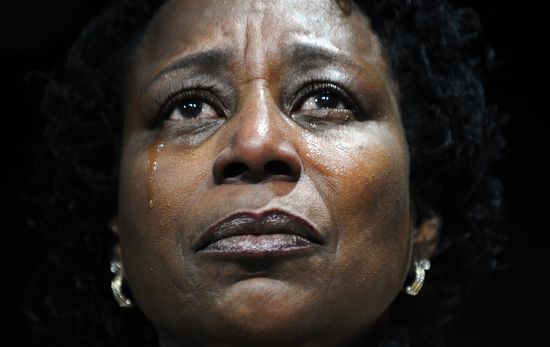
(Photo: A supporter cries as she listens to US President Barack Obama address a campaign event at the University of Illinois at Chicago in Chicago, Illinois, on January 11, 2012. By Jewel Samad /AFP/Getty Images)

Will Iran’s Nuclear Program Fail On Its Own?

One can hope. Jacques Hymans fits Iran into a broader pattern of nuclear programs failing from managerial incompetence:

The historical record strongly indicates that the more a state has conformed to the professional management culture generally found in developed states, the less time it has needed to get its first bomb and the lower its chances of failure. Conversely, the more a state has conformed to the authoritarian management culture typically found in developing states, the more time it has needed to get its first bomb and the higher its chances of failure…

In a study of Iranian human-resource practices, the management analysts Pari Namazie and Monir Tayeb concluded that the Iranian regime has historically shown a marked preference for political loyalty over professional qualifications. “The belief,” they wrote, “is that a loyal person can learn new skills, but it is much more difficult to teach loyalty to a skilled person.” This is the classic attitude of authoritarian managers. And according to the Iranian political scientist Hossein Bashiriyeh, in recent years, Iran’s “irregular and erratic economic policies and practices, political nepotism and general mismanagement” have greatly accelerated. It is hard to imagine that the politically charged Iranian nuclear program is sheltered from these tendencies.

Do US Interests Ever Diverge From Israel’s? Ctd

A reader writes:

I assume that you will publish something dissenting from Jennifer Rubin's latest segment, but I felt compelled to comment in some fashion.  It was breathtaking.  She argued, with a straight face, that the interests of the US and Israel diverge because we can't agree on which of us wants to own the glory for an attack on Iran.  That the act of going to war with Iran is a prize to be sought.  I wondered how she'd answer the question, and I was absolutely dumbfounded. 

Another writes:

I will take Rubin's long-winded answer as a no.

Another:

Isn't it fascinating that, when asked if US interests ever diverge from Israel's, Ms Rubin says yes … but immediately notes that it is "interesting" that the question is asked about Israel, but not about Great Britain or Australia. Can she really be so clueless? Australia and Great Britain doubtless lobby the US government for their interests.  But only Israel has both a huge, successful lobby and an entire political party dedicated to the proposition that it is always in America's interest to support Israel everywhere and under all circumstances, no matter what Israel may decide to do.  Is it really possible to not see that difference?  Or does she see it, but just refuse to acknowledge it?

Another:

It's interesting that Rubin ends by saying that she sees Israel taking action against Iran because the Obama administration is disinclined to act forcefully on foreign policy (almost exactly her words). How quickly the administration's actions in Libya or against Osama bin Laden are forgotten. The Obama administration has certainly shown they are willing to act forcefully. They've also shown they're willing to take a more measured approach, as with the review in Afghanistan, before sending in more troops. It's certainly possible to take different view points on situations, but it's amazing how Obama's critics continue to paint him with broad brush strokes that are easily refuted.

By the way, thanks for opening up the Ask Andrew series to other writers and pundits. It's been fascinating to see other viewpoints I might not have otherwise seen, especially the current run with Rubin. Given reader feedback to her answers, it might be interesting to have her do a follow-up series where she responds to readers.

I've extended an invitation for her to respond on her blog to which we would very happily link.