The Trophies Of War

War_Dead

Shafer connects the latest from Afghanistan to military history:

The desecration of the bodies of Japanese soldiers was so common that in 1944, Life magazine published a light-headed photo of a young woman posing with a Japanese soldier’s skull sent to her from New Guinea by her Navy boyfriend. That same year, columnist Drew Pearson reported(pdf) that Representative Francis E. Walter (D-Penn.) had presented President Franklin D. Roosevelt with a letter opener made from the forearm of a Japanese soldier.

Relatedly, Lexington counters me:

I happen not to think that the war in Afghanistan is an imperial war, but more to the point I suspect that the soldiers' behaviour in this case had nothing to do with whether it is imperial or not. Almost every war has its atrocities.

Yes, but long, long wars with constantly recycled and exhausted troops, often acting alone or in small units, is a function of empire. The war in Afghanistan has lasted longer than Vietnam. Americans are not suited for such endless occupations; and they test even the most professional military's discipline and command.

(Photo: On April 30, 1944 Lieutenant (Junior Grade) E. V. McPherson, of Columbus, Ohio with a Japanese skull, which serves as a mascot aboard the United States Navy motor torpedo boat 341. Wikipedia Commons)

What Nixon Wrought

Pete Wehner has a nice post up about confirmation bias and Jonathan Haidt's fascinating new book. It's as honest as our motto, "Biased and Balanced." At least we try to be balanced when my views can be cogently countered by others. Hence our constant reader threads and dissents and reaxes from around the web and platforms for Jen Rubin et al. – designed, I hope, to work against the kind of epistemic closure I suffered from before the Iraq war forced me to recognize my own profound fallibility and failure. But this passage leapt out:

According to Haidt, individual reasoning is not reliable because of "the confirmation bias" – and the only cure for the confirmation bias is other people. "If you bring people together who disagree," he argues, "and they have a sense of friendship, family, having something in common, having an institution to preserve, they can challenge each other’s reason." We’re not very good at challenging our own beliefs – but we’re quite good at challenging the beliefs of others. Our task is (to borrow from William Saletan’s review of Haidt’s book) "to organize society so that reason and intuition interact in healthy ways."

I cannot help but think of Richard Nixon's Southern Strategy, and how its legacy still poisons our politics. For a very long time, the deep cultural divide in this country was in part managed by the Democratic party. Its alliance of Southern conservatives and Northeastern liberals – perhaps exemplified by the Kennedy-Johnson ticket – gave what we now call parts of red and blue America a joint incentive to work out their differences through a common partisan affiliation. The had a fellowship that facilitated compromise. A less coherent ideological party structure actually created a more coherent political debate. I wonder if civil rights legislation would ever have been achieved without this.

This isn't a new insight, of course. But as we survey the grim prospect of this election season and the polarization that appears immune (and would be immune on Haidt's argument) to reason, we should take a moment to remember Nixon. And the deep damage his opportunism wrought.

What Would Good Religion Look Like?

Tyler Cowen ponders Douthat's new book:

My main question is what could have become of most organized religion in an era of newly found television penetration — a competing source of ideas about right and wrong — and the birth control pill and sexual liberation of women?  Not to mention gay rights.  The recent evolution of American religion may not be optimal, but it is endogenous to some fairly fundamental forces.  Non-religious thinking seems to offer especially high returns to successful people these days, and while American religion certainly has survived that impact (unlike in the UK?), what is left will seem quite alienating to much of the intelligentsia, Ross included.

For a sneak peek of my back-and-forth with Ross over Bad Religion, watch here.

The Man On Horseback

This out-take from Fox News – leaked by the now outed mole – lifted my right eye-brow a notch when I first saw it:

Of course, I still have some strains of class resentment from my homeland, but a president who owns horses and whose wife's horse performs in dressage competitions? That's a royal family lifestyle. In case you're not familiar with dressage, The Hill helps out:

Romney personally selected the music accompanying the choreographed performance of a horse competing in an international dressage championship beginning Wednesday. Romney and his wife Ann co-own Rafalca, a highly regarded 15-year-old Oldenburg mare they have sponsored in numerous dressage competitions including this year’s World Cup Final, which takes place in the Netherlands.

Dressage is a highly disciplined form of horsemanship that can appear to look like dancing… DressageDaily.com revealed in August 2010 Romney also picked music from the soundtrack of the film “The Mission” for Rafalca's freestyle routine at the National Dressage championships.

And here is Rafalca in her dressage best:

10.-Jan-Ebeling-USA-on-Rafalca-competing-in-Meggle-Prize

Not exactly great positioning for a candidate campaigning for more tax cuts for the wealthy and massive cuts in aid to the poor. The top hat is a great touch, no?

Heave. Retch. Repeat. Ctd

Many readers are taking issue with this line: "And so my heart sinks as I see Obama drifting to the left, offering the silly Buffett Rule instead of serious tax reform…" One notes:

According to a CNN/ORC International survey, 72% favor the "Buffett Rule." So I have to disagree with your assessment of Obama "drifting to the left."

Another:

It's the tip of the damn spear, Andrew.  It's the most obvious, publicly favored, contrast-drawing component of a larger tax plan. It alone would bring in $47 billion in the next ten years, and that's if the Bush tax cuts are allowed to sunset. Add a hundred billion if it doesn't. It also establishes a basic fairness that was advocated by Ronald Reagan himself. Yet today's GOP not only will not support it, they will filibuster it while the media casually reports that 60 votes are necessary for anything to pass.

Another:

Obama tried serious budget reform and you saw how far that got.

He has now tried two small tax code changes. The Republicans rallied to defend the massive and blatantly useless tax breaks for oil and gas companies.  Now they've rallied to defend the wealthiest from paying historically low taxes, just higher historically low taxes than they do today.

The Buffett Rule was a very good piece of costless politics.  The lines are now very clearly drawn between the parties, and the CBO is on Obama's side.  This is not the time for a sinking heart.  Serious tax reform was never going to happen during our economic rebuilding phase anyway.

Now if Obama is reelected and he still does not perform on serious tax reform, then MY heart will sink.  But I always thought this wouldn't be touched until his second term.  This is partly due to an influential writer and blogger who convinced me that Obama played "the long game" and was planning on two terms right from the beginning.

Another:

Sometimes all we need are simple, incremental tweaks. I'd think that a conservative would be 100% in line with this type of thinking. Raising taxes on the Buffett-level segment of population is a simple, fair-minded reform that nets billions in deficit reduction over the years. Incrementally adjusting Social Security and Medicare caps can push each system's solvency out for decades.

I take the point – and Tomasky's too. My concern is that Obama has to have a clear proposal not just for more fairness but for more growth. This is the only area where Romney has an opening. I don't believe that Romney's current debt-ballooning reprise of supply-side loopiness is credible for growth. But he'll try to make it sound like that for an electorate deeply depressed as this recession's long term toll continues to mount. If Obama were to portray the Buffett Rule as a downpayment on serious tax reform, then he might address the problem.

The Neocon Nightmare

Jalill

What if the talks with Iran actually reach a serious deal? Ignatius thinks it's possible:

The mechanics of an eventual settlement are clear enough after Saturday’s first session in Istanbul: Iran would agree to stop enriching uranium to the 20 percent level and to halt work at an underground facility near Qom built for higher enrichment. Iran would export its stockpile of highly enriched uranium for final processing to 20 percent, for use in medical isotopes.

In the language of these talks, the Iranians could describe their actions not as concessions to the West but as “confidence-building” measures, aimed at demonstrating the seriousness of Supreme Leader Ali Khamenei’s public pledge in February not to commit the “grave sin” of building a nuclear weapon. And the West would describe its easing of sanctions not as a climb down but as “reciprocity.”

Khamenei's "grave sin" statement was noticed by the Obama administration – and may be used as a way for Tehran to climb down without losing face. Here's the statement:

“The Iranian nation has never pursued and will never pursue nuclear weapons . . . because the Islamic Republic, logically, religiously and theoretically, considers the possession of nuclear weapons a grave sin and believes the proliferation of such weapons is senseless, destructive and dangerous.”

Khamenei could tell his people: we never wanted nuclear weapons, and now I have averted the dreaded "Zionist entity" from attacking our peaceful nuclear program by a deal with the major world powers. The accommodating line from Tehran is still audible:

In an interview Monday with the Iranian student news agency, Foreign Minister Ali Akbar Salehi explained that “making 20 percent fuel is our right,” but that “if they guarantee that they will provide us with the different levels of enriched fuel that we need, then that would be another issue.”

For me, the key test is full IAEA access to all nuclear sites identified as potentially covert military programs. All of this could be done in confidence-building stages. The trouble, of course, is that the Netanyahu-Romney axis could try to derail this, as Fareed worries. Netanyahu is still grotesquely comparing the Iranian nuclear program to Auschwitz. And his disturbed and dangerous psyche could mesh with Romney's goal of running a Cheneyesque GOP campaign on defense: hulk go smash. But this paradoxically could help make a deal possible. Obama is Tehran's best hope for a suspension of threatened European sanctions this summer, and Netanyahu's crazed Holocaust obsession and Romney's foreign policy crudeness would be the alternative. That's the final leverage for the great powers to use to persuade the Iranians that it is now or never.

So we are reaching what is clearly a moment of truth for Obama's Iran policy. So far, I'd argue, it has all the ingredients of success, has been a real diplomatic feather in the cap for the administration and, if it reaches a serious deal, will represent a real coup for Obama abroad. He will have ended torture, finished the war in Iraq, destroyed al Qaeda, killed bin Laden and resolved the Iran question. An Iran deal would also show how exactly Obama's long game can work, if given time.

Know hope.

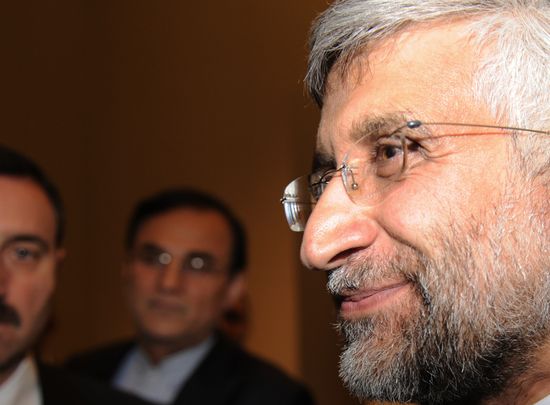
(Photo: Iran's chief nuclear negotiator Said Jalili leaves after a press conference, on April 14, 2012 as Iran and six world powers open talks on Tehran's disputed nuclear programme in Istanbul. By Bulent Kilic/AFP/Getty Images.)


Is S&M Anti-Feminist? Ctd

A reader writes:

I think when one asks that question, one must distinguish between consumers of S&M literature and practitioners of S&M. I mention that because at the local S&M club that we attend (in DC, btw) the number one rule is "women rule." Yes, women may be subs (submissives) and bottoms (those acted upon), but they call the shots regarding limits. Violating that rule is the fastest way to get thrown out of the club (if you're not beaten up by the other men first). Part of the "submissive head space" is surrendering control – but it's the sub's choice to surrender control, and the sub can break out of when whenever the sub wants (some call it "topping from the bottom").

Another shares her kink:

Despite being a feminist and having a lot of power in my professional and personal life, I do so love escaping with a good bodice ripper, complete with strong male leads who dominate (not S&M, mind you). I don't see anything contrary about it. People are complex. People want to be wanted. People want to relinquish control and relax. People want to have fantasies where they can pretend to be carefree in ways they know would be quite dangerous out in the real world.