Heave. Retch. Repeat.

Returning from my breather, the reality set in. It's Romney vs Obama and no amount of my Santorum scenarios, Palin panics, Gingrich giggles or Paul swoons can now disguise the fact. The dread I feel is partly knowing that Romney is not even excruciating enough to be amusing. We cling to Seamus as tightly as he clung to his car roof penthouse. Even the Togg, Tagg and Tigg sons, or whatever bland all-American name is affixed to each, cannot compete with Alaskan wonder of Tripp and Trig and Levi. And on top of this, a very boring man is nonetheless prepared to tell outrageous lies, repeat them proudly, and intensify the polarization of the country even further. So we have another red-blue war, led on one side by a total cynic.

And so the promise of Obama – an end to this pattern – was delusional, not so much because he didn't try or have the ability, but because the other side immediately decided that this epochal moment for the country, the first black president, was not a time to compromise and resolve some deep long-standing issues, specifically on taxation and spending. What might have been an integrating, reforming moment evaporated with zero Republican House votes on a desperately needed stimulus in the worst recession since the 1930s.

And so my heart sinks as I see Obama drifting to the left, offering the silly Buffett Rule instead of serious tax reform, and Romney tacks to the W-Cheney right, promising tax cuts, defense increases and drastic debt reduction, without providing any clue as to how this can be afforded.

So we are left with Hilary Rosen versus Ann Romney, on which MoDo has the best summary.

Heave. Retch. Repeat.

Is There An Autism Epidemic?

We can't be sure yet:

The earliest prevalence studies from 1966 to 1979 showed around 4-5 cases per 10,000 children in England and the USA. However the latest rates from the Center for Disease Control and Prevention showed 113 cases per 10,000 American children. … Let’s be clear that we don’t definitely know all the causes of the increasing numbers of children diagnosed with autism as a whole, or which of the underlying disease entities or subgroups are involved. Possibilities include expansion of the diagnostic criteria, greater awareness of autism by physicians and the public, secondary diagnoses added to individuals with intellectual disability, enhanced survival of preterm infants, older age of the parents, and as-yet-unproven environmental toxins. 

The Urban Forest

DC_Trees

New research quantifies the economic benefits of urban trees: 

Every tree in urban Tennessee provides an estimated $2.25 worth of measurable economic benefits every year. Might not seem like a lot, but with 284 million urban trees in the state, the payoff's pretty big. Through energy savings, air and water filtering and carbon storage, the urban trees of Tennessee account for more than $638 million in benefits, according to a report [PDF] conducted by the Forest Service of the U.S. Department of Agriculture and released earlier this year. 

The biggest savings are attributed to carbon storage, which the authors of the report value at an estimated $350 million. … The trees are credited with removing 27,100 tons of pollutants each year, including ozone, particulate matter, and sulfur dioxide. And because of the shading they provide, these urban trees are credited with saving about $66 million in energy costs annually.

Brad Plumer also points to the effect of trees on city home values.

(Photo: Cherry blossoms in full bloom on trees around the Tidal Basin March 22, 2012 in Washington, DC. By Karen Bleier/AFP/Getty Images)

Is The “Cohabitation Effect” Obsolete?

In the most-shared article in the NYT last weekend, psychologist Meg Jay warned couples against living together before marriage. Hanna Rosin rolls her eyes:

Jay trotted out the usual clichés about women looking at living together as a step toward marriage while men see it as a way of putting off commitment. And then to elevate her argument beyond anecdotal evidence, she cited the famous "cohabitation effect,” a sociological finding that couples who live together are more likely to get divorced. The idea is based on old research from the 1980s. Recently Wendy Manning [of Bowling Green] has analyzed couples married since 1996 and found that the cohabitation effect "has almost totally faded. We just can’t detect it anymore."

In the 1980s cohabitation was much less common, so it’s possible that people who did it were somewhat more experimental to begin with. But in the last 10 years, cohabitation has become the norm. Nearly 60 percent of women aged 25-39 have lived with a partner and the number among younger women is nearly 80 percent. So, knowing that the divorce rate is going down, and then doing the simple math, it can’t be true that all those couples are more likely to get divorced, can it?

Hanna insists that "the train wreck are the 15-20 percent of what sociologists call 'serial cohabitors.'"

Is “Texts From Drone” Funny?

Texts_Drone

Ari Kohen isn't laughing at the new tumblr:

I know, I know. It’s dark satire intended to hold a mirror up to our society. You’re laughing, sure, but you know deep down that you’re giving us some powerful, powerful stuff that’s really going to make us think twice about the role we’ve all played as citizens of this democracy, about how we’re all lying to ourselves, and about how libertarians are the only ones who really care about the suffering of others.

But you know what it really is? It’s pictures of injured children with jokes attached to it.

The author insists it's not supposed to be funny.

Why Is It So Hard To Catch A Cab?

A couple reasons:

They drive long hours for little money: the average cabdriver earns $27,060 a year, before expenses. They are at high risk for traffic accidents and, because they carry a lot of cash, for robbery. When drivers turn down fares to neighborhoods like mine, it’s not because they don’t want to miss a second of The Diane Rehm Show while they take my cash and make change. Those trips, where they probably won’t get a return fare, and must instead burn time and gas while the meter’s off, can mean the difference between profit and loss for the day; cabbies can’t afford too many of them.

The White Male’s Candidate Of Choice

Dem_margin

Romney can lose women and Latinos and still win:

Romney could … stop fretting about women voters entirely and hope to build up a 15-20 point lead among men. Bush stayed very close to Al Gore in 2000 – even though he lost women by 11 points. Romney actually tied Obama in a October 2011 nationwide poll, despite trailing by 14 points among women. Wherever Romney's likely deficit ends up among women voters, he can compensate for it among men.

The Least Walkable Cities

They lean Republican:

Look at the walkability map and you’ll see that unwalkable cities are concentrated in the South. While the northern United States developed an industrial economy, the South was dominated by agriculture until the last few decades. Whereas industry breeds density, immigration, and social mobility, agriculture requires vast plots of land and leads to an entrenched social order dominated by the large landowners. The historical perspective might help explain why cities such as Houston, which today is one of the nation’s largest ports and a magnet for immigration, remain relatively unwalkable.

The Daily Wrap

6a00d83451c45669e20168ea41c123970c-550wi

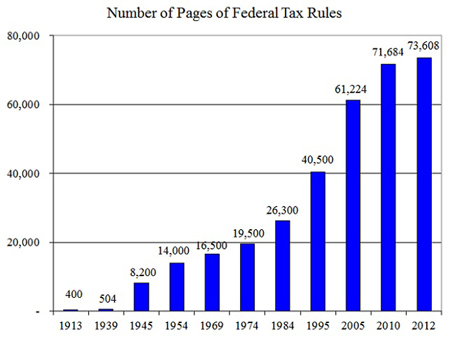
Today on the Dish, Andrew defended his view of the race's importance, aired more thoughts on Palin's viability, took Obama to task on the deficit and taxes, checked on the reality of government spending and the need for tax hikes, and labelled tax breaks "fundamentally unfair." Relatedly, since it was tax day, we gave you tips on filing, explained why the IRS didn't calculate them for you, and looked at dangerous tax loans. We also posted some rules for reading polling data, put Arizona on Obama's radar, wondered if Romney really could make a centrist move, broke down the fundamentally cautious character of modern campaigns, met the "teavangelical" candidate for Congress, listened to readers on Jennifer Rubin and W.'s biggest mistake, traced the individual mandate back to George Washington, questioned whether the Secret Service had gotten out of control, and read Biden's lips (badly). Ad War Updates here and here.

Andrew also shared his (highly positive) childhood history with IQ measurement, lost faith in a two-state solution, and reexamined the Iran strike countdown. Bibi was vulnerable in the upcoming election and Iran attacked filmmaking. We debated S&M and feminism, spotlighted an extraordinarily effective form of birth control, continued the gyms and health discussion, put the George Zimmerman trial in a broader context, and noted some nepotism. Idealist depictions of politics went out of style, music had extraordinary powers, science decoded old book smell, and blogs prospered. Ask Jennifer Rubin Anything here, Hewitt Award Nominee here, Chart of the Day here, VFYW Contest Winner here, VFYW here, MHB here, and FOTD here.

Z.B.

“We Cater To The Hood”

Ral

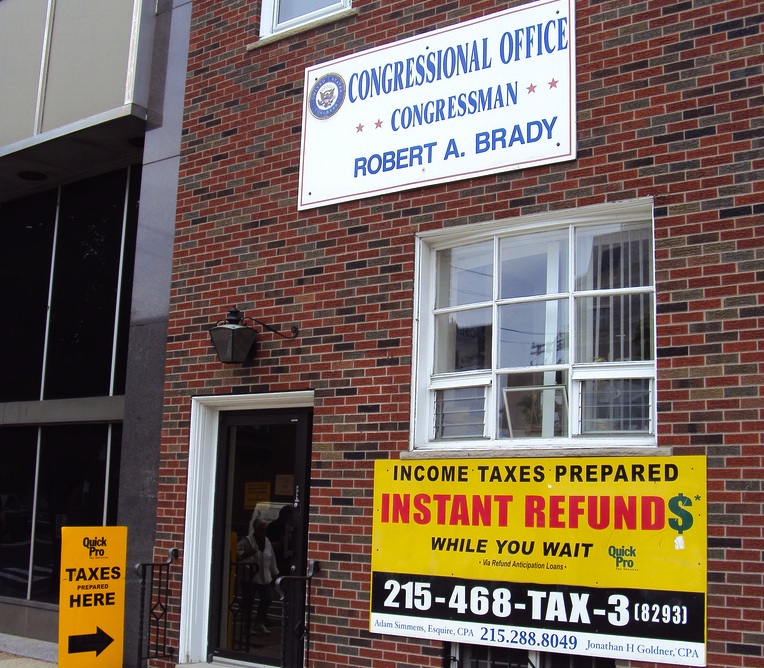
The Aughts were a big decade for tax refund anticipation loans, geared towards lower income clientele:

Customers wanting a RAL [refund anticipation loan] paid [the company] Jackson Hewitt a $24 application fee, a $25 processing fee, and a $2 electronic-filing fee, plus 4 percent of the loan amount. On a $2,000 refund, that meant $131 in charges—equivalent to an annual interest rate of about 170 percent—not to mention the few hundred bucks you might spend for tax preparation. "Essentially, they're charging people triple-digit interest rates to borrow their own money," says Chi Chi Wu, a staff attorney at the National Consumer Law Center.

Regulators are finally cracking down.

(Photo: "Refund Anticipation Loans and a Local Congressman – Broad Street in Philadelphia, PA" by Flickr user Paul Saberman)