Ad War Update

The DNC calls attention to Romney's "penchant for secrecy": 

MoveOn.org celebrates the Buffett Rule:

Previous Ad War Updates: Apr 16Apr 13Apr 11Apr 10Apr 9Apr 5Apr 4Apr 3Apr 2Mar 30Mar 27Mar 26Mar 23Mar 22Mar 21Mar 20Mar 19Mar 16Mar 15Mar 14Mar 13Mar 12Mar 9Mar 8Mar 7Mar 6Mar 5Mar 2Mar 1Feb 29Feb 28Feb 27Feb 23Feb 22Feb 21, Feb 17, Feb 16, Feb 15, Feb 14, Feb 13, Feb 9, Feb 8, Feb 7, Feb 6, Feb 3, Feb 2, Feb 1, Jan 30, Jan 29, Jan 27, Jan 26, Jan 25, Jan 24, Jan 22, Jan 20, Jan 19, Jan 18, Jan 17, Jan 16 and Jan 12.

To See What Is In Front Of One’s Nose …

Goldblog now moves the possible date for a unilateral war on Iran by Israel to June of this year. Fred Kaplan suggests the rationale:

If the Israelis really are intent on attacking the Iranian nuclear facilities, they’re likely to do so before this November’s American presidential elections. If they started an attack and needed U.S. firepower to help them complete the task, Barack Obama might open himself up to perilous political attacks—for being indecisive, weak, appeasing, anti-Israel, you name it—if he didn’t follow through. It could cost him the votes of crucial constituencies. If the Israelis tried to pressure the United States into joining an attack after the election, Obama would have (to borrow a phrase from another context) more flexibility. So, to the extent the Israeli leaders have decided to attack (and it’s not at all clear they have), they are probably thinking: much better sooner than later.

Note that this simply implies that a foreign government would be relying on US domestic pressure to force the US administration to join a war it did not seek. I'm not sure what that is, but "alliance" is not the correct word.

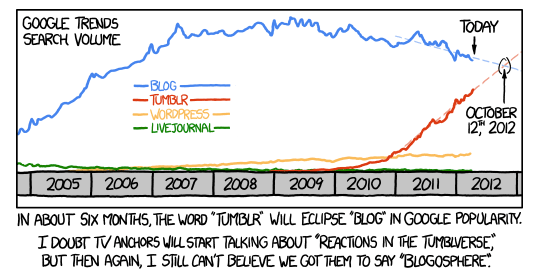
Believing In The Blog

Screen shot 2012-04-16 at 11.17.33 AM

Nine years ago, Phil Gyford started putting Samuel Pepys' 1660 London diary online, with each day's post corresponding to the same day's entry. Russell Davies celebrates the project, which will end on May 31, the last entry Pepys wrote in 1669: 

From the start it was clear that Pepysdiary.com meant something. Clay Shirky said in 2003, talking about the emergence of blogs: "The vertigo moment for me was when Phil Gyford launched the Pepys weblog… What that said to me was: Phil was asserting, and I now believe, that weblogs will be around for at least ten years, because that's how long Pepys kept a diary. And that was this moment of projecting into the future: this is now infrastructure we can take for granted." In some worlds ten years isn't very long: it's not if you're digging an undersea tunnel or discovering a cure for disease. But in the busy, silly world of early 21st-century media, making a ten-year assertion was a big deal — something akin to the Clock of the Long Now.

But the next ten years?

(Graph by xkcd)

Why Doesn’t The IRS Do Your Taxes For You?

Yglesias's answer:

[F]or the vast majority of the population, most of the pain of tax compliance could be eliminated by a few keystrokes at IRS headquarters. So why don’t we do it? Two reasons. One is lobbying by the tax preparation industry to discourage states and the feds from developing easier tax-paying systems, as California recently did. The second is lobbying by anti-tax conservatives. When the Golden State implemented its ReadyReturn system, it did so over the objections of Grover Norquist and his anti-tax pressure group Americans for Tax Reform, which fears that if taxes become less annoying voters might be less unhappy about paying them.

Face Of The Day

GT_FACE-TAX-PROTEST_120417

A protestor wears stickers on his face during a tax day demonstration in front of the James A. Farley Post Office on April 17, 2012 in New York City. Dozens of protesters participated in a demonstration against loopholes that allow banks and corporations to pay lower income taxes than most individual tax filers. Similar rallies were held across the city throuhgout the day. By Justin Sullivan/Getty Image.

Getting Your Tubes Filled

Jon Clinkenbeard urges more people to pay attention to what he calls "the best birth control in the world":

If I were going to describe the perfect contraceptive, it would go something like this: no babies, no latex, no daily pill to remember, no hormones to interfere with mood or sex drive, no negative health effects whatsoever, and 100 percent effectiveness. The funny thing is, something like that currently exists. The procedure called RISUG in India (reversible inhibition of sperm under guidance) takes about 15 minutes with a doctor, is effective after about three days, and lasts for 10 or more years.

A doctor applies some local anesthetic, makes a small pinhole in the base of the scrotum, reaches in with a pair of very thin forceps, and pulls out the small white vas deferens tube. Then, the doctor injects the polymer gel (called Vasalgel here in the US), pushes the vas deferens back inside, repeats the process for the other vas deferens, puts a Band-Aid over the small hole, and the man is on his way. If this all sounds incredibly simple and inexpensive, that’s because it is. The chemicals themselves cost less than the syringe used to administer them.

Eleanor Ray questions why there hasn't been more progress in the US:

Female humans have been presented with lots of ways to prevent the S from getting to the E and making the B, whether it be taking crazy hormones (mine make me menstruate only every six months, and throw up immediately if I try to smoke a cigarette), more rubber bits, intensive scheduling, or passing pieces of copper through their cervixes. Hilariously, the closest the RISUG people have gotten to international validation is a "$100,000 Gates Foundation grant to pursue a variation of RISUG in the fallopian tubes as a female contraceptive." WHY WOULD YOU DO THAT? 

There's now a petition to get the procedure funded here in the States.
The Magic Of Music

It can spring to life patients with severe dementia:

The Week rounds up research associated with the wildly popular video:

"Music imprints itself on the brain deeper than any other human experience," says renowned neurologist Oliver Sacks, who appears in the film. Pairing music with everyday tasks such as having a brief chat or taking medicine can help patients develop a rhythm they can use later to recall the memory of that conversation or medicine. But it's not just patterns and rhythms — music also taps into the brain's emotional centers. "Music evokes emotion, and emotion can bring with it memory… it brings back the feeling of life when nothing else can," says Sacks.

Tax Filing Tips

Some helpful advice for superheroes and citizens alike:

Unless you are indestructible/immune to all harm… or else the kind of absurdly wealthy superhero who has a live-in physician (or personal gentleman with field medical training) on staff—or you, yourself, are styled Doctor [Something]—you probably spend no small amount of time in hospitals, or at least at ambulatory clinics, getting stitches and tetanus shots and generally being put back together and readied to return to the streets. Save your receipts. Your medical—and dental—expenses are deductible, though only in the amount by which your total expenses for the year exceeds 7.5 percent of your AGI. Still, that’s nothing to sneeze at, even if you are the kind of superhero who doesn’t ever sneeze because you are invulnerable to germs.

Is The Secret Service Out Of Control?

Amy Davidson reflects on the recent prostitution scandal. Jacob Heilbrunn suggests it points to a culture of corruption at the agency: 

The best way to think about the Secret Service is to realize that its name is bogus. It isn't secret. Instead, it's like any other government agency intent on maximizing its influence, reach and numbers. It can always dream up new threats that it needs to address. Congress has pretty much signed off on anything the agency wants. Why not subject the Secret Service to the scrutiny that other government agencies are now receiving? 

Ambinder is more sympathetic:

The Service can be arrogant when it comes to aspects of its protective mission, but has always exuded a sense of humility about itself. It does not have, like the FBI and CIA, any employee dedicated to working with Hollywood producers. It rarely gives reporters access to even its least sensitive operations. It does not leak, a rarity in Washington. 

Humility and discretion clearly went missing in Cartegena, in a serious lapse for the Secret Service. But the lapse did not occur amongst those who protect the president most closely, and so the ultimate damage done to the Service will probably prove to be lighter than it seems today.

Earlier Dish on the president's trip here