Are Tax Breaks Fundamentally Unfair?

Tax_Rules

In my view, tax breaks are a function of various impulses: special interest lobbying, and the desire of politicians to do something about something by lowering the tax on it. The result is not a market economy, but an insanely complex, government-manipulated pseudo-market. And I see no way to really tackle it than a complete abandonment of all tax breaks, except for charity. Alex Brill notes the result:

When some millionaires don’t pay income taxes, it irks both the less well-off who pay hundreds or thousands of dollars in taxes annually and the millionaires who pay hundreds of thousands of dollars in income tax. Similarly, a typical taxpayer with an income between $75,000 and $100,000 should be miffed that nearly half a million others with the same income avoid income taxes completely. It is more shocking to hear of millionaires who pay no income taxes, but both situations raise legitimate questions of fairness.

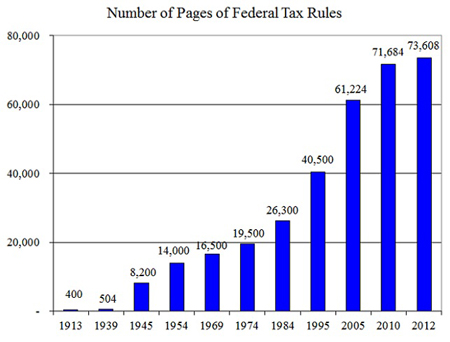
The tax system we have is what one would expect of an oligarchy, not a democracy. It generates profound cynicism about government, it entrenches the rich while decimating the middle class, and it distorts market efficiency. Chart from Chris Edwards, who goes further:

All the different rates, deductions, credits and exemptions under the income tax create huge violations of the principle of equality under the law. For example, high earners typically pay a much higher share of their income in federal income taxes than do other Americans — despite President Obama's claims. IRS data show that households earning more than $1 million annually pay about 25 percent of their income in federal income taxes, on average, which is more than double the average rate paid by middle-income households.

Of course, historically the tax rate on the rich is very low, as Ezra Klein makes clear. His larger point:

[W]hen economists think about the role taxes play in a person’s decision to work, they think about two things. There’s the “substitution effect,” where higher tax rates make you work less, because you keep less of every extra dollar you earn. But there’s also the “income effect,” in which higher tax rates make you work more, because you need to earn more to be able to live how you want to live, or retire when you want to retire. The question is, which dominates?

Relatedly, Derek Thompson rounds up 11 tax charts.

Can Bibi Be Beaten?

Bernard Avishai forecasts Israel's upcoming election:

The first thing to say is that Netanyahu is, in spite of his lead in the polls, vulnerable. The parties of Global Israel—Labor, Kadima, Yair Lapid’s new center list, Meretz, etc.—lack an obvious leader just now (except for the perennial figurehead, Shimon Peres). But they are held together by a mounting and widely shared fear that the two-state solution is slipping away; fear of new and catastrophic political isolation owing to Netanyahu’s ideology and recklessness. Educated Israelis fear losing advantages in global commercial networks that depend so much on personal connections, including visits to Israel. They fear cultural boycott. This kind of thing can trickle down.

His view of Obama's influence on the race:

What can Obama do? Actually, he’s already done it. First, he has to look like he can win. The mere plausibility of an Obama victory will prompt low-grade panic among middle class Israelis, political analysts, etc., about Netanyahu’s past efforts to play him. Second, Obama must keep doing what he’s been doing on Iran. Netanyahu’s trump card is the Iranian threat. Many assumed he had cornered Obama, leaving him no choice but to “finish the job” if, as the American election approached, Israel attacked Iran unilaterally. But Obama slipped Netanyahu’s trap and pretty much put Netanyahu in one of his own.

Does It Matter Who Wins In November? Ctd

Countering me, Mataconis bets that Romney's foreign policy would resemble Obama's:

Leaving aside the ideological points [Romney] continues to score with his rhetoric regarding Iran, it’s worth noting that Romney is not privy to the intelligence briefings that the President receives, nor the advice of the nation’s top military commanders. Assuming he’s elected President, one of the first things that will happen will be a full intelligence briefing. When that happened to Barack Obama in November 2008, several commentators noted that he seemed suddenly subdued and that his comments about foreign policy began to take on a new light. That would be called the light of reality. If he’s elected President, Mitt Romney will see that light too, and we’ll find that things won’t change nearly as much as some people fear.

Steven Taylor differs. My fear is that this is a man who backed torture, who wanted to "double Gitmo", whose belief in America's divine destiny has Mormonism to back it up, who was best buds with Netanyahu, who believes that Russia is our "number one foe", who wants a big increase in defense spending, and who promises a war on Iran. That's what we have on the table versus Mataconis' feeling that Romney would turn to pragmatism in office, as the weight of the office and the permanent interests of the US sink in.

It's possible – just as it was possible for George W. Bush to go from a "humble" foreign policy to the eradication of tyranny from the face of the earth. But I have learned a lot about the enormous pull of the military-industrial complex and the almost accountability-free CIA from the last decade, and none of it makes me feel comfortable about Romney's neocons storming the barricades once again.

The Cautious Candidates

Adam Sorensen reflects on a campaign marked by tentativeness and inhibition: 

This is what the modern presidential campaign requires. Every semi-public utterance will find its way into the news; every available scrap of personal history will worm its way to daylight. That’s why we end up with candidates like Romney and Obama, men of catalog-perfect families, immaculate pasts and abundant political caution. There will be lapses: Obama recently had an overly earnest exchange with Russia’s Dmitry Medvedev on a hot mic. But Romney’s weekend fundraiser barely counts. Even behind the garden wall, he’s careful.

Is S&M Anti-Feminist?

Newsweek_Cover_Crop

On the cover of Newsweek, Katie Roiphe considers what the wildly popular erotic novel Fifty Shades of Grey says about the modern woman:

It is perhaps inconvenient for feminism that the erotic imagination does not submit to politics, or even changing demographic realities; it doesn’t care about The End of Men or peruse feminist blogs in its spare time; it doesn’t remember the hard work and dedication of the suffragettes and assorted other picket-sign wavers. The incandescent fantasy of being dominated or overcome by a man shows no sign of vanishing with equal pay for equal work, and may in fact gain in intensity and take new, inventive—or in the case of Fifty Shades of Grey, not so inventive—forms.

Dana Goldstein pushes back:

Sadomasochism is problematic if one partner is doing it just to please the other and feels hurt by it. But I don't think truly consensual S&M complicates women's demands for full equality, or provides evidence of some anti-feminist backlash among the urban educated class that is consuming work like "Girls," "Secretary" and Fifty Shades of Grey. Because many women now assume a certain level of egalitarianism at work and at home, they feel more comfortable experimenting sexually.

Could Palin Have Beaten Romney? Ctd

Like Douthat, Millman suspects that Palin would have flamed out:

No, Palin doesn’t have a special bond with her supporters; she was just the vehicle of the moment, and a particularly potent one, for the moment. Had she run, and proved to be a terrible candidate – compared to Republican rivals, not compared to a hated Democrat – her supporters would have reluctantly moved on. They abandoned Herman Cain; they would have abandoned her. They might love her, but they wouldn’t want to lose with her.

Larison agrees. But what Palin does is polarize and ignite. If she had run an insurgent Tea Party campaign against Romney, she might have taken off as a base protest candidate. She was the previous veep candidate after all. Her real problem? Debates. They proved rather critical in shaping this primary race and her know-nothingness might even have dimmed her star among the proudest know-nothings. But we'll never know. Which, as Martha Stewart would say, is a good thing.

Reading Biden’s Lips

Badly:

Allahpundit puzzles all the sex jokes:

Unless I’m forgetting something, he’s never had a sex scandal. I think it’s more a function of his persona: The hair plugs plus the slightly unctuous easy charm, replete with occasional use of lingo like “man” to punctuate his thoughts. (“If you like your plan, you can keep your plan, man.”) He’s got the superficial attributes of an aging bachelor who’s still on the prowl, even though of course he’s not. 

Beinart Unbowed

The NYT Jonathan Rosen review of The Crisis of Zionism attained a kind of Platonic ideal of the response of the American Jewish Establishment. The first and most important principle of that Establishment is that the settlements are not to be discussed, mentioned, debated or wrangled over at any length. I cannot count the number of friends who over the years have quickly conceded that they do not support the settlements, and then move briskly on to another distraction. Rosen follows this party line exactly – even when reviewing a book focused precisely on such settlements, and even as half a million settlers now sit on illegally occupied land. Peter makes the obvious counter-point:

Most fundamentally of all, Rosen ignores my contention that by holding millions of West Bank Palestinians as non-citizens, and building settlements that eat away at the possibility of a viable Palestinian state, Israel is imperiling its democratic character. That simple, and unoriginal, fear lies at heart of The Crisis of Zionism. Does Rosen share it? He never lets on because in addition to persistently ignoring the specific factual claims in my book, he ignores the book’s central argument.

And then lards up the review with smears, untruths and a complete absence of any quotations. The notion that Beinart ignores the standard and fair criticisms of past Palestinian leaders is simply wrong, as any reader will see. Yes, he presses the case that the Israelis and their American patrons have recently led the Jewish state into a dead end – but his book is an argument, not a history. He lacerates one side – persuasively, I might add – but doesn't excuse the other.

I have to say it was great to have a break from all of this for a few days. Because when you step back a little from the fray, you see, I think, how pointless it is close to becoming. I simply cannot see a two-state solution any longer, given what we have learned about where Israeli and US politics are heading. Obama was the last train from the station. He may push again if he gets a second term, but he knows he cannot win. The Christianists, neocons and Democratic Israel fanatics are far stronger than any president. Romney, for his part, would put the settlements on steroids, and re-open a hot religious global war by attacking Iran. The real shift in US policy toward Israel has been the embrace of the settlements by the Christianist base of the GOP over the last decade and their continuing power. The real development is the fusion of Jewish and Christian fundamentalism around the cause of Greater Israel.

Which means to say that a democratic Israel is living on borrowed time. And Peter's book will one day be seen as one lone protest, a marker that not everyone acquiesced in Israel's degeneration, not everyone put blinders on. Just most.