Justice For Everyone, Not Just Trayvon

After reading the opinions of various people "who study or practice criminal law," Balko fears that the  Zimmerman indictment was about politics more than evidence:

I've read in several places the proposition that if the races had been reversed that night in Sanford, Trayvon Martin would have spent the last month awaiting his murder trial from a jail cell. I think there's plenty of history to support that sentiment. But we can't hang all of the inequities of the criminal justice system on George Zimmerman. He deserves to be tried only on the facts specific to his case. Even gung-ho, wannabe cops deserve due process, and a fair crack at justice.

TNC largely agrees.

Obama And The Debt

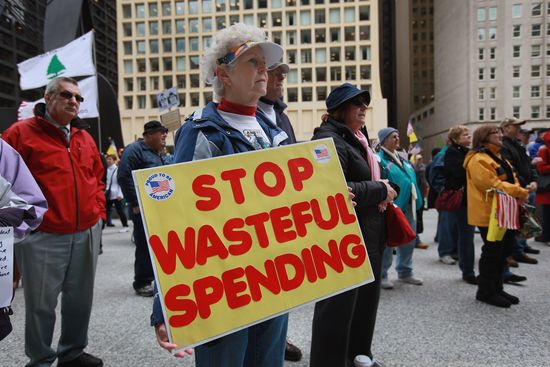
Spending:scottolson:getty

Like David Brooks, I feel whip-sawed a lot of the time. The gamble of Obama's re-election message seems so far to be a mix of personal popularity and tax fairness. I can see the logic of this. Obama is hated by a resilient part of the population, but pretty well liked as a human being by many. As the CNN poll yesterday showed, he has real strengths but one obvious weakness:

Obama has double-digit leads over Romney on likeability, honesty, confidence, values, leadership and almost every other characteristic tested, with one important exception."Obama and Romney are essentially tied on who is more likely to get the economy moving again, and that may provide Romney an opening to chip away at Obama's current overall lead," says Holland.

And my view is that worries about the economy may not be assuaged by tepid, sustained growth this year alone. Obama hasn't gotten into my head yet how he plans to stabilize the debt or reform taxes. And yet both those issues seem to me to be crucial to seeing where Obama wants to take us. Here's what David Brooks has learned:

During Obama’s presidency, domestic spending topped out at 4 percent of G.D.P. But, in the Obama budget, over the next 10 years, that spending would fall to 2.2 percent, much lower than anything Reagan achieved … Annual federal deficits, which are at about 8 percent now, would come down to around 3 percent between 2015 and 2022. The total federal debt is now at about 74 percent of G.D.P. Under Obama’s plan, it would rise to 78.4 percent of G.D.P. in 2014 and then stabilize at about 76.5 percent from 2018 to 2022.

Basically, what we’re looking at is a period of stability, administration officials say, which would soothe credit markets and give us time to make further adjustments. This, they conclude, is responsible prudence.

There is indeed responsible prudence in this, as there was prudence in avoiding the debt trap that premature and excessive austerity has brought to Europe. But to present a budget proposal that never sees a balanced budget over a decade means the debt will grow and grow, unless it is inflated away. And at this moment in US history, we are facing a huge fiscal drain from the baby boom retirement. If anything, we should be running surpluses now.

The gap between Obama's plans and this reality unsettles me. I look at Romney and see much, much more debt – because of his massive defense increases, even further tax cutting, and refusal to specify which deductions will be ended to pay for it, and the political implausibility of the massive cuts to Medicare and Medicaid that he needs to keep the debt from spiraling.

But that shouldn't let Obama off the hook.

The president says he wants tax reform and debt reduction but is still playing politics in pushing the GOP out front on the issues. He may regret it. If he cannot show how he will cut the debt, not just slow its exponential growth, and if he cannot embrace a simpler, clearer tax system, he is ceding two central issues to the GOP. He may get away with it. But he once offered something more.

(Photo: Scott Olson/Getty)

Nepotism Watch

A priceless quote from a piece about the absurd spectacle of hiring a journalist just because she is a former president's daughter:

Chelsea [Clinton] just renewed her original three-month contract, but there isn’t much to show for it. "Almost nothing," is how one well-placed industry observer describes her tenure at NBC. The industry observer, who has had dealings with Team Chelsea, continues: "Certainly she’s not operating as a reporter. You need a regular presence to become established and break through. Yes, she has world wide name recognition at a young age, but you still have to do the work and show up on screen."

The View From Your Window Contest: Winner #98

Vfyw_4-13

A reader writes:

Was that picture taken in Alexandria, VA, just southwest of Old Town from the booming Carlyle/Eisenhower Avenue neighborhood? If I had to guess, I'd say the picture was taken through a window from within the US Patent and Trade Office (or one of the many nearby condo complexes), given the apparent height of the shot. It looks like I can see the George Washington Masonic Temple in the background.

Another writes:

The storefronts and style of buildings, the quality of the lighting, the hills in stretching up in the background, and the minaret (I think?) remind me of central Amman, Jordan. No idea whereabouts. The buildings stretching up and down the hills make Amman particularly beautiful at night.

Another also guesses Amman:

If it is, you're likely to have 500 guesses – and the location is likely easy, but I'm sure by now someone has gotten it right.

The number of entries was actually closer to 25 – the lowest ever, making this contest one of the most difficult yet. Another reader:

Paris! My mom live is one those high rises, the few built within the city limits in the '70s. It's next to Jaures metro in the 19th.

Another:

Valencia, Spain? Sometimes you just have to guess.  It looks European and southern, since the trees have full foliage. The church steeple could be Spanish.  But really, I'm just guessing.

Good guess – correct country. Another nails the right city:

Bilbao, Spain! I recognize that cathedral and adjacent apartment blocks. My wife and I were there last April, to celebrate our anniversary. We met quite near where I think this picture was taken – I remember there being quite a few foreigners around, as well, for a city with tons of local flavor. I also remember babies, being held aloft to poop in forsaken plots of land, as we traversed the lolling city blocks in search of a ferret shop. We had heard that Bilbao was good for ferret shopping, but actually we never found one! Anyway, if that isn't Bilbao, poo poo.

Another sends an aerial image:
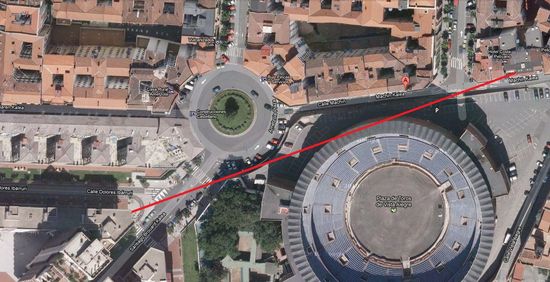
VFYW1

Another reader:

For me the key clue was the little red painted ad on the wall, which looked like a Dia supermarket. Other parts of the image said Spain, and then I realized the building center right was the city's bullring.  And since not that many Spanish cities have big buildings, I knew it was a bigger city.  So I stated image searching for particular bullrings, and this one looks like Bilbao's.  It has what appear to be crests or coats of arms on the white panels.

Another:

I recognized this instantaneously. Even though I only wandered past the bullring once while visiting Bilbao, it was just obvious right away. And I was also only there for a night – odd. But there was something distinctive about Bilbao, and all of Basque country in general. An awesome place.

Another:

Well, I've been living abroad for more than 16 years now and I must confess that it took me a while to recognize my hometown, Bilbao, the biggest city in the Basque Country, Spain. Here we're just overlooking Vista Alegre Arena, the city's bullring, which was built in 1882 and where Ernest Hemingway found some inspiration. I am not much of an aficionado (bullfighting fan) myself. For me, being there once was more than enough. Precisely identifying the street and number is going to be more difficult, though, because there have been a lot of new developments in that area recently. I'll go for the Santiago Brouard Street, near the Amézola Square.

Correct street. The winner was the only reader to guess the exact window:

Winner

This is looking out on to the Plaza de Toros de Vista Alegre from the building on the corner of Calle de Santiago Brouard and Calle Dolores Ibárruri in Bilbao, Spain. The building in the immediate foreground is circular, and screams, "arena".  And it appears open-air and small.  I couldn't get bullfighting ring out of my head despite having no experience or interest in it beyond reading Hemingway.  This thought persisted despite it not matching anything that came up on Google images.  Wikipedia came to the rescue with a list of "Bullrings of the world". Luckily I only had to go to the fifth one on the list.  It is actively used for bullfighting, and in the summer of 2010, 54 bulls were killed in Bilbao.

Details from the submitter:

The very top left window, the 6th European floor or the 7th American floor (they consider the ground floor 0, not 1).

Last semester I was studying abroad in Bilbao, Spain, living in a homestay with a pretty odd 44-year-old single guy. He had a nice place, listened to good music, and fed me well, but was really closed minded and hated the internet for some reason.  He was also really into organic food and every week his brother would come by and deliver us fresh vegetables from their dad's garden, so that was nice, me being a nutrition major and all.

I was basically there to learn Spanish quick-like and to have an adventure. I studied at the University of Deusto, which is pretty big on international exchanges, and it was used to helping international students like me with whatever I had trouble with (lots of things, because I didn't speak Spanish very well when I arrived.) I had some early classes, hence the picture of the sun rising over the bull ring there, but overall enjoyed Bilbao despite its smelliness (it's a pretty industrial place even though the government is trying to make it greener, it used to be a huge commercial port, but where the docks used to be is now the Guggenheim and a park).

One more entry:

I am a proud winner of the contest about a year ago (Cullera, Spain), so I am not really trying to get my entry into the contest this time.

Still, I could not refrain from writing to you, since the picture is from the city where I was born and raised. It took me about two seconds to think "Spain" and then about twenty more seconds to realise it was actually Bilbao. It is funny how every time you include an image from urban Spain, either for the contest or the daily VFYW section, it has some difficult to describe air of familiarity. The same happens to me with Italy (the picture the other day from Rome was also crying out "Italy" before I read the caption). I guess people from other countries have the same kind of impressions when they see their cities.

What we see in the picture is sunrise at the Plaza Ametzola, with the Vista Alegre Bullring to the right and the white towers at Plaza Zabalburu in the back. My guess is that it was taken from the sixth or seventh floor of the building at the corner of the streets of  Santiago Brouard  and Dolores Ibarruri (Kalea is Basque for "calle", i.e. street, as you may have imagined).

Bullfighting is quite popular in Bilbao, with corridas being part of the programme of the Semana Grande (or Aste Nagusia, in Basque), the week-long fiesta that takes place every year at the end of August. There are also many people who dislike them, of course, not only for humanitarian reasons, but also for their association with Spain, and particularly Andalusia and Southern Spain, with all its associated stereotypes of backwardness, conservatism, poverty, dependence on welfare.

For the time being the enemies of bullfighting have not been very vocal in the Basque Country, but in Catalonia, as you may know, bullfighting has been recently outlawed, with a lot of controversy in other parts of Spain. The new conservative government in Madrid has actually made some noise in the direction of fixing this with some kind of regulation from the central government, giving bullfighting some kind of "cultural good" protection. This would certainly create a row in Catalonia, so I hope Rajoy is clever to let things stay the way they are now. We have enough problems. 

Ok. Enough. Thank you for posting the picture from Bilbao. It was fun.

P.S. I hope you do not mind that I made a click on the Facebook "I like it" button, so I may have prompted some not regular readers (some of them from Bilbao) to see the picture. Maybe some of them decide to participate, which I am not quite sure that fits the purpose of the contest. But I hope they won't.

(Archive)
George Washington’s Health Insurance Individual Mandate

Mitt Romney and Barack Obama have an illustrious predecessor

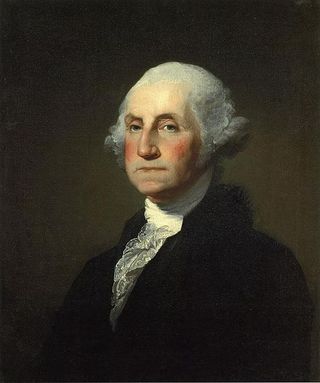
In 1790, the very first Congress—which incidentally included 20 framers—passed a law that included a mandate: namely, a requirement that ship owners buy medical insurance 501px-Gilbert_Stuart_Williamstown_Portrait_of_George_Washingtonfor their seamen. This law was then signed by another framer: President George Washington. That’s right, the father of our country had no difficulty imposing a health insurance mandate. 

That’s not all. In 1792, a Congress with 17 framers passed another statute that required all able-bodied men to buy firearms. Yes, we used to have not only a right to bear arms, but a federal duty to buy them. Four framers voted against this bill, but the others did not, and it was also signed by Washington. Some tried to repeal this gun purchase mandate on the grounds it was too onerous, but only one framer voted to repeal it.

Six years later, in 1798, Congress addressed the problem that the employer mandate to buy medical insurance for seamen covered drugs and physician services but not hospital stays. And you know what this Congress, with five framers serving in it, did? It enacted a federal law requiring the seamen to buy hospital insurance for themselves. That’s right, Congress enacted an individual mandate requiring the purchase of health insurance. And this act was signed by another founder, President John Adams. 

Meanwhile, a conservative law professor explains why the Obamacare mandate "passes constitutional muster" here

Can Romney Tack To The Center?

Perhaps not:

For conservatives, the basic appeal of Bush was that he’d be their own Clinton – someone with similar charm and charisma who’d finally be able to deflect the Democratic attacks. They didn’t want him straying too far ideologically, but they were more than happy to give him a lot of room to roam.

Today’s conservatives aren’t looking for another Clinton. They haven’t faced a humbling defeat at Obama’s hands (not yet, at least), and they believe adamantly that rigid adherence to their ideology is a winning national strategy. This doesn’t mean Romney won’t try to distance himself, but if he does, he’ll face a much fiercer backlash than Bush ever did.

Starting with immigration. Watching him move from his primary position is going to be fascinating. It's odd but Romney seems both the most protean and yet most rigid of politicians. My bet is that he remains a captive of a party intent on radicalism at home and abroad. And he will aim to please them.

What Was W’s Biggest Mistake? Ctd

A reader writes:

What does it say about the narrowness of Jennifer Rubin's worldview that she identifies GWB's biggest mistakes as ones that damaged him or the Republican party politically and not ones that had significant impact on the American people or the world?  How about ignoring the memo that alerted him to an imminent terrorist attack?  Interesting that the one mistake involving the war in Iraq that Rubin names is Bush's failure to respond to "accusations" that he lied about the existence of WMDs.  The problem is, he did actually lie about several things related to WMDs.  He lied about yellowcake uranium.  He lied about the intelligence that said there were no WMDs.  And he lied about the connections between Saddam Hussein and Osama bin Laden. 

His intelligence officers contemporaneously knew that there was no yellowcake uranium and  that there were no such connections even as he made those claims, in case Ms. Rubin doesn't recall.  Was it not a serious mistake that he lied to the American public about the reasons for going to war?  Was it not a serious mistake that he had no strategy for winning the war?  Was it not a serious mistake that he sent in troops who were significantly under-resourced?  Was it not a serious mistake that he essentially abandoned the hunt for a dangerous-but-difficult-to-get enemy in exchange for going after a powerless-but easy-to-get target?

One can identify mistakes that any president – or virtually any person – made without tarnishing his integrity or moral character, if one is squeamish about raising those questions, but Rubin instead acts as if those decisions didn't exist, that they were mere inevitabilities. 

Seriously? Rubin's argument for GWB's "mistakes" is akin to saying that Pope John Paul II's biggest mistake was failing to effectively refute the claims of those who suffered abuse at the hands of his priests, not in presiding over a hierarchy that systematically protected the abusers and hid the truth.

Why So Many Wheat Allergies?

800px-Wheat_blue_sky2

It really is fascinating watching the gluten-free world expand and expand. I feel enormously better since giving up flour. A possible culprit: the wheat we're eating today is a fairly recent invention:

[M]odern wheat remained essentially the same until the mid-twentieth century, when the International Maize and Wheat Improvement Center (IMWIC) and other wheat research centers set out to combat world hunger. Over the following decades, thousands of new varieties were created to dramatically increase yields. … 

[William Davis, author of Wheat Belly] writes, “The oversight in the flurry of breeding activity, such as that conducted at IMWIC, was that, despite dramatic changes in the genetic makeup of wheat and other crops, no animal or human safety testing was conducted on the new genetic strains that were created. So intent were the efforts to increase yield, so confident were plant geneticists that hybridization yielded safe products for human consumption, so urgent was the cause of world hunger, that these products of agricultural research were released into the food supply without human safety concerns being part of the equation.”

(Hat tip: Suzanne Lindgren)