A Very American Disease

Erin Fitzgerald explores what it's like to have Type 2 diabetes in a country where over a third of the population is pre-diabetic:

I’ve spent some time trying to come up with a new name for type 2 diabetes. It hasn’t been easy. … My current favorite name for type 2 diabetes is Six Years Off. That’s how much an average Type 2 diabetic’s lifespan is shortened, according to this study. But that, understandably, creeps some people out. So until this gets dealt with by a UN committee, I mostly call Type 2 diabetes The Reason I Don’t Eat Your Blueberry Muffins, Even Though You Have Assured Me They Are Healthy.

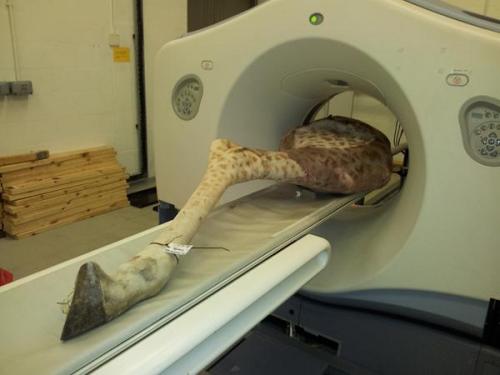
How You Give A Giraffe A CT Scan

One body part at a time:

Giraffe-leg-ct

Zoologist John Hutchinson dissects nature's biggest beasts for the British show "Inside Nature's Giants":

Hutchinson has a job that is centered around the frozen carcasses of all manner of strange (and usually rather large) creatures. His research is all about the evolution and mechanics of motion. He studies living animals, both through dissection and 3D modeling, and he tries to use that data to better understand how extinct animals—including dinosaurs—might have moved around.

At his blog, What's In John's Freezer?, Hutchinson explains the above image, along with some other stunning (if gruesome) shots:

This specimen died in a UK zoo recently, apparently from trauma (falling?), which we’re trying to help them figure out in the course of our scans dissections. We often provide a pretty detailed postmortem service in return for being given cadavers, since we are a vet school with a lot of expertise in pathology and anatomy. Also, we have been describing the kinds of pathologies we observe along the way, because terribly little is known about some diseases/injuries in non-domestic animals, so there is plenty we can contribute to the scientific literature as a result.

Community Colleges Are Failing?

A new report suggests as much:

Fewer than half (46%) of students who enter community colleges with the goal of earning a degree or certificate have attained that goal, transferred to a baccalaureate institution, or are still enrolled 6 years later. The rates, unfortunately, are lower for Hispanic, Black, Native American, and low-income students. Nearly half of all community college students entering in the fall term drop out before the second fall term begins.

Kay Steiger sounds off:

Community colleges aren’t just the B squad anymore. For a lot of people, particularly low-income people and students of color, they’re a first choice. Publicly funded two-year institutions need to figure out a better way to serve these communities, or those groups will simply turn to better marketed for-profit schools.

Where the money to improve community colleges will come from remains a mystery:

Joshua Wyner, executive director of the Aspen Institute's College Excellence Program, says it is unlikely that the funds community colleges have lost through state-budget cuts will be restored. "The real fundamental question," he says, "is, How can we serve more students at a lower cost with higher levels of success?"

We Do What We Can

In Henry James’s short story "The Middle Years," the main character, Dencombe, offers a summation of his life:

We work in the dark—we do what we can—we give what we have. Our doubt is our passion and our passion is our task. The rest is the madness of art.

Brian Morton burrows into the passage:

Let’s listen again to Dencombe: "Our doubt is our passion and our passion is our task." I love the fact that he uses the word "passion" and the word "task" in the same sentence—the one so exalted, the other so commonplace.

More than this, I love that he equates them. Our passion is our task. To follow the calling of art, to keep faith with it, to continue with your daily labors despite the frustrations, the distractions, and the other varieties of madness that will inevitably beset you—all this requires passion, but it also requires something else, something more down-to-earth. Call it steeliness. Call it persistence. Call it tenacity. Call it resilience. Call it devotion. 

The Origin Of The Universe

24hrphotograph

Lawrence Krauss compares it to Darwin's Origin of the Species:

[B]efore Darwin life was a miracle; every aspect of life was a miracle, every species was designed, etc. And then what Darwin showed was that simple laws could, in principle, plausibly explain the incredible diversity of life. And while we don't yet know the ultimate origin of life, for most people it's plausible that at some point chemistry became biology. What's amazing to me is that we're now at a point where we can plausibly argue that a universe full of stuff came from a very simple beginning, the simplest of all beginnings: nothing.

Krauss believes science, and the idea that something can come from nothing, should provoke people:

I think Steven Weinberg said it best when he said that science doesn't make it impossible to believe in God, it just makes it possible to not believe in God. That's a profoundly important point, and to the extent that cosmology is bringing us to a place where we can address those very questions, it's undoubtedly going to make people uncomfortable.

(Panoramic photograph by Chris Kotsiopoloulos shot over thirty hours via Colossal, courtesy the artist and Greek Sky.)

About Last Night

I have limited memory of the annual Village Prom last night (aka The White House Correspondents' Association Dinner) because I had such a good time. But at some point, my polite conversation with Uggie, the Jack Russell terrier from "The Artist" got out of hand:

Photo

See: Santorum was right. Give us gay marriage and, before you know it, it's man on dog.

Caritas – Above All, Caritas

Stirring words from Dale Martin:

Any interpretation of Scripture that hurts people, oppresses people, or destroys people cannot be the right interpretation, no matter how traditional, historical, or exegetically respectable. There can be no debate about the fact that the church's stand on Adulteresshomosexuality has caused oppression, loneliness, self-hatred, violence, sickness, and suicide for millions of people. If the church wishes to continue with its traditional interpretation it must demonstrate, not just claim, that it is more loving to condemn homosexuality than to affirm homosexuals. Can the church show that same-sex loving relationships damage those involved in them? Can the church give compelling reasons to believe that it really would be better for all lesbian and gay Christians to live alone, without the joy of intimate touch, without hearing a lover's voice when they go to sleep or awake? Is it really better for lesbian and gay teenagers to despise themselves and endlessly pray that their very personalities be reconstructed so that they may experience romance like their straight friends?…

All appeals to "what the Bible says" are ideological and problematic. But in the end, all appeals, whether to the Bible or anything else, must submit to the test of love. To people who say this is simplistic, I say, far from it. There are no easy answers. "Love" will not work as a foundation for ethics in a prescriptive or predictable fashion either — as can be seen by all the injustices, imperialisms, and violence committed in the name of love. But rather than expecting the answer to come from a particular method of reading the Bible, we at least push the discussion to where it ought to be: into the realm of debates about Christian love, rather than into either fundamentalism or modernist historicism.

We ask the question that must be asked: "What is the loving thing to do?"

That's from Martin's book, "Sex And The Single Savior." What I love about the passage above is that it forces doctrine to confront the challenge of experience. My view is that even if you cannot abandon the view that homosexual sex is wrong because it is not procreative, you can still see the broader Christian good of homosexual relationships in civil marriage and mutual commitment, compared with the practical alternative for these children of God.

In practice, in other words, the total proscription of homosexual acts fails the caritas test. Ask yourself a simple question: how many celibate Christian homosexuals manage to avoid masturbating? It answers itself. The homosexual person cannot divest him or herself from her own body and the body has a sexuality, whose total repression will only come at a great cost: a warped, slowly distorting and often lonely psyche, depression, anger, the adoption of some kind of public mask, the constant necessity of deception if you are closeted, the recourse to acting out sexually because it is the only way you know to express sexuality (outside of love and intimacy) … and on and on.

In my early twenties, I came to a simple conclusion in my conscience. If I did what the Church wanted, and turned myself into a repressed, wounded, sexually-maladjusted character, I would – practically speaking – become far less Christian in my whole life than if I surrendered to what God made me; and tried, in honesty and sincerity, to live as good a life as I could. I was worried about what I was becoming after 23 years living under the weight of dogma: someone whose internal repression prompted me to want to control others, a creature of euphemism and deception with all the soul-corruption that constant dishonesty brings, and, frankly, the bitterness and anger that permanent lack of bodily intimacy will surely encourage and foster. I've seen it. I lived among the walking wounded of the generations older than me. No one should feel forced to live that way. And the cruelty it requires is not something one can find even a glimmer of in the Gospels.

At some point, the critical mass of tortured repressed gay hierarchs who cling to this doctrine with white knuckles and crippled hearts will give way to caritas and perspective and healing. And even as the hierarchy darkens, you can see, if you look closely, where the light is creeping in.
The Science Of The Near Death Experience

Explored:

The scientific [Near Death Experiences (NDE)] studies performed over the past decades indicate that heightened mental functions can be experienced independently of the body at a time when brain activity is greatly impaired or seemingly absent (such as during cardiac arrest). … These findings strongly challenge the mainstream neuroscientific view that mind and consciousness result solely from brain activity. As we have seen, such a view fails to account for how NDErs can experience—while their hearts are stopped—vivid and complex thoughts and acquire veridical information about objects or events remote from their bodies.