Is Firing The Derb Enough?

In the aftermath of NRO's "purge," Pareene questions whether conservatives will ever be able to get a handle on racists so long as they're willing to leave "race and IQ" an open question:

If conservatives seriously want to understand why the "cudgel of racism" is still wielded against them, they may want to try to picture how actual black people interpret their fascination with "proofs" (or even just "interesting arguments") that blacks are genetically inferior.

NRO's Robert VerBruggen defends his publication:

I consider myself an agnostic on many questions relating to race and genetics. I do strongly believe, like numerous scientists including at least one New York Times contributor, that race is not just a "social construct"… Pareene says that these beliefs don’t make me a "racist," though apparently they warrant 300-plus words in an article about the "racists" of "the Right." I, for one, think it’s important that we come up with a definition of racism that focuses on ill will rather than sincere beliefs about facts. There is no reason to force people to choose between being called "racist" — or at least being lumped in with racists — and being wrong.

I should leave this subject alone for my own good, except to say that one always needs to distinguish between valid data and invalid inferences from valid data. But it may be worth sharing a personal bias that has definitely affected me on this question.

IQ was once a proud issue for the left. In Britain after the Second World War, the Labour government established an IQ test for all eleven year-olds, called the Eleven Plus, and then separated the generations into more academic "grammar schools" and more vocational "secondary moderns". This was my first encounter with IQ, and it gave me a chance to get an education I otherwise would not have had a hope of. It also liberated millions of young meritocrats from Britain's class system, filling Oxford and Cambridge with the brainy working and lower middle classes, unleashing potential more broadly.

In the 1970s, the left shifted and regarded any notion of intellectual ability as suspiciously elitist, ended grammar schools and the IQ test. Since then, the proportion of Oxbridge students who come from modest backgrounds has shrunk in favor of the established aristocracy.

I guess some will always see IQ as a way to put some people down. That's deplorable and stupid. But I also associate it, given my own biography, with helping some people make their way up. That's worth putting on the table.
The Reality Of Government Spending

Government_Spending

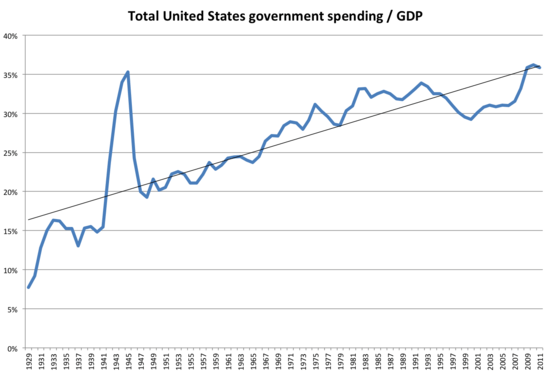
Josh Barro ponders the above chart on US government spending over time. And again, he shows how ideology distorts reality. The reason the government spends more as a proportion of GDP is partly the welfare state and partly demography. Put the two together, and it's delusional to believe you could bring spending much below 30 percent, especially facing the boomer retirement years. The fiscal resonance of this is that revenues have to go up some. I'd rather entitlements and defense took bigger cuts, but it's crazy not to have revenues as part of the solution. Actually to reduce revenues even more, which appears to be Romney's (check watch) position is a recipe for default. Barro's bottom line:

[G]overnment spending as a percentage of GDP cannot be expected to stay flat over time. That doesn’t mean we should just say “eh, whatever” and balance the budget entirely on the tax side. But it does mean we should expect the federal budget to be a bigger share of the economy in 2020 than it was in 2000, and structure the tax code accordingly.

Don Taylor makes related points:

It is of course mathematically possible to shrink spending to meet the historical level of tax collection. However, it is important to realize that we spent more than 21 percent of GDP (the target for revenue/spending balance in around 2035 suggested by Simpson-Bowles) in 1970, 1975, 1980 and 1985—and the baby boomers were mostly working and paying taxes then, and not moving into eligibility for Medicare and Social Security. 

Can Obama Win Arizona?

Tomasky rightly fears overconfidence among the Obamaites. But Arizona is not an impossible target:

If McCain wasn’t from Arizona and Obama had competed in 2008, Obama probably would have won the state by a meaningful margin. The Obama campaign would have registered thousands of new non-white and young voters, and Arizona would probably be widely regarded as a critical swing state in 2012.

But Obama didn’t compete in Arizona, and now the Obama campaign is attempting to create the increased non-white registration and turnout necessary to sway the state with presumably less white support. Whether the Obama campaign can do so is questionable, but given their success in 2008 and the sheer number of unregistered young and non-white voters, it would not be wise to dismiss their chances. 

Chart Of The Day

Taxes_Fair

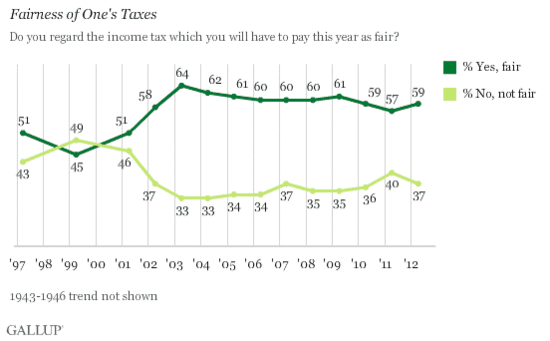
The Bush tax cuts had a major impact on how Americans view their taxes:

Few Americans are eager to pay more in federal taxes, but the majority are at least content that what they pay is fair, and close to half consider their tax obligation about right. Fewer than half express more negative views, including 37% who say the amount they pay is unfair and 46% who say it is too high.

How To Read The Polls

Among Nate Silver's tips is to "not over-learn the lessons of history":

[T]here have been only 16 presidential elections since World War II. That simply isn’t a lot of data, and overly specific conclusions from them, like “no recent president has been re-elected with an unemployment rate over 8.0 percent” or “no recent incumbent has lost when he did not face a primary challenge,” are often not very meaningful in practice and will generally not carry much predictive weight.

Blumenthal decodes recent conflicting polls. In short:

With just under six months remaining before Election Day, voter preferences are soft and polls are apt to produce divergent results.

Gyms Are Bad For You? Ctd

Screen shot 2012-04-16 at 8.32.19 PM

Readers keep the thread going:

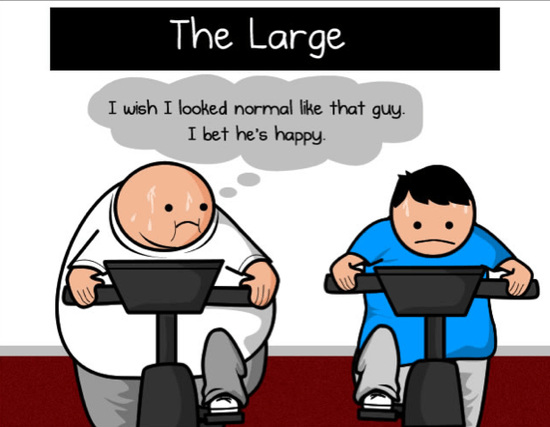
In response to your reader who says obese people can't go to the gym due to body-shaming, she needs to 1) find another gym, 2) find a different personal trainer, and 3) get a better exercise bra. I used to avoid the gym because I assumed I'd be looked down upon or mocked because I'm overweight.

But In my late 20s I realized that was a moronic reason to not get healthier, and hired a personal trainer to help me get better adjusted with the environment. What I found was that absolutely no one cared about me at the gym at all. No one paid attention to me because they were all wrapped up in their own exercise routines or admiring themselves in the mirror, or listening intently to their headphones or the TVs mounted on the wall. No one gives a damn about my big ass. The idea that fat-shaming happens at gyms is 95% in the heads of of those fearing the gym.

And don't use your boobs as an excuse. I am a similar size and my life was changed by finding a sturdy underwire exercise bra. Go to a proper lingerie store that can give you something better than you can find at Target. I can do jumping jacks until the cows come home without an ounce of discomfort.

If your personal trainer didn't suggest such a thing to do, or response to your concerns with some sensitivity, you found a crappy personal trainer. There are better ones out there – plenty that used to be obese, too, and got over their fears to improve their health. Talk to several before committing to a workout, and if it doesn't work out after one or two sessions, find another one. Trainers I've worked out with in the past have been, to a person, excited for me to be taking strides in improving my health and driven to find out what kind of exercise works best for me in terms of results and enjoyment. The ones I've worked with have trained people of all weight levels, age levels, and physical ability – they're not jocks looking to train more jocks.

While I still sometimes find myself uneasy at the gym, I realize it's because I'm body-shaming myself if I've gotten off track – disappointed my stretch pants are tighter than they used to be, or that a workout that was easy a year ago has gotten hard because I got off track and got lazy. It's never been because of other gym-goers or staff.

Another writes:

If it's gym intimidation that is keeping one from getting into shape, may I recommend working out at home? There are plenty of home video exercise programs, many of which are incredibly effective. I don't wish to plug a specific program, but I've been doing the P90X programs at home, and am in the best shape of my life. Granted, my gym trips were pretty aimless – I'd run a little, lift weights at random – and P90X is a highly-regimented training program (which one can combine with a nutrition plan for better effect), so I benefitted immensely from the detailed direction the program offers. But no more gyms for me – P90 is more efficient, and in the long run, less expensive (all I really need is a pull-up bar and a set of dumbbells or resistance bands).

Another:

If watching "The Biggest Loser" has taught me anything, it's that overweight people are (mostly) overweight because of emotional issues like insecurity and depression. I've read that people who succeed in losing weight through exercise are prone to relapse and put the weight back on. It seems to me that if you don't address the underlying emotional issues, diet and exercise are going to be temporary measures at best. I think it's obvious to extrapolate from there that a person with insecurities about their weight is going to have a hard time going to the gym, and might even do more damage to their mental state when they fail to achieve their gym goals.

On a slight tangent, I turned 30 last year and for the first time in my life dropped the puppy fat I'd been carrying around since college. I did it by using medical pot to stabilize my emotional state, which helped me stop shoveling burgers and pizza into my face every night (kind of counterintuitive for those familiar with the munchies, but it worked for me). I went from ~2500 calories per day and binges of 5000+ on weekends to around ~1800 per day, which, with my office worker no exercise lifestyle, is just a bit less than I needed. 12 months later I had lost 6 inches off my waistline and my self confidence skyrocketed to the point that I no longer need the pot to regulate my appetite. It cost about the same as a gym but was (believe me) a great deal more enjoyable and easier than previous failed attempts to run it off on a treadmill.

One more:

Losing weight is 80% watching your caloric intake. If reaching a certain number is your only goal, you don't even need to go the gym. However, losing weight should never be the only goal; losing weight should only be a corollary of the true goal.

Being thin does not in any way equate with being healthy. There's tons of people who look like they are in better shape than me who I would annihilate in a one-mile race, or a pushup contest, or long distance cycling, or whatever. When I applied for life insurance, the nurse took my blood pressure three times because she couldn't believe how low it was. There's plenty of thin people who dropped dead from heart attacks because they think that being thin means they don't have to worry about blood pressure or cholesterol. This is simply not true. Genuine health is something that your body fat level has surprisingly little to do with. Better a chunky mountain biker than a slender couch potato.

The goal should be to achieve genuine health, and concerns about hitting a particular number on the scale should be a secondary goal. It's this mindset that weight is the sole measure of health that makes people think of exercise and diet as unpleasant tools to be discarded at the first opportunity rather than a necessary part of a whole and happy life. The gym is to health what the church is to spirituality; it's a place that is not strictly necessary, but helpful if used properly.

This has to be a lifetime thing. You can never stop. If you are still thinking that exercise and nutrition are things you do until you fit in the bikini, you are doomed. It should be viewed as a permanent lifestyle change, like changing religions or having kids.

(Image: From an eight-panel cartoon from The Oatmeal titled "At the gym: who is looking at whom")

The Chemistry Of Old Books

Revealed

Chemists at University College, London have investigated the old book odor and concluded that old books release hundreds of volatile organic compounds into the air from the paper. The lead scientist described the smell as 'A combination of grassy notes with a tang of acids and a hint of vanilla over an underlying mustiness.'

Where Are The Idealist Political Shows?

In this weekend's NYT magazine, Carina Chocano reviewed HBO's "Veep":

If "The West Wing" was a fantasy of hyper-competence, "Veep" is its opposite: a black-humor vision of politics at its bleakest, in which both sides have been co-opted by money and special interests and are reduced to posturing, subterfuge, grandstanding and photo ops.

In response, Alyssa ponders contemporary political shows:

[A] truly idealistic show hasn’t thrived in the age of Obama. Maybe it’s [that] the ridiculousness of our politics has consequences bigger than the President’s sex life this time around, and idealism would actually be kind of a downer.

Ad War Update

Obama's Super PAC spotlights Romney's riches: 

Paul Waldman comments on the now-famous photo at the center of the ad: 

Romney hasn't really told a persuasive story about how his personal wealth figures into his candidacy. Other rich candidates have; Ross Perot, for instance, argued that he put aside his successful business to help the country out of its terrible deficit problem. It seemed to make sense; there were reasons Perot didn't win, but being too rich wasn't one of them. Romney would like us to think that his success in business is evidence that he's smart, competent, and understands the economy, and these are all things that would make his presidency just as successful as Bain Capital. And maybe they would. But the Obama folks are going to do their best to make sure every time he tries to make that case, they're there to say, "Oh yeah? Just look at this picture."

The Obama campaign annotates Romney's NRA speech: 

Meanwhile, the RNC issues the latest in its "'Hope' to Hypocrisy" series: 

Alex Burns has more

There's a bit of a messaging chess game being played here between Obama and Republicans, as the president starts to pre-spin a possible summer economic slowdown (he has said inaction on Capitol Hill could stall recovery) and the GOP tries to preempt any inclination the public might have to cut Obama some additional slack. The RNC message fits in with the second goal, as well as the broader Republican priority of making sure Obama pays as high a price for the recession as possible.

Lastly, the RNC latches onto the GSA scandal:

Mataconis rolls his eyes

Testifying under oath before Congress without knowing whether ones words could end up becoming the basis of a criminal charge is positively idiotic, and it would have been malpractice for an attorney not to advise their client to assert their 5th Amendment rights. For confirmation of that fact, one need look no further than the case of Roger Clemens, who foolishly volunteered to testify before a Congressional Committee when he didn’t have to and is now again on trial for perjury (the first trial having been dismissed when prosecutors accidentally used inadmissible evidence during their opening statement). Not only is it not surprising that these individuals plead the 5th, it would have been surprising if they hadn’t. 

Previous Ad War Updates: Apr 13Apr 11Apr 10Apr 9Apr 5Apr 4Apr 3Apr 2Mar 30Mar 27Mar 26Mar 23Mar 22Mar 21Mar 20Mar 19Mar 16Mar 15Mar 14Mar 13Mar 12Mar 9Mar 8Mar 7Mar 6Mar 5Mar 2Mar 1Feb 29Feb 28Feb 27Feb 23Feb 22Feb 21, Feb 17, Feb 16, Feb 15, Feb 14, Feb 13, Feb 9, Feb 8, Feb 7, Feb 6, Feb 3, Feb 2, Feb 1, Jan 30, Jan 29, Jan 27, Jan 26, Jan 25, Jan 24, Jan 22, Jan 20, Jan 19, Jan 18, Jan 17, Jan 16 and Jan 12.