The Daily Wrap

Today on the Dish, Andrew came back from his staycation, declared this election's highest stakes to be in foreign policy, disapproved of Obama's new tone, and bet Palin could have beaten Romney. We wondered if Obama and Romney were actually close, puzzled over Mitt's Republican DREAM Act and secret tax plan (here and here), and examined Communist witchunting as a fundraising tactic. The NRA sounded crazy and the recession might have been much worse.

Andrew also blasted Bill Donohue's nastiness about adopted children, noted some encouraging statistics about Newsweek, and went after the NYT review of The Crisis of Zionism. We also teased out the implications of the weekend attacks in Afghanistan, worried about Central America's reaction to the war on drugs, and assesed the UN's success (or failure). GDP didn't measure everything important, Italy had crazy gangs and a crazier ex-Prime Minister, Google Earth saved a life in India, and medical tourism might help save US health care. Ackerman's Ask Anything questions stayed up, Wilkinson switched focus to fiction, and Hari chatted with Greenwald.

We also listened to readers on The Dish and religion, took in a poetry review from 1939, and pondered the character of consciousness. Writing changed when done by hand, speech impediments differed in different contexts, a disability scarred one reader's love life, hot real estate agents moved property, and kids languished in juvie. Readers debated filming books and Tupac lived. Smart phones spread, lie detectors failed, and aluminum used to be more valuable than gold. A cardboard arcade warmed our hearts and pot wine was a thing. Ask Jennifer Rubin Anything here, Quotes for the Day here, here, and here, Headline of the Day here, FOTD here, MHB here, and VFYW here.

– Z.B.
What Is Consciousness Made Of?

Uruguay-5

Tim Parks grabs a beer with philosopher Riccardo Manzotti, who believes that consciousness is a process:

His favorite example is the rainbow. For the rainbow experience to happen we need sunshine, raindrops, and a spectator. It is not that the sun and the raindrops cease to exist if there is no one there to see them. Manzotti is not a Bishop Berkeley. But unless someone is present at a particular point no colored arch can appear. The rainbow is hence a process requiring various elements, one of which happens to be an instrument of sense perception. It doesn’t exist whole and separate in the world nor does it exist as an acquired image in the head separated from what is perceived (the view held by the "internalists" who account for the majority of neuroscientists); rather, consciousness is spread between sunlight, raindrops, and visual cortex, creating a unique, transitory new whole, the rainbow experience. Or again: the viewer doesn’t see the world; he is part of a world process.

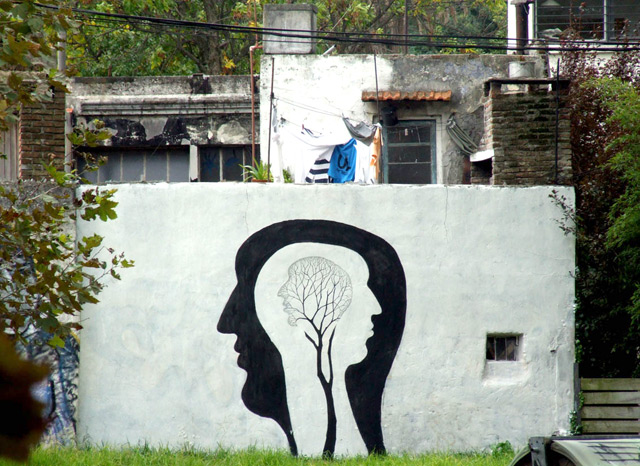
(Street art by Pablo S. Herrero and David de la Mano in Montevideo, Uruguay, via Colossal)

Romney’s Secret Tax Plan, Ctd

A Romney staffer claims that Romney was "tossing ideas out, not unveiling policy" during his closed-door fundraiser. Suderman is unsurprised that Romney's remarks were substance-less:

The news here isn’t that Romney announced new policy proposals. The news is that he’s still trying to get away with tailoring his messaging to his audience, and with telling people what he thinks they want to hear rather than what he actually believes. On that front, Romney revealed nothing. Perhaps because there’s nothing to reveal.

Caine’s Arcade

A nine-year-old's cardboard creation gets a much-deserved crowd:

Filmmaker Nirvan Mullick explains:

One day, by chance, I walked into Smart Parts Auto looking for a used door handle for my ’96 Corolla. What I found was an elaborate handmade cardboard arcade manned by a young boy who asked if I would like to play. I asked Caine how it worked and he told me that for $1 I could get two turns, or for $2 I could get a Fun Pass with 500 turns. I got the Fun Pass.

What the fun pass has brought Caine:

The 11-minute documentary has been viewed 1 million times on Vimeo and almost 500,000 times on YouTube.

In the film, Mullick used Facebook and Reddit to plan a flashmob to surprise Caine at his arcade, in what would become "the best day of Caine’s life." The silver lining to this story is the scholarship fund Mullick set up for Caine’s college education, which has already raised more than $90,000. Mullick astutely notes, there’s no saying what this boy could accomplish with an engineering degree.

What Makes A Book Unfilmable? Ctd

A reader writes:

Great novels do not tend to make great movies. The best literary adaptations on the big screen tend to be shorts stories and novellas that focus largely on the physical aspects of the characters. So The Man Who Would Be King makes a better movie than The Sound and the Fury because in the former, character is revealed through externalized action, while in the latter most of the drama takes place in the interior worlds of the characters that are hard to photographWhat movies do better than any other medium (including television) is place the viewer in a powerfully vicarious experience. We wince, twitch and squirm in our theater seats because we are in the characters’ shoes and share their experiences on a visceral level.

What novels do better than film is place the reader inside the psychological world of the character.

In The Death of Ivan Illich, Tolstoy takes us through the experience of a man dying in a way so vivid that we feel we really understand what it’s like to watch life slip away. But there is not a lot of filmable cinematic action, the most powerful part of the novel is completely uncinematic. In Mrs. Dalloway, Woolf takes us on stroll through the private thoughts and ruminations of several people, private thoughts that are enchanting in their novel form but become trite and confusing flashbacks or longwinded narration on the screen and bear no resemblance to the effortless way the text reveals the terrors and yearnings of these people we feel we know so well by the end of the book.

Another reader wants to stop comparing books to films:

Why, after a century of filmmakers adapting stories, books and plays for the screen, do some still not understand that no adaptation can be the source?  All art should be evaluated for what it is, and not against some other type of art, even if the storyline behind both is the same.  Most these days consider the film called The Shining a very good example of cinema, with masterful performances and the unmistakeable look of a Kubrick film.  However, when it premiered, many fans of King's book were outraged.  I remember my sister-in-law being fuming a couple of days after seeing it, complaining how details as well as whole scenes were changed, or simply left out.

Sometimes filmmakers have made changes in the story because they did not have the budget, time, resources, expertise, or technology to film certain scenes.  At times, though, major changes have been made because they just wanted that change.  

The point is the film is not the book, only the book is the book.  Films should rise and fall based on how well they succeeded as a film. Dune wasn't a bomb because of some failure of the filmmaker to catch Paul's internal narrative as well as the book.  It failed because in the end, it wasn't a good film (my apologies to my favorite director, David Lynch, for criticizing his only turkey).

The Smart Phone Explosion

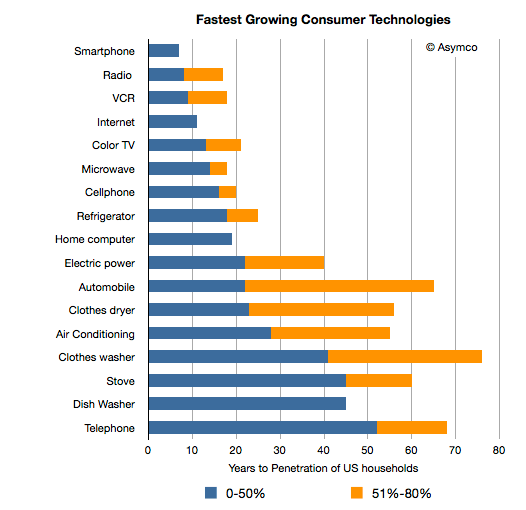
Take a second to digest this chart:

Fast_Growing_Technologies

Ryan Avent's eyes open wide:

Smartphones—extraordinarily powerful, mobile, data-network-connected computers equipped with GPS, accelerometers and all sort of other gee-whizzery—have become so ubiquitous so fast because they're so remarkable (and because falling tech prices have quickly made them affordable). But because they've become so ubiquitous so fast, I think we underappreciate the revolutionary potential of a world in which powerful mini-computers are everywhere …

The Measure Of A Nation

big problem with GDP:

GDP cannot answer such essential questions as whether we are consuming too much of the wrong things or saving too little. To any government statistician tallying GDP, $100 spent on textbooks is sadly no more valuable to society than $100 spent on cigarettes. Americans spend more than $80 billion on smoking each year and an estimated $160 billion on the health care costs related to smoking-induced illnesses. Together that’s about 1.5 percent of American GDP—nothing to boast about. 

A conference at the UN just produced the first World Happiness Report. The trend could spark changes in the US:

Health policies, particularly those affecting the availability of mental-health services, would likely look far different if misery were factored into the cost-benefit analyses now measured solely in dollars. In this country, the obvious case for instituting family-leave, sick days and vacation policy could finally be recognized. Governments would have the numbers they needed to craft policies that promote strong social connections and altruism, both of which are associated with happiness.

Ronald Bailey is wary of the report.