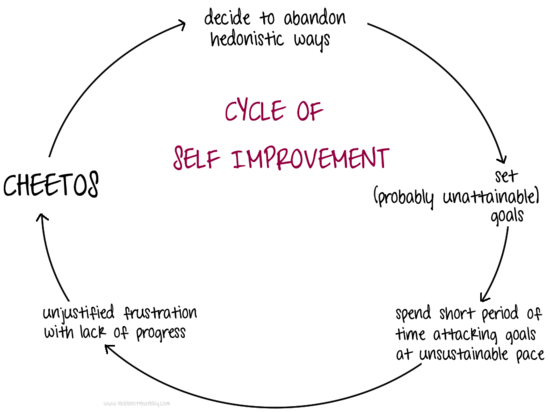
Gyms Are Bad For You? Ctd

CycleofimprovementF

by Zack Beauchamp

A reader writes:

I'm sympathetic to your overweight reader who feels intimidated by the gym. It is a scary place. But the thing is–everyone is intimidated at the gym. It is scary for everyone. I go every week with someone I can outlift, but three racks down from me is someone who can squat three times the weight I can. And if not that, there's some guy who's built like a tank, grunting every rep and throwing dumbbells around, and maybe someone's rolling their eyes at his myogenic melodrama instead of judging the person who's got some extra weight and is trying to better themselves. Or maybe everyone should just worry about their own routine and fuck off.

At any rate, if you feel intimidated at the gym, I kind of think that's half the point. No matter how fit you are, there's someone who's more fit. Get inspired.

And the other thing is: she doesn't need a trainer. She doesn't need to be doing jumping jacks at whatever pace he thinks is necessary. If she eats at a caloric deficit she'll lose weight. Do something, do anything.

A second complicates the discussion:

I lost about 90 lbs. I lost the most weight when I stopped  going to the gym.

I was on a program that was all about calorie intake (surprise – it works), and the physiologist who designed the program actually advised that I not exercise too much. He proscribed some light weight training, mostly bodyweight exercises, a few times a week to maintain muscle. The idea is that you lose weight when you feed your body just enough an no more. Vigorous exercise requires more calories than your body can burn in fat at the rate their needed.

Also, I'm an ex-football player – my joints really don't miss all of the extra strain from weight-training. Exercise is a good thing. People can exercise in gyms. The key is knowing what you actually want with your body and the healthiest, most effective ways to get it. Seeing an overweight, middle-aged person trying to shed pounds on the bench press is, to me, ridiculous.

A third takes a somewhat different view:

The social stigmas and constructs surrounding the idea of "the gym" are bizarre. I've transformed myself from an extremely obese 270lb person into a typical gym rat and, through the looking glass, I see that judging people trying to get healthy or look better is the furthest thing from any regular gym user's mind. If anything, I feel proud of them for having the guts and enduring the pain necessary to get what they want. The idea that there is some sort of process of "body shaming" that forces fat people from gyms is the most ridiculous type of hyperbolic imaginary bullshit.

(Chart by Kendall at this is not that blog)

Every Man For Himself?

by Maisie Allison

Economist David Savage compares the "orderly" response of the passengers on Titanic to the panicked reaction of the passengers on the Lusitania, which sank in less than 20 minutes three years later:

"If you've got an event that lasts two-and-a-half hours, social order will take over and everybody will behave in a social manner," Savage says. "If you're going down in under 17 minutes, basically it's instinctual."  On the Titanic, social order ruled, and it was women and children first. On the Lusitania, instinct won out. 

A recent paper (pdf) tells a different story:

Since the sinking of the Titanic, there has been a widespread belief that the social norm of ‘women and children first’ gives women a survival advantage over men in maritime disasters, and that captains and crew give priority to passengers. We analyze a database of 18 maritime disasters spanning three centuries, covering the fate of over 15,000 individuals of more than 30 nationalities. Our results provide a new picture of maritime disasters. Women have a distinct survival disadvantage compared to men. Captains and crew survive at a significantly higher rate than passengers. We also find that the captain has the power to enforce normative behavior, that the gender gap in survival rates has declined, that women have a larger disadvantage in British shipwrecks, and that there seems to be no association between duration of a disaster and the impact of social norms. 

The Economist ponders the study:

Social norms may hold up—if a combination of other factors supports them. But depending on the circumstances, the dynamics of the situation might go either way. One example, almost trivial in comparison, is littering and the broken window theory: if we observe others breaking social norms and rules, we are more likely to do so ourselves. Maybe it is the role of an enforcer to steer the dynamics in a favourable direction. One such example might have been the captain on the Titanic.

Recent Dish on Titanic here

The E-book Economy

by Maisie Allison

The DOJ is suing five major publishers and Apple for allegedly colluding to raise e-book prices "in order to retaliate against Amazon’s discounting." Yglesias isn't fazed by the charges: 

[T]he only way for these firms to stay viable is to publish books people like and to sell them at a price readers want to pay. Whether they merge, collude, or simply find a convenient confluence of interests around Apple’s efforts to compete with Amazon, there’s no real threat to competition here. Literary culture, for better or for worse, is dealing with a radically transformed business landscape. The Justice Department is, at best, irrelevant to this process.

Three of the publishers have already settled with the DOJ. More on the case here and here.

Alien Flicks And American Guns

by Zack Beauchamp

Olivier Schmitt sees alien invasion movies as windows into America's foreign policy mindset:

The notion of peer-competitors, which designates a state which could be as powerful as the United States, is very important in the American strategic debate. Interestingly, while the emergence of a peer-competitor is officially feared, one almost has the impression that the U.S. wished to have one. It is as if strategists (military and civilians) were frustrated by the last decade of relatively low-tech COIN (although some new technologies were widely used on the battlefields) and wanted a real competitor to emerge in order to finally be able to use their expensive and so sophisticated hardwares. Screw the insurgent and his AK-47: we want large-scale air battles and cruise missiles to flow! This is translated in the movies by the use of high-tech of some kind, even in movies worshiping the action of the local grunt.

Our Patchwork Of Pot Laws

by Patrick Appel

Katherine Mangu-Ward reviews Pot Inc, Greg Campbell's new book about growing medical marijuana:

[C]onflicting rules have created a web of technicalities that cause Mr. Campbell to jump every time the doorbell rings. Haunted by the odor of mature plants in his basement, "every Jehovah's Witness or Girl Scout who came calling became a suspected DEA agent or undercover narc." He discusses his crop with clerks in gardening shops but remains worried by the idea of a possible pre-dawn raid on his family's home. One of the achievements of his book is to illustrate how untenable half-measures are in the long run.

The View From Your Airplane Window

by Chris Bodenner

Readers keep flooding the inbox with great views from above (many more after the jump):

Lesotho, March 21 9-00 am

Lesotho, 9 am

LAX

“No idea why the NY Jets’ plane is at LAX during the off-season, but oh well.”

Somewhere Over New Mexico.

“Somewhere over New Mexico”

Severn Bridge near Bristol, England

Severn Bridge near Bristol, England

Galveston Bay-TX

Galveston Bay, Texas

Can Syria’s Truce Hold? Ctd

by Zack Beauchamp

Marc Lynch, noticing a wave of non-violent protest as the cease fire stays in place, believes Assad is in real trouble:

Given his lost legitimacy and the economic collapse, I don't believe that Assad can survive at this point without using force.  He seems to have believed that he could crush the opposition before his international window closed, but he did not. 

If Syrians continue to take to the streets and the regime is restrained by international pressure from responding violently, a snowball could begin to roll, especially if those still sitting on the fence or backing the regime out of fear come to see that opposition as peaceful and inclusive rather than as a potentially life-threatening armed force. It would be remarkable to see a non-violent, mass protest movement emerge from the wreckage of civil war like a Phoenix. It may in fact be too much to expect, given the evolution of the status and role of the armed groups within the opposition and the horrors which the regime has inflicted upon the population.  But it's something to encourage and to protect.

Dating With Disabilities, Ctd

by Chris Bodenner

A reader writes:

I found out that I had multiple sclerosis at the age of 25. Now I am 33 and married, but dating often involved a difficult dance due to the hidden nature of my affliction. I never knew when the appropriate time was to inform potential mates of my disease and disability. I did not share the information until after a few dates because the disease posed no immediate physical threat to others and most romantic flings fizzled out quickly anyways.

However, I remember one time – weeks after informing my then-girlfriend that I had MS – when I was experiencing an exacerbation of my symptoms that required me to see the doctor, who requested that I take it easy around the apartment for a weekend. That weekend she said to me in tears, "You can't guarantee me that you are going to be OK." I didn't know how I was supposed to respond and I internalized my feelings, as many men are wont to do at that age. As time went by and I processed her words, I became angry that she would make such an accusatory statement to someone with my affliction, who was currently in the throes of a wretched exacerbation, and that she had only been dating a couple of months. I decided from that point on that I could not trust her or rely on her for emotional support. I could feel myself passive aggressively breaking up with her and hated myself for it.

Another writes:

I have a mostly hidden disability, a rare genetic disease that ruins my connective tissue, especially ligaments. Through hard work I walk with a cane, when many with this disease are in wheelchairs. I don't think confidence was ever my issue with dating – I'm a geek girl for one thing, and thus had a ready pool of guys who were interested in any female who could debate the finer points of Star Trek. In fact, I'm married, which is when I discovered the real downsides to disability and relationships.

He was fine with my disability when we were dating and engaged. I explained the relevant details (no biological kids for one) and my limitations. Everything seemed great; he seemed accepting and willing to look past it.

And then we married and started living with each other. It's one thing to know "this person is going to be in pain frequently for the rest of their life and will never heal" and another to live with it. It's hard to watch someone be sick or hurting or frustrated by their body's refusal to do what everyone can.

He's always taken his health for granted. I can't – I'm not healthy, and I never will be. Managing my body and working around its limits consumes a lot of time, and that impacts him too. He has admitted it is a lot harder to live with than he ever imagined. I wonder if others have better imaginations – and if his was better, would he have married me?

Another:

This is the first time I’ve ever written to the blog, since it’s the first time I’ve ever felt like an authority on a blog subject. I’m a 31-year-old straight male, and I’ve been dating a disabled girl for the last five years or so. She has muscular dystrophy and is confined to a wheelchair. She can’t walk or stand on her own, but I think it’s important to clarify that she’s not paralyzed; she’s just very weak. Even lifting her arms is very difficult, so she’s unable to perform many simple tasks like brushing her hair, cutting her food, or tying her shoes. I help with these things, and I’m sometimes surprised to find that I’m more of a nurturer than I ever would have imagined a few years ago.

It’s a permanent condition, with no cure. She gets progressively weaker, and the disease progresses at such a slow pace that the pace itself becomes its own cruelty. We slowly realize that she can’t do things she once did, but we never really talk about that.

We met through on an online dating service aimed specifically toward disabled customers. We’d both exited serious long-term relationships (with non-disabled people) a few months before we met. I admit going into the relationship I wasn’t sure if the disability was something I could manage. Even now I wonder. But still, she likes science fiction and video games, and tolerates/"enjoys" football, baseball, and soccer. So what if she has a physical imperfection. She’s just about the nicest person I’ve ever met, and I seriously doubt (with my impaired social skills, especially) that I could meet and strike up a relationship with another person with whom I’m so well matched.

In a lot of ways, I’d rather deal with the physical disability instead of someone who is coping with emotional or mental problems. There’s a lot to be said for having the condition out in the open.

History Rewards Warmaking

Warpresidentialratings

by Maisie Allison

Fabio Rojas explains

David Henderson and Zachary Gouchenour have a paper on the topic of presidential ratings. The finding is simple. American war casualties, as a fraction of the population, positively correlate with how historians rate U.S. presidents. More death = better presidents. The regression model includes some controls, like economic growth. 

Gene Healy recently discussed the paper: 

Presidents have long recognized the "wartime bonus" doled out by historians. Henderson and Gouchenour quote Teddy Roosevelt: "if Lincoln had lived in times of peace, no one would know his name now." … It's also worth reminding presidents that, as Wilson, Truman, and George W. Bush discovered, unnecessary wars make presidents unpopular. While historians may eventually award extra credit for spending American blood and treasure, ordinary Americans generally don't. 

More on war and the executive here.