How A Flock Of Geese Could Start A War

by Patrick Appel

Fred Kaplan explains how an Israeli and Iranian nuclear stand-off would differ from the Cold War: 

It takes a half hour for an ICBM to fly from Moscow to Washington; that’s just barely enough time for the president to decide what to do if a blip on the radar screen suggests an attack is underway. It takes about five minutes for a short-range missile to fly from Tehran to Israel. That’s probably not enough time. There were several times during the Cold War when America’s finely tuned radars mistook a flock of geese for a flight of Soviet missiles or when a software glitch produced a false warning of an attack. In all these instances, the leaders could afford to wait a bit to see how the signals panned out.

North Korea’s Missile Mishap

by Patrick Appel

Evan Osnos resists rubbing North Korea's failure in its face:

The launch was always geared toward a domestic audience, a celebration intended to solidify the reputation of young, untested leader Kim Jong-un. He flunked that test, but at his level of North Korean politics, no child is left behind, and he—or, more importantly, the military and civilian leaders who depend on him for their power—must now demonstrate their relevance and vitality. The last time around, after the 2009 rocket failure, that meant a nuclear test. A year later, North Korea sank a South Korean ship, killing forty-six sailors. Then it shelled a South Korean island.

GOP Support For Afghanistan War Plummets

by Maisie Allison

A majority of Republicans now accept that the war has not been worth it:

Public support for the U.S. war effort in Afghanistan has fallen to an all-time low, with only 30 percent of respondents saying it has been worth fighting. Since the 2001 invasion, almost 2,000 U.S. troops have been killed and more than 15,000 have been wounded in Afghanistan. According to the poll, two-thirds of Americans think the war has not been worth fighting, equaling the most negative public assessments of the U.S. war effort in Iraq.

One wonders, as Marc Thiessen surely does, if the presumptive GOP nominee will eventually recalibrate along the lines of last summer's slip (seen above), or if he really does intend to double down on the "no apology" bit.  More on the Romney campaign's "hawkish yet murky" foreign policy here.  Amy Davidson reflects on the case of the anti-war Republicans:  

Most wars are long wars, if you count the hurt they cause later. The new poll results suggest that the public may have a better sense of this than the leadership of either party. Mitt Romney has suggested that Obama isn’t doing enough to win, and needs to heed his generals more. Obama, meanwhile, may have listened to his generals a little too much for some of his supporters: before the withdrawal now planned, he sharply increased the number of troops. Will they both be at war with an electorate that wishes we weren’t in Afghanistan at all?

Do Political Labels Make You Stupid? Ctd

by Patrick Appel

A reader writes:

One great example of Matt Glassman's point about party labels as a necessary shortcut is judicial elections.  Absolutely no one pays attention to these.  I'm a law student at a top-10 school, and in a seminar I'm taking on judicial decision making the vast majority of the class, including myself and the professor, were not sure even whether we had ever voted in a judicial election.  If that group of people does not pay attention to judicial elections then really, no one does.

The only time the public hears about judicial elections is when an interest group attempts to unseat a judge.  Prominent examples include California removing Rose Bird and two other Supreme Court justices over opposition to the death penalty and, more recently, Iowa removing justices for requiring marriage equality.  Such campaigns often disingenuously capitalize on issues likely to spark outrage: in West Virginia, Justice Warren McGraw was removed from the bench when business interests, unhappy with his treatment of corporate defendants, funded an ad campaign focusing on a single vote by Justice McGraw in a case involving child molestation (see here at page 5).  One newspaper ad targeted a California municipal judge for never imposing a prison sentence, when municipal judges in fact do not have the authority to impose prison time (see here at page 6).

States that hold judicial elections vary in whether party labels appear on the ballot.  One study found that nonpartisan judicial elections actually leave judges more vulnerable to this sort of interest group attack, because voters' only information is the attack, and not the party label cue that might reflect a broader alignment of values than isolated decisions misleadingly portrayed in an ad campaign.  Ironically, nonpartisan elections were intended as a reform to increase judicial independence and reduce political influence over decision making.

Another reader differs:

Matt Glassman’s analysis rests on a huge causal assumption that I think is difficult to defend.  He believes that “no one has yet devised a better system of signals that allow low-information voters to make election choices that reflect their political beliefs and interest priorities.”  I think you could reverse the causation here and argue that people are low information voters precisely because they make voting decisions in a tribal manner, rather than on an analysis of proposed policies or even their own self-interest.  The fact that partisanship serves a social-identity function discourages carefully thinking or information seeking.  Once I’ve decided I am going to vote republican (or democratic), there really isn’t any rational reason to become a high-information voter.

I would remind Matt, that most people’s party membership is extremely well predicted by social factors (i.e., the party affiliation of their peers and neighbors) and is NOT well predicted by objective measures of self-interests. 

Can Syria’s Truce Hold?

by Zack Beauchamp

Kofi Annan's brokered cease-fire in the country appears to be restraining violence, but Assad is still refusing to comply with the cease-fire fully by withdrawing troops. Jack Goldstone thinks it can't hold:

The dyamic of the last few months appears to remain. Whenever Assad’s forces let up their assault, opposition forces gather in protest or to secure areas.  As one protestor indicated, there is no going back to peace with Assad — too many have been raped, tortured, or killed.  So no cease-fire is likely to be stable; opposition forces and demonstrators will use a cease-fire to show their rejection of Assad, and the government will move in to shut down such actions.

Michael Totten nods. Michael Wahid Hanna prays the Annan plan works out, because the only alternative appears to be massive, prolonged violence:

The ceasefire that is at the crux of current attention is not an end in and of itself. The six-point plan endorsed by the Arab League and the United Nations also seeks to establish a Syrian-led political process that addresses the legitimate aspirations of the Syrian people. While the terms of a transition are left unspecified, it should be clear to Russia and others that any credible managed transition will require the removal of Assad from power. There can be no stability in Syria if the regime remains fully intact. In light of the indispensability of Russia and China and their reservations about the consequences of a political transition, focus should now shift to fashioning a serious transition process that retains specific figures and institutions from the Assad regime while allowing for genuine political change to take root. If international consensus cannot be marshaled around such basic realities then Syria is destined to suffer from escalating and protracted conflict that is the sole alternative to a diplomatic resolution.

He's on-point here. There's no evidence that either Assad or the opposition is willing to back down or capable of making the other one do it anytime soon, which is a recipe for instability and, more importantly, humanitarian catastrophe. It seems in the best interests of all third parties, including the Russian stick-in-the-mud, to work out a mutually agreeable international plan for Assad's exit.

The Importance Of A Balanced Literary Diet

by Patrick Appel

In response to the debate over adults reading teen fiction, Andrew Sprung makes an obvious but essential point:

[W]hile the best children's books can bring many core human experiences 'marvelously' to life, there are many equally or more intense experiences that they can't touch. While there's nothing wrong with an adult devoting leisure time to The Lion, The Witch and The Wardrobe, or Harry Potter and the Deathly Hallows, they are not sufficient. They should not crowd out The Gulag Archipelago, or The Moons of Jupiter, or Midnight's Children. Confining your reading to children's books would be like confining your sex life to hugs and kisses.

The Unseen Complexity Of Foreign Nations

20110108_WOC856_0

by Zack Beauchamp

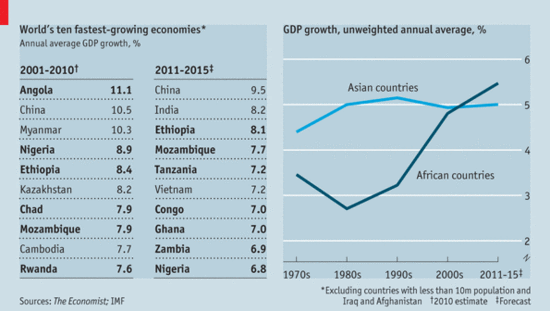
Richard Dowden bashes simplistic media treatments of African countries:

For the past ten years many African countries have been growing at rates we in the West can only dream about – thanks largely to an emerging middle class, mobile phones and China’s demand for its raw materials. Now our businesses are following the Chinese into Africa looking for its fabled wealth. Africa is now a place for investment. … [Africa] can be both poor and disease-ridden and rich and dynamic at the same time, sometimes in the same village. To be a proper news story and fit into the outdated news agenda, it has to be one or the other.

Jack McDonald doesn't see anything special here:

[R]eally, when we think about it, we tend to get a bad picture of the entire outside world.

… I think, on balance, the world as presented by the mainstream media is biased against anywhere outside our own borders. If Africans happen to think their presentation in the British mainstream media is bad, please spare a thought for Argentina, who make the news in relation to the Falklands and little else, with maybe a blip when they defaulted on their debts almost a decade ago. That’s a country of about 40 million people, and the only thing we really care about is their intentions towards a rock in the south Atlantic.

(Chart from The Economist.)

Dating With Disabilities, Ctd

by Chris Bodenner

Great stories are starting to flood in from readers on this topic. One writes:

I have Aspergers Syndrome – self-diagnosed at 21, officially diagnosed at 25 (I'm now 27) – and while I'm "mild" enough to "pass" in everyday life, it has always become an issue when dating, and usually sooner rather than later. I've become very good at reading social cues and body language, but I inevitably miss or misinterpret things, and I always thought that was my fault and that I had to apologize and explain myself, since I was The Disabled One. 

That led to great, sometimes crippling anxiety over the issue of disclosure: when do you tell someone you have a disability?

For how long do you keep it to yourself? Are you keeping it to yourself out of shame, thinking that if the other person knew he wouldn't like you anymore? (Being gay hasn't helped in this regard. It automatically means the dating pool is several orders of magnitude smaller, and the pressure on young gay men in my big city to not just appear perfect, but be perfect, is enormous.) 

I didn't date at all in high school, dated a little and unsuccessfully in college, and not at all in graduate school. Every single one of the guys I disclosed to stopped calling and stopped returning my calls, regardless of how well it had been going. I tried different delivery tactics – serious, funny, nonchalant, self-depricating – and the result was always the same. I met my need for human intimacy and companionship mostly by having a lot of random sex. 

Well, the most terrifying and wonderful thing just happened: I've met someone. It's still very early and I don't want to jinx it, but this has all the signs of a long-term loving partnership. I couldn't be happier. And you know what? I haven't disclosed – because it hasn't come up. We get all of each other's weird jokes. We make each other laugh hysterically, uncontrollably. He is never sarcastic. His body language is stunningly, incredibly clear. He does what he says he's going to do. When I'm with him, I forget about Aspergers. 

And that's true of the other two men I've had experiences like that with (both of whom I ended up separated from due to geography after a few weeks, or even a few hours). That's the disclosure lesson I've learned: if I even need to think about disclosing, he's not the guy for me. I guess I'm just saying Aspies need to find the people who love them for all of who they are, which I don't think is any different from what everyone else needs. We're all the same.

P.S. Sorry for the length of this. We Aspies are not known for our brevity.

Another reader:

I'm finding this conversation about disabilities very interesting, but was struck by a moment of self-realization in the comments of the reader who lost his arm to a rattlesnake bite at a young age. The way he describes the awkwardness of the dating years and the tendency to get to know a girl/woman before he had the courage to ask them out was all too familiar. Technically, I'm not disabled, unless you count being just a little over 5' tall a disability (I've known many who would consider that a disability and suspect it was part of the reason I was once turned away by a navy recruiter after an initial enthusiasm). I don't want to steer this toward a conversation about short men, since that has been covered here before. I just wanted to share that I find it amazing how my own patterns of behavior are mirrored by someone who is truly disabled.

Speaking of our thread on short men, Andrew made a great distinction worth recycling for the disability thread:

But all attraction is irrational. That's part of the point. The idea that we should somehow stigmatize this, that people should refer to non-discrimination rules in their romantic and sex lives, seems absurdly over-wrought. Maybe it's stupid in terms of electing presidents; but not in the world of love, which is entirely about discrimination. And must be.

Though if someone is attracted to a person with a disability but refuses to act on it because of a perceived social stigma, that's when the discrimination becomes shitty. By the way, a dissenting reader thinks I was shitty for posting the clip of Amy Poehler's character with Tourettes:

As a 55-year-old gay man with a moderate case of Tourettes (including the daily, multiple, involuntary use of the N-word, here in ATLANTA), couldn't you have used a better clip of a disability? I know you want to entertain, when I see this, it just makes me sad for you. Oh, and throw in my (since 1984) pos hiv status, my diabetes, my depression, it's just a laugh riot, since no one ever makes jokes, ever, about mental illness or puts down people with HIV. I read the Dish every day, and this was just like some kind of Faux News segment about the evils of Muslims.