What Happened To American Food?

by Patrick Appel

Adam Ozimek praises Tyler Cowen's new book:

Cowen's history of how American food came to be so mediocre is a strong counterargument to those who look to blame the phenomenon on commercialization, capitalism, and excess of choice. In contrast to the usual narrative, Cowen tells us how bad laws have played an important role in shaping our food ecosystem for the worse over time. This includes prohibition's negative and long lasting impact on restaurants, and the government aggressively limiting one of our greatest sources of culinary innovation: immigration. This is not to lay the blame entirely on the government. Television and a culture that panders to the desires of children have also incentivized poor culinary trends. 

Can Liberalism Survive?

GT_GERMANY_120411

by Zack Beauchamp

Der Spiegel just ran a fascinating profile of Moritz Pfeiffer, a German historian who, in 2005, interviewed his grandmother and Wehrmacht-veteran grandfather about their war experiences. He then spent the next 7 years matching their testimonies against the historical record. Describing his grandmother as both "loving [and] kind" and a "committed, almost fanatical Nazi," he judges his grandparents to have been gripped by

A state of emotional coldness, a lack of self-criticism and absolute egotism combined with a strong deficit of moral judgment as well as the support, acceptance and justification of cruelty when the enemy was affected by it…It was a necessary human reaction.

The history Pfeiffer is grappling with only took place 70 years ago, a blink measured by reference to the long run of human history. Many suggest this means we're only another blink away from something similar; that people like Pfeiffer's grandparents are principally shaped by the events and institutions that surround them, and, hence, liberalism and the cessation of Holocaust-like violence against civilians that travels with it can only survive until the next great historical upheaval.

I think they're wrong. Liberal democracy, by virtue of its peculiar emphasis on individual freedom, is perhaps the only political system in history to be directly responsive to changes in the people it governs. Because liberalism is so capable of adapting to shifting human needs and goals, its global ascendance is far more durable than historical determinists would have you think.

The determinist argument goes something like this: Our currently unprecedented run of peaceful, democratic self-determination is dependent on certain contingent features of our world, like the distribution of political power. While the "ordinary German" today might be a committed liberal, the "ordinary German" in 1937 was willing to accept Nazi rule. Since the only thing history has shown is that no political regime lasts forever, it's more than likely the current distribution of power will change. The era of liberal democracy and coterminous peace will melt away as surely as the Roman or British Empires, likely due to events we can't well predict. 

But there's a disconnect in there. The fact that people respond to the circumstances they find themselves in doesn't mean that people must respond principally to political circumstances. Indeed, the basic plasticity of humans is responsible not only for our political choices, but also for shaping our non-political identities. Circumstances also helped determine the fact that some people want nothing more than to open a coffee shop, raise a family, pray to Jesus, or play the oboe. What a person values the most, in terms of their own life goals and ambitions, is the most important determinant of their attitudes and actions toward the broader world.

The basic human commitment to individual own life-projects ought to give us hope for liberalism's durability. The foundational liberal creed is that, in all spheres of life, each person should be able to pursue whatever it is they most value. The function of political rights, be they political, social or economic, is to ensure that citizens are free to pursue their vision of the good life absent coercion. In this sense, the basic system is near-infinitely adaptable: cultural norms or sub-state shifts in attitudes, like the increasing moral convergance in favor of marriage equality, are never a threat to the state so long as they don't demand coercion of other citizens. Liberalism is, in essence, a plastic political system for a plastic species.

This feature of liberalism explains why liberal democracies, so far, tend not to be replaced once consolidated. So long as people are allowed to pursue their own life-plans with a minimal amount of state interference, no one has any reason to mount a serious challenge to the state proper. Anger over specific events, like poor economic performance or wars, is sated by voting out the party deemed responsible. Humanity's stubborn malleability, rather than threatening the political status quo as it has in the past, is well accounted for by liberal political institutions in a way that can't be replicated by, say, Chinese authoritarian capitalism. 

It doesn't follow from this that liberalism is inevitably going to spread globally or that it's impossible to overthrow a liberal state once it's consolidated. History hasn't stopped. Rather, I'm suggesting that getting beyond liberal democracy is going to take something over and above what has previously overthrown many political orders: the fact that global institutions have changed in the past doesn't mean that they will in the future. The point is strengthened by multiple features of the modern world. For example, massive wars of conquest, that oh-so-potent source of global transformation in the past, seem peculiarly unlikely in the modern world for reasons that both do and don't relate to democratic governance.

Which brings us back to Pfeiffer. He's chosen to orient his life around uncovering painful truth for many Germans. That his project is not only tolerated, but celebrated, speaks volumes about the ability of liberal polities to react to changing times – and the fact that we're lucky to live when we do.

(Photo: Visitors walk among stellae at the Memorial to the Murdered Jews of Europe, also called the Holocaust Memorial, on January 26, 2012 in Berlin, Germany. Germany observed Holocaust Memorial Day on January 27 to commemorate the 6 million Jews and other victims murdered by the Nazis in the Holocaust. By Sean Gallup/Getty Images.)
Romney’s Bogus Statistic

Job_Losses_Women

by Patrick Appel

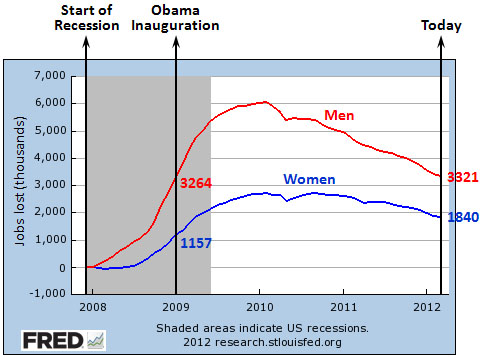
Romney claims that 92.3 percent of the jobs lost since Obama's inauguration belong to women. Kevin Drum uses the chart above to expose Romney's accounting trick:

It's important for Romney to start on January 1, even though Obama wasn't inaugurated until January 20. Why? Because if you started on February 1, you'd end up with women accounting for something like 300% of all job losses, and that's ridiculous enough that it would give the whole game away. Even the rubes wouldn't buy that.

Catherine Rampell highlights an uncomfortable truth:

[T]he ax falls predominantly on women when governments shrink, a trend that many Republicans (including Mr. Romney) have endorsed. The main way to stem these state and local job losses is to give more federal money to the states, a policy that Democrats (including the president) have been supporting and Republicans haven’t.

Sorensen points out that it's hard for Romney "to argue he would have been able to do better just for women.":

There’s a political flaw in Romney’s talking point, too: It’s very hard for him to argue he would have been able to do better just for women. Given the above explanation for the gender discrepancy, an effective women-targeted policy prescription would have involved greater state aid–stimulus, in the generic political parlance–something that Republicans generally oppose. The left-leaning outlet Talking Points Memo reports the Romney campaign did not have a response when asked what Obama could have done differently. The main reason: it would have involved taking a decidedly un-Republican position.

The Politics Of The Buffett Rule

by Patrick Appel

Chait acknowledges them:

A senior administration said today that breaking the GOP’s dogmatic insistence on preserving or deepening Bush-era tax rates for the rich is a key step to making a sensible budget reform possible. The Buffett Rule is a symbolic fight to expose Republican extremism.

Yes, it’s a relatively small change. No, it won’t eliminate the deficit all by itself. But Republicans oppose it because they won’t accede to any higher taxes on the rich, no matter what – not even on people who are paying lower rates than the middle class.

Tomasky is uneasy:

[I]t worries me that fairness is more the theme than growth. Thinking about fairness comes more naturally to liberals, and they/we care passionately about it. But that doesn’t mean we should assume everybody else does. 

Dating With Disabilities

by Chris Bodenner

Tracy Clark-Flory covers a controversial new show from the UK, "The Undateables":

Lisa Egan, a Brit who blogs about disability issues, says, "Most of the people who’ve claimed that the title is offensive are either non-disabled people or disabled people who are in long-term relationships; often relationships that were forged before acquiring their impairment." She points to a Guardian survey finding that 70 percent of respondents would not consider having sex with a person with a disability. "The reality is that I am undateable," she says, adding, "I am undateable because we live in a world where disablist prejudice is ubiquitous."

That said, Egan does take issue with the actual content of the series.

"My problem with the show is its obsession with ‘confidence,'" she says. One of the issues with "the confidence rubbish" is that "there’s an element of victim blaming going on," she explains. "If you’re disabled and you can’t get a shag it must be because you’re just not confident enough. ‘It’s nothing to do with our prejudices, oh no. It’s you. You must try harder.'"

Hephzibah Anderson is more forgiving of the series:

For anyone who's ever sifted through online dating profiles, each aiming at something quirky and thus all hitting a single, conformist note, there's something undeniably impressive about these individuals. Lumping them together is a patronising premise, but in the end, it's we the audience whom the voiceover really patronises, whether it's reminding us of what Asperger's entails or driving home the way modern romance encourages us to commodify one another. Meanwhile, Richard is shrewd, Penny keeps her cards close to her chest, and Luke appears to have found a girl who thinks his Tourette's is funny. "Slut!" he blurts across the pub table. "Thanks," she preens, giving as good as she gets.

Despite the documentary-makers' best efforts to obscure it with cheap laughs and a teaser campaign of questionable ethics, there is bravery here, as well as a powerful emotional understatement.

Any readers have an enlightening experience dating with a disability?

And If Romney Loses?

by Maisie Allison

Mataconis entertains every establishment Republican's nightmare scenario: 

Conservatives will argue that, once again, the Republican Party lost because it nominated the moderate instead of the conservative candidate, and because it didn’t “take the fight” to President Obama, whatever that means. In reality, that will be untrue but it really won’t matter. The GOP Establishment will cower in the corner and the right will go on the war path. By 2016, the odds of a moderate candidate being about to pass muster with the base of the party will be somewhere between slim and none, and Rick Santorum will be one of the people best able to take advantage of all of this. 

Larison isn't so sure

Imagine how much greater the desire to have a Republican President will be if Obama is in office for another four years. That will cancel out the instinct to turn to a more conservative nominee. After eight years of the Obama administration, there will be more Republicans interested in simply winning the election than there are today. They will likely be ready to tolerate a nominee as compromised as Romney, or they might be willing to accept a nominee even less conservative than the current iteration of Romney pretends to be.

Will Obamacare Increase The Deficit? Ctd

By Patrick Appel

Barro counters Blahous:

[Blahous] makes the case that [the Medicare] trust fund solvency is an important political motivator, and a “crisis” around the trust fund in 2016 would create significant downward pressure on Medicare spending. But I’m skeptical. Unlike with Social Security, there is no consensus view in Washington that Medicare taxes should cover the cost of the Medicare program over the long term.

And given the way debates over Medicare usually go, and the political strength of both seniors and the doctors’ lobby, I have great difficulty seeing a manufactured “crisis” over the Medicare trust fund actually leaving to significant cuts in Medicare. I think CBO has had good reasons for ignoring the law and assuming that Medicare payments will continue as scheduled even after the trust fund is empty.

Cohn nods:

We assume that government will keep paying benefits for Medicare even if that means finding money from outside the Trust Fund, because, by law, people are entitled to those benefits. That’s why we call the programs "entitlements.” Conservatives should know this as well as anybody, because this is precisely why we have a long-term deficit problem—we’re on the hook for entitlement benefits that, according to projections, future government revenues will not fully support.

Growing Up Ex-Gay

by Zack Beauchamp

Gabriel Arana pens a deeply moving reflection about his high school dependence on ex-gay guru Joseph Nicolosi and the discredited psychological movement more broadly:

It’s true that while in therapy, I did not feel coerced into believing [Nicolosi's] theories. Like nuclear fallout, the damage came later, when I realized my sexual orientation would not change. I could have told Nicolosi about my thoughts of suicide, my time in the mental institution. I could have told him that my parents still don’t understand me but that I’m grown up now and it has less of a bearing on my life. I could have told him that I married a man. But I realize it wouldn’t be of any use: I’ve changed since I left therapy, but Nicolosi has not. For years I shared my innermost thoughts and feelings with him. Now I want to keep this for myself.