
Avalon, California, 7.42 am
Avalon, California, 7.42 am
by Zack Beauchamp
Tom Scocca vents about the ubiquitous word processor:
Word's stylistic preferences range from the irritating—the superscript "th" on ordinal numbers, the eagerness to forcibly indent any numbered list it detects—to the outright wrong. Microsoft's inability to teach a computer to use an apostrophe correctly, through its comically misnamed "smart quotes" feature, has spread from the virtual world into the real one, till professional ballplayers take the field with amateur punctuation on their hats.
by Chris Bodenner
A reader writes:
The most sensible explanation I've heard for why fighting is sanctioned in hockey is because the players are all wielding potential murder weapons – their sticks. By allowing players to sort out their grievances over dirty hits with bare-knuckle fights (and even instilling in players the idea that this is acceptable from a young age, which is what watching the NHL does) you make it less likely that a player will take a hard swipe at another player with his hockey stick in a moment of rage. They are conditioned, by ritual, to drop the stick and the gloves and start throwing punches.
I'm not sure I totally buy that explanation (or that other remedies aren't available) but you can kind of imagine an immature kid in a peewee hockey league lashing out in a moment of frustration using the object most handy, his stick.
Another writes:
One of your commenters wrote: "Professional basketball, particularly during the playoffs, is every bit as physical, especially under the basket, as hockey." If I had been drinking anything when I read that I would have spit it all over my screen. I can only assume that this person has never watched a professional hockey game in their entire life.
This is a foul in basketball. Not just a foul, but a flagrant foul that resulted in the ejection of the player from the game. Hardly a nightly occurrence in the NBA. What was the terrible offense? He bumped a guy with his shoulder and that guy almost (gasp!!!) … almost fell down! He like, had to put a hand down to catch himself and everything!
This is the official video guidance from the NHL rules enforcement department on both illegal and legal hits under rule 48 (hits to the head). Check the legal hits starting at 2:20 of the video. The first one, and then the one at 2:53, are particularly instructive. Those by themselves make your reader's comment absurd; those players get leveled, beyond anything any NBA player has ever experienced in their entire career foul or no foul. And that’s what's permitted! Hits that go beyond that, sometimes well beyond that, and draw penalties are nightly occurrences and NHL players have to operate in that physical reality as well.
I remember watching Trevor Linden put a guy through a plate of plexi-glass and into the stands during the 1994 Stanley Cup playoffs. That was a legal hit too. No penalty called. So claiming that the NHL and NBA have comparable levels of physicality is like saying the same of the NFL and your neighborhood flag football game.
Another muses:
Here it is important to make a distinction between watching pro sports and participating in sports. I hear people say all the time that sports teaches you the value of hard work and dedication and other wonderful things. Yeah, participating in sport does. Watching pro sports teaches you none of that. It's like expecting to gain values from watching someone do math. It's laughable. You might gain some technical know-how, but without doing the thing for yourself, you will not learn values or gain meaning from the experience because it was vicarious.
Pro sports is just entertainment, and grafting arbitrary values onto them in the hopes of bettering ourselves does not, in my opinion, work. This doesn't mean that we can't have a morally accepted standard for what is viewable on TV. But if networks can air boxing and MMA, then hockey should be allowed to have fighting, if enough fans find it entertaining, and they get the ratings they want. It's not about values, and if you're worried about the example that hockey sets for kids, well, there are far better role models for kids in the first place.
Then the argument rests on whether we're willing to risk athletes' health for the sake of entertainment. Well, I have trouble telling lavishly compensated, consenting, professional athletes, who make up a minuscule fraction of our population, what level of risk they find acceptable. They have powerful unions that negotiate in their interests; they are not disenfranchised workers. And yet so much media attention is paid to their health, mental and otherwise. Even an NHL player making league minimum will make well over 15 to 20 times as much in a year as an EMS worker, and there are probably a lot more EMS workers in this country than professional hockey players. Where is the national outcry about their working conditions and mental health?
Finally, there is the attitude towards fighting in general. This is a subjective thing. Just because you cannot conceive of fighting as a meaningful experience, doesn't mean it isn't. There is something primal and human about the need to duke it out, and I think a lot of the players that grow up in the culture of hockey understand how a good fight puts you in touch with your humanity in ways that art, science and math cannot.
Another sends the above trailer:
A movie came out this winter called Goon. It's about a hockey enforcer. I've been following the posts regarding this topic but missed how the conversation was started.
The conversation was started by our popular thread on head injuries in football. Our reader and others can catch up with the hockey thread here, here and here.
by Patrick Appel
A reader writes:
Come on, this is such an awful idea. We are already seeing a huge problem with people going to college, majoring in a field with not a lot of job prospects, and then not making a lot of money as a result. Why the hell would you take a student majoring in a field with strong earnings prospects (i.e. any of the engineering fields) and have them heavily subsidize students majoring in fields with no earnings prospects?
Another reader is less dismissive:
The idea of paying for college with a percentage of future earnings isn't entirely a new one. I recall students talking about private investors interested in making similar deals back when I was an undergrad in the late 1990's. Here's an article from 2008 about a student who tried to do this on his own on eBay.
The only thing really "novel" about the idea in the post is that it'd be the university itself, not private investors, on the other side of the deal. I have my doubts about it. In over a decade of hearing about this idea, even getting a few private investors interested has been very difficult. If you can't get a few investors, I don't know what hope there is in convincing an entire state university system to give it a shot.
What I'd be more interested in knowing is what percent of people's income currently goes towards financing their student loans? On average is it much different than the 5% of income mentioned here? Obviously for some it may be, and other's it isn't. For high income earnings, this 5% rule may be a bad deal.
If young students can even somewhat accurately predict their future earnings (granted, given most undergrads I've met, they can't), you may run into a "lemon" problem where the only students who want to participate are the ones most certain they won't ever be earning much. That is, only "interpretive dance" majors (to unfairly pick on a group) would participate, but business school students would be more likely to opt out. That is, if opting out is allowed under these students' plan. Are the students suggesting that potential students have no choice but to give up 5% of their future earnings?
by Zack Beauchamp
Ann Friedman makes the case. It's somewhat wanting:
Gyms are energy-sucking, disease-riddled, crowded, and often expensive. It's an industry that exists because people pay a lot of money for the privilege of not meeting their personal health goals. (People overestimate the amount they'll use their membership by as much as 70 percent.)
People may "overestimate" the amount they use their gym, but that doesn't mean they're more likely to exercise if they follow Friedman's advice to exercise outdoors. In my case, at least, a gym membership was a gateway drug of sorts out of an unhealthy college lifestyle and in to outdoor running/free weight lifting. The guilt created by shelling out a bunch of cash was a pretty strong motivator to at least try it out. In any event, when America's facing an obesity epidemic and a health care cost crisis, it seems pretty shortsighted to warn people away from a reasonably effective means of staying healthy.
by Maisie Allison
Walter Kirn scoffs:
My theory is that in the Oprah-haunted '90s, when self-help had supplanted public-policy as the preferred path to widespread human betterment, the press needed an apolitical way to talk about politics. They made it about feelings. They made it about identifying, relating. They forgot about Harvard and Yale, the will-to-power, the ruthlessness that is ambition's twin, and finally they forgot about us. They forgot that we want to salute, not share a hug, and that we don't mind a little remoteness if its offset by wisdom, strength, and intellect.
Wilkinson focuses on Kirn's view of Romney.
by Zoë Pollock
Not everyone believes so:
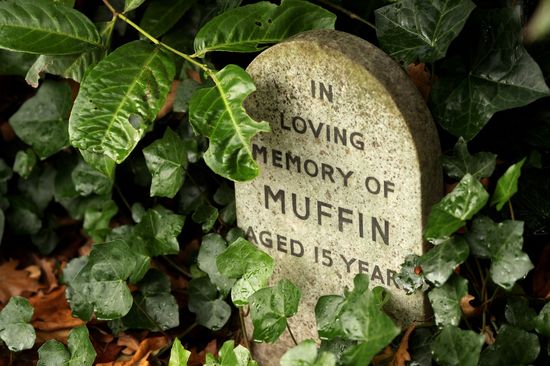
Contributing to a book called Making Animal Meaning, anthropologist Jane Desmond has written about the power of pet obituaries to subvert the animal-human boundary and thus to unnerve a healthy segment of the human population. Some years ago in the Iowa City Press-Citizen, Desmond's local newspaper at the time, an obituary was printed for a black Labrador dog named Bear—the first animal obituary published by the paper. Bear, who frequently walked along, and napped on, the town streets, had been known to many locals. Even so, that brief obituary, writes Desmond, "became the cause of bitter debate" in the community. Especially offended was a woman whose sister-in-law's obituary had appeared on the same page as Bear's.
(Photo: A gravestone for the deceased pet 'Muffin' stands in the Hyde Park pet cemetery on November 18, 2010 in London, England. The cemetery is situated in the small garden of Hyde Park's Victoria Gate Lodge and was created in the 1880s. It contains over 300 graves although the last pet was laid to rest in 1976. George Orwell is reputedly to have described the cemetery as 'perhaps the most horrible spectacle in Britain' By Oli Scarff/Getty Images)
by Patrick Appel
What caused it?:
If walking is a casualty of modern life the world over—the historian Joe Moran estimates, for instance, that in the last quarter century in the U.K., the amount of walking has declined by 25 percent—why then do Americans walk even less than people in other countries? Here we need to look not at pedometers, but at the odometer: We drive more than anyone else in the world.
by Maisie Allison
The Obama campaign holds onto evidence of Romney's "severe" conservatism as the general election looms:
Jamelle Bouie parses - and applauds - the strategy:
Romney’s strength is that he makes a great first impression—he seems reasonable, confident, and competent. Attacking him as a “flip-flopper” only reinforces that view, and makes him seem less threatening to voters who aren’t sure that they want to support a Republican. Alternatively, by attacking him as too conservative, Democrats remind the public of its dislike for the GOP, and tie Romney to the most unpopular elements of the conservative agenda. It also helps that the former Massachusetts governor is also working to define himself as a conservative, in order to secure support from the Republican base.
Meanwhile, the Herman Cain subplot gets weirder:
Previous Ad War Updates: Apr 10, Apr 9, Apr 5, Apr 4, Apr 3, Apr 2, Mar 30, Mar 27, Mar 26, Mar 23, Mar 22, Mar 21, Mar 20, Mar 19, Mar 16, Mar 15, Mar 14, Mar 13, Mar 12, Mar 9, Mar 8, Mar 7, Mar 6, Mar 5, Mar 2, Mar 1, Feb 29, Feb 28, Feb 27, Feb 23, Feb 22, Feb 21, Feb 17, Feb 16, Feb 15, Feb 14, Feb 13, Feb 9, Feb 8, Feb 7, Feb 6, Feb 3, Feb 2, Feb 1, Jan 30, Jan 29, Jan 27, Jan 26, Jan 25, Jan 24, Jan 22, Jan 20, Jan 19, Jan 18, Jan 17, Jan 16 and Jan 12.
by Chris Bodenner
A reader writes:
Much as I love Bruce Bartlett for many many things, his VAT hobby horse just drives me up the wall. The implementation of a value-added tax without the wholesale radical changeover to a VAT from the current system of state and local sales/use and income taxes would be insanely complex and beyond impossible to administer for businesses/individuals. Just what a nightmare. (Full disclosure: I’m a sales tax and VAT accountant and his VAT plan would be very much in my personal economic interest; I’m still against it.)
Another writes:
Let me join what will no doubt be a horde of respondents casting doubt on the advisability of swapping income taxes for a sales tax. Such taxes are highly regressive in nature.
The person making 24k a year – basically scraping by month to month – is taxed on all of their purchases while the person with earnings well above their cost of living can bank their savings, allowing their wealth to grow over time. They are also far more likely to be spending outside of the country and bypassing US consumer taxes altogether. A 10% increase in the cost of milk is a much bigger deal for a single mother of three than for an investment banker.
The same host of lobbyists who have made the US tax code such a byzantine mess will descend on any sales tax measure with glee, arguing for exemptions based on whether or not a good is "essential" or not. I live in Canada, where federal and provincial taxes are relied upon heavily and there all sorts of elaborate rules concerning how they are applied. Peanuts and salt are not taxed because they are "food". Salted peanuts are taxed as a "snack". Bread isn't taxed, but tampons are.
People are given "refunds" of sales tax based on their declared income as a means of mitigating the regressive nature of the tax, but again, how these refunds are calculated and applied varies by province and administration year to year. The suggestion that a tax system based on sales taxes ends the complicated and interminable dance of politicians and lobbyists is naive in the extreme.
Another:
Sorry, but the Graetz plan will have essentially no effect on the real complexity of the tax code. Probably 99% of the tax code is built around dealing with problems caused by people who make more than $100,000 and on figuring out exactly how much money someone makes. None of that would go away. In fact, I'm not sure I can think of a provision other than the rates for people with less than $100,000 in income and, apparently, the earned income credit that would go away.
Take my wife as an example. She runs her own business. The annual gross is significantly above $100,000, but that's before expenses and deductions for health insurance and her IRA. To figure out whether she owed taxes, under the Graetz plan, she'd have to do exactly what she does today. This would be true for any business that grossed at least $100,000.
What the Graetz plan would do (which is no small thing) is eliminate the complexity of compliance for a large segment of the population. Although the 1040EZ and 1040A are very simple forms, many people are scared of them, and there would be a real benefit to eliminating the obligation to file for so many people. The issue is whether the benefits would be worth the tradeoff from adopting a VAT, which is, after all, a regressive tax that would hit the people who are supposed to benefit from the plan much more heavily than the people who would continue paying income taxes. For someone in the current 10, 15 or maybe even 25 percent bracket, the VAT might well cost more than the income tax.
 The Dish