Growth Increases Death

by Maisie Allison

Suzy Khimm examines the unusual correlation: 

Perhaps there’s more job-related stress when employment goes up, resulting in less healthy behavior and less time for exercise. Or maybe more folks are dying in auto accidents as they drive to work. But researchers at Boston College’s Center for Retirement Research believe there’s another explanation. In a new paper, researchers argue that economic boom times create a scarcity of caregivers in nursing homes, raising the mortality rate through a disproportionately high numbers of deaths among the elderly

The Danger Of Going Public


by Patrick Appel

Felix Salmon is wary of IPOs:

Going public might be good for a company’s investors and employees, but it is usually bad for the company itself. It forces CEOs to focus on short-term stock fluctuations at the expense of long-term growth. It wrests control from the founders and gives it to thousands of faceless shareholders. For hugely successful mega-businesses—Apple, Facebook, Google—going public has its benefits. Public companies enjoy cachet, tax advantages, and access to more and better financing options. But for many young companies, the drive to go public results in a death spiral of unsustainable growth.

Does Cannabis Increase Creativity? Ctd

by Chris Bodenner

Another reader addresses the question:

It depends on the variant. Sativas give you a burst of energy and make you want to do things and see it to its completion. Great for housework, not so great for writing a novel. Indicas make you a body-heavy couch potato. Great for relaxing, again, not so great for writing. However, an indica/sativa or a sativa/indica hybrid has enough body relaxations that I don't mind the long stretches of focusing and only typing, The sativa part will bring enough spark to the mind's energy that ideas click and I end up doing victory dances at the end of scenes.

More on the sativa-indica distinction:

Indicas are very effective for overall pain relief and is often used to treat insomnia for many people. Indica buds are most commonly smoked by medical marijuana patients in the late evening or even right before bed due to how sleepy and tired you become when high from an indica strain of marijuana, like Kush.

Benefits of Indica:
1. Relieves body pain
2. Relaxes muscles
3. Relieves spasms, reduces seizures
4. Relieves headaches and migraines
5. Relieves anxiety or stress

Sativa dominant marijuana strains tend to have a more grassy type odor to the buds providing an uplifting, energetic and “cerebral” high that is best suited for daytime smoking. A sativa high is one filled with creativity and energy as being high on sativa can spark new ideas and creations. Many artists take advantage of the creative powers of cannabis sativa (marijuana) to create paintings.

Benefits of Sativa:
1. Feelings of well-being and at-ease
2. Up-lifting and cerebral thoughts
3. Stimulates and energizes
4. Increases focus and creativity
5. Fights depression

To keep the creativity flowing, Scott Morgan has tips on how to avoid getting busted with pot.

Forecasting The Iran Negotiations

by Zack Beauchamp

Laura Rozen plays down expectations:

Few analysts I spoke to expected the day-long Istanbul talks to be sufficient time to hammer out any sort of agreement. They suggested that Western negotiators may be looking to Istanbul as an opportunity to observe Iranian negotiators’ body language and see if there is receptivity for further meetings in the coming weeks.

Gary Sick expects the sanctions to determine the outcome:

In a way, it will be a race to see who is hurt the most by sanctions. They are aimed at Iran, of course, but they will also have a direct impact on the price of oil – which means the price of gasoline and its ripple effects on economies that are already vulnerable as they struggle to recover from the recent recession. President Obama is gambling that Iran will be hurt most, and soonest, leading to concessions. But the damage of higher oil prices to Western economies could have equal or even greater negative impact on our own economies at a very delicate moment. 

Reza Marashi and Ali Reza Eshraghi compile historical evidence about when and why Khamenei has been willing to compromise with the West.

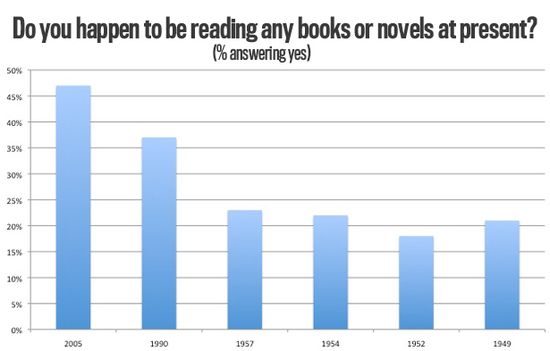
The Golden Age Of Reading

by Patrick Appel

Is now, apparently:

Reading_Books 

Alexis ponders the bar graph:

After I posted this chart, Twitter friends made some good points: 1) This chart does not establish that high-quality literature readers have increased. That is true. 2) There are a lot of factors that go into these numbers and variables that are unaccounted for. 3) The big spike is partially driven by higher levels of higher education attainment. 4) Perhaps the quality of books has fallen, even as the number of readers has grown.

Point four comes with an embedded assumption that the books of the past were, on average, better than the ones today. But we tend to judge the past by the very best books (Nabokov!) and the present day by the worst books (Snooki!). The bad ones of yesteryear have gone out of print while the bad ones of today are alive and being sold in supermarkets. 

Bush’s Tax Victory

by Patrick Appel

Ezra Klein acknowledges it: 

For all that Democrats talk about returning to the Clinton-era tax rates, they only ever mean for the top two percent of taxpayers — the folks who are now in the 35% bracket, but whom they would like to see in a 39.6% bracket. The reality is that, on tax policy, Democrats are now closer to Bush than to Clinton. But neither side much likes to admit that. For Democrats, it means confessing to how far right they've moved on taxes. And for Republicans, it means admitting how far right Democrats have moved on taxes.

Silly Adult, Those Books Are For Kids, Ctd

by Chris Bodenner

A reader points out:

Catcher in the Rye and To Kill a Mockingbird are young adult novels, you know. Many young adult novels are just "novels" made accessible for teenagers, because they're the ones in the thick of the angst that the "adult novelists" write about for the rest of their lives. That's what I like to tell myself while I'm writing my YA novel, anyway.

Another thing To Kill a Mockingbird and Hunger Games have in common: they're both on the top-10 list of banned books in school libraries. Another reader:

I was in the midst of the last the Harry Potter book when I was still traveling too much for business.  I cannot tell you have many adults would see what I was reading – on the bus, airplane, hotel lobby etc. – and start up a conversation around the book.

Even one of my clients saw the book in my bag and spent 15 minutes of a 30-minute critical business meeting discussing the series.  These talks always started with the so-called children's book and progressed to more so called adult conversations. Not one of those conversation would have began without that so-called childrens lit book.  Even the client who saw the book called me two weeks later to discuss our business proposal but ended up talking about how were both bummed that Harry Potter finally ended. (He signed the business deal, by the way.)

Another:

My brother is 58. He had not read a book since high school until a coworker lent him Twilight. It lit him up like a Christmas tree. Now, a couple of years later, he has not stopped reading and his interests are broader and have included the likes of Tom Clancy and other challenging adult fiction. It won't surprise me a bit if he reads, and loves, Hunger Games. More power to him.

And I too occasionally dip into YA novels by authors like Garth Nix, who also writes adult fiction. In truth some of them are every bit as good as their counterpart in adult fiction, if less demanding grammatically.

Previous discussion here and here.

Is The Buffett Rule A Meaningless Gimmick?

by Maisie Allison

According to Bloomberg, it would only affect 4,000 taxpayers. Josh Barro thinks it's unserious:

The most legitimately important loophole that allows people to avoid tax on unrealized capital gains is that when you die, your assets will have their basis “stepped up” to their value at your death, meaning your heirs avoid tax on all the gains during your lifetime. But the solution to that problem is to eliminate the step up in basis, not to introduce the Buffett Rule.

Ezra Klein differs:

The Obama administration has released a series of deficit-reduction proposals that cut or raise around $4 trillion over the next 10-12 years. Their 2013 budget, for instance, included $1.5 trillion in specific tax increases, and trillions more in spending cuts. The Buffett Rule is one particularly high-polling policy among many. Meanwhile, it’s $47 billion more in loophole-closing than either Ryan or Romney have offered. 

Philip Klein counters

 As Vice President Joe Biden tweeted earlier today, "I’m for the Buffett Rule because it just makes sense. Like the President says—it’s not class warfare. It’s math." In reality, it raises just $47 billion over a decade, or less than one percent of the $6.4 trillion in projected deficits during the same period under Obama's budget. By pointing out this actual math, all critics of the "Buffett rule" are doing is showing that the proposal is, in fact, more about class warfare.

Andrew Leonard also sees the Buffett rule as a political half-measure:

It’s a rhetorical measure, designed to rev up his base and capitalize on populist resentment. That’s all well and good in an election year, but if Obama really wants to make a promise that means something, he should be shouting from the top of every hill and mountain how this time he really is going to let the [Bush] tax cuts expire … vowing to let the Bush tax cuts on the wealthy expire means something. Pushing for the “Buffett rule” does not.

Indeed, the rule would have a tiny impact on the deficit. But despite the crass demagoguery, it presents a framework for broaching the revenue debate even if the goal should be radical tax reform. As Jared Bernstein concludes

Any time we can close a tax loophole and generate both more fairness and any level of fiscal improvement we should do so. And according to the official scorekeepers, compared to the revenues we expect to collect under current law, with the Bush tax cuts sunsetting as planned at the end of this year, it raises about $50 billion. Compared to current policy – if we leave the tax cuts stay in place – it raises $160 billion. … [T]he typical middle-income household pays about the same federal income tax rate (13 percent), as 10 percent of millionaires ($1-10 million, 15 percent), multi-millionaires ($10-100 million, 14 percent), and multi-multi-millionaires ($100 million +, 12 percent). So, yeah … I’d say that until we can overhaul our tax code, we need the Buffett rule.