The Daily Wrap

6a00d83451c45669e2016303f1b2c5970d-550wi

Today on the Dish, Maisie compiled reax to Santorum's drop out and I defended the idea that the man had legitimate appeal inside the GOP. Chris thought through the phenomenology of asexuality and implored you to Ask Jennifer Rubin Anything, Patrick posed a tough question for Ross Douthat, and I both sharpened the liberal/neoconservative line on foreign policy and explored a justification for US global military presence. We fit Romney into a chameleon suit and explained the real reason a veep matters. Ad War Update here.

We also checked a new study on Obamacare costs, looked at the View from Your Recovery, explored a quick path to tax simplification, battled with IRS bureaucracy, worried about privacy in a cashless world, cautioned against smartphone addiction, and broke down the evidence about putting head shots in resumes. Student debt exploded and alumni offered loans.

Libya's future was murky and Assad buckled. We questioned the durability of federal marijuana laws, debated pot's creativity-enhancing effects, noted that caffeine could theoretically make you lazy, and warned against the dangers of sitting. The morality of procreation discussion moved away from abstraction, nose erections were a thing, and readers aired thoughts on YA books (here) the comparison between injuries in football and hockey (here and here). Ask Charles Murray Anything (on his marriage equality conversion) here,VFYW Contest Winer here, VFYW here, FOTD here, and MHB here.

Z.B.


“Isn’t That Parenthood?”

by Patrick Appel

A hope-filled story that may leave you wiping tears from your eyes:

How does Ross Douthat, who argues that well-adjusted individuals have a duty to bring children into this world, square that position with his opposition to marriage equality? If the tender loving care shown in the video above isn't an example of model parenting, I don't know what is.

Will Obamacare Increase The Deficit?

by Patrick Appel

Nobody knows for certain:

In a new study, Chuck Blahous, who is a public trustee for Medicare and Social Security, concludes that the 2010 health law will add at least $340 billion to the federal deficit from 2012-2021. This is contrary to the official estimates by the Congressional Budget Office, which initially figured the Affordable Care Act would reduce the deficit by about $132 billion from 2012-2019. Who’s right? Who knows? In truth, unknowable and unpredictable changes in overall health costs will dwarf the variation between Chuck’s estimate and CBOs.

Ezra Klein takes Blahous's estimate much less seriously.

Santorum’s Last Laugh

GT_SANTORUM_120410

by Zack Beauchamp

So Santorum up and left, taking with him the last vestiges of interest in the GOP primary. But the fundamental problem Santorum exposed inside the GOP hasn't been resolved – the party is still primed for a savior, not a candidate.

Despite Santorum's very "Washington" background, he somehow became the hope for Republicans fed up with Romney's perceived moderation. The reason is Santorum's perfect dogmatism: he has a consistent record (with only minor heresies) of taking the most hardline conservative position both in speech and in deed. No one, as often stated during the campaign, doubted the sincerity of his positions. And unlike the other competitors for the "most conservative" belt over the course of the cycle – Bachmann, Cain, and Perry – he managed to sustain his surge by failing to implode as spectacularly either of these people. He was, in short, the only consistent, solid hard-right champion in the race.

But no more than solid.

Santorum was uninspiring and perpetually underfunded, unable to persuade almost anyone that he was a serious candidate until the structural barriers to victory were nearly insurmountable. And yet, he still managed to get a bunch of Republicans – particularly evangelicals, judging by election returns – to join Team Rick.

This wasn't, as Jon Chait puts it, "entirely the function of his being a Republican not named Romney," – otherwise, why Santorum and not Gingrich? Understanding Santorum's success as a consequence of ideological appeal beyond the "warm body" factor best explains his consistently high favorability ratings among Republicans.

This interpretation suggests that a conservative firebreather need not flame out a la Bachmann. His campaign is proof of concept for the theory that one can both be a demonstrably committed rightist and make a serious bid for the GOP nomination for the White House.

The obvious conclusion is that, assuming Romney loses in 2012, the candidate best positioned to win the GOP nod next time around will be someone with Santorum-esque views with an extra dollop of political talent. There's no necessary reason that someone with hard-right views has to have weak electoral skills, and Santorum's shifted the Overton Window enough that someone like him can't be disregarded out of course in 2016. That's when we'll see how this ends.

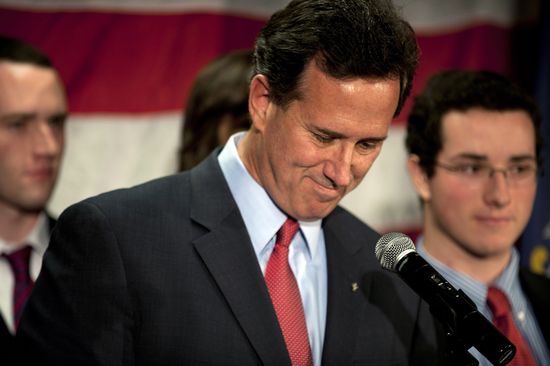
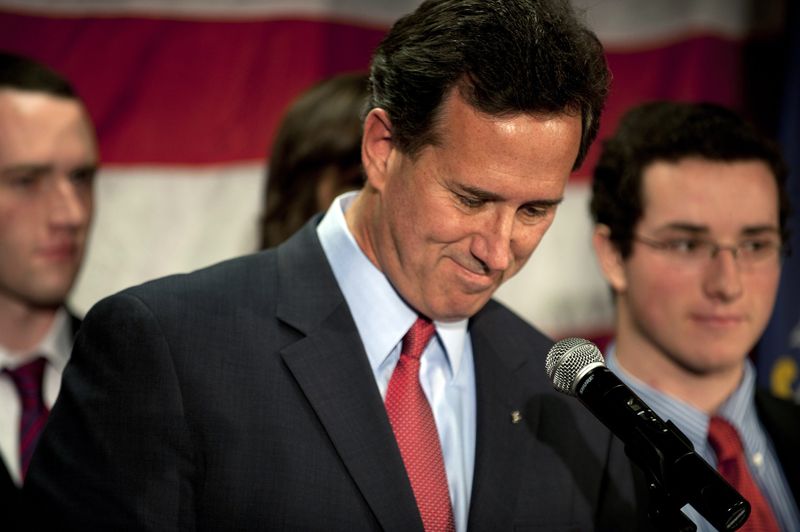
(Photo: Surrounded by members of his family, Republican presidential candidate, former U.S. Sen. Rick Santorum announces he will be suspending his campaign during a press conference at the Gettysburg Hotel on April 10, 2012 in Gettysburg, Pennsylvania. Santorum's three-year-old daughter, Bella, became ill over the Easter holiday and poll numbers showed he was losing to Mitt Romney in his home state of Pennsylvania. By Jeff Swensen/Getty Images.)

The Political Chameleon

by Patrick Appel

Tomasky's theory of Romney:

He’s not conservative, but he’s not moderate either. Why people assume he must be one or the other is another puzzle, because there is a third choice, which is the correct one: none of the above. He’s everything, he’s nothing; he’s whatever he needs to be. And he has shown no political courage to buck his party’s establishment at any point in his career (pursuing health care in Massachusetts was hard, maybe, but not exactly an act of ideological daring). So, if he ever is president, he’ll be whatever the situation requires, which, given that he’ll be the head of a severely right-wing party, means that he’ll be pretty severely right wing.

Why Do We Have Children?

by Patrick Appel

Millman counters Douthat:

[D]o people really have children based on an abstract obligation? When people do have children out of obligation, it’s not generally abstract – it’s concrete. I’ll have this kid to please my mother, or my husband, or to win the battle of the womb with the Zionist enemy. Those don’t sound like the kinds of motives that Douthat is aiming for.

And when people undertake to live their lives based on an abstract principle, there’s generally (in my experience) a concrete motive underneath. And, of course, the same thing is true on the other side of the ledger. I refuse to believe that there is a single human being who has refused to have children because of some abstract argument about the environment or some such. There’s bound to be a much more concrete reason, with "the environment" serving as a useful piece of intellectual justification.

Boxing On Ice, Ctd

by Chris Bodenner

A reader stresses the importance "enforcers":

Fighting in hockey is not "superfluous"; it's a necessary way of protecting the players on the ice. I know it sounds counterintuitive, but you need to follow hockey to get it. Fighting is a both a threat and a punishment for players who throw dirty hits. The teams that fight, that have players that stand up for one another, rarely see cheap hits against them. (The Bruins and the Rangers are the best example of this.) Because of the nature of hockey, it would be too easy for a fourth-line enforcer to destroy a first-line talent and take him out of the game if the only thing he had to fear was a suspension. Every player going up against the Bruins and the Rangers knows that they will be punished right then and there if they do not make good, clean checks.

Another adds, "Without the fight to settle the matter, I believe there would be a tit-for-tat of dirty and questionable hits that would make the game more dangerous." Another writes:

Actually, the set enforcer is a fading job in the game today.

While it is true that players who can handle themselves in a fight are highly valued by many organizations, there is no longer much room in most lineups for a player whose sole job is to fill that enforcer role as defined by your reader. (Hence Brian Burke's lament about his enforcer Colton Orr this season.) The game has gotten so fast and has put such a premium on skill that if you can't skate and play at both ends of the ice, you're being pushed out of the NHL. And there are teams like my Detroit Red Wings that don't even put a premium on guys who can skate, shoot, hit AND fight. They're more than satisfied with the first three.

One final point to contradict your reader: it's not just refusing to ban fighting that has the NHL's efforts to solve the concussion problem coming up short. The League has also refused to institute a head contact ban. The old guard has argued that it would take hitting out of the game entirely because players will be too afraid to try any hit whatsoever. Yet smart money says that with coaches still demanding the utmost intensity from their team, players would adjust. They'd find a way to be responsible for their bodies in a hit much like they are expected to be responsible for their sticks regardless of the circumstance (even an inadvertent light tap above the shoulders with a stick is a penalty).

The closest we've come to a head contact ban is a rule against blindside hits where the head is the principle point of contact. NHL disciplinarian Brendan Shanahan has interpreted that somewhat loosely at times, to be sure, but nonetheless, needless concussions continue, largely due to the game's elder statesmen leaning hard on outdated thinking. That, coupled with an increased enforcement on boarding (hits from behind into the boards) and charging (mainly enforced as leaving the ice to make a hit), have helped, but there is still plenty of work to be done at the pro level of hockey.

So while the NFL has much more it can do to address the crisis, at least it has banned the obvious hits to the head. Both Leagues will have to address this issue more comprehensively sooner or later. I keep pulling for the NHL to get it on the sooner side, but progress has been slow.

Another adds:

While your reader is correct in noting that the NHL has attempted to deal with head injuries and violence, things are not as rosy as implied. There's a sense that, after starting with tough sanctions, Brendan Shanahan has gotten more lenient over the course of the season and that he's been "gotten to" by general managers and coaches who don't want players suspended for long periods of time.

The best way to move the game to one of more speed and agility and away from brute strength would be to increase the size of the rinks to those used in international play. That, of course, would cost owners money in terms of both construction costs and lost seats.

Another reader takes on Gopnik's analysis:

Anyone who is writing about fighting and hockey and says "No sane argument can be made that fighting contributes anything of value to the sport" and then claims " The proof, definitive, is that both Olympic hockey and women's hockey are played without any fighting at all and delight far more than the NHL's ever more corrupted form of play" can't possible be taken seriously.

There are plenty of arguments to be made that the value of fighting in hockey is negative but to claim there isn't anything of value added is absolutely nuts. It is difficult to compare the Olympics (a short tournament) to the NHL season. If there is a dirty hit in an Olympic game, the teams often won't be facing each other again. In the NHL, teams can face each other as much as 6 times in the regular season, let alone the playoffs where they face each other anywhere from 4 to 7 consecutive games.

Remember the Todd Bertuzzi/Steve Moore incident where Bertuzzi broke a bone in Moore's neck? I won't get into the debate on that specific incident but it started because Steve Moore, in a previous game, committed a very dirty hit on one of Vancouver's best players, Naslund, and Bertuzzi did that to him because Moore wouldn't fight him. The end result to eliminating fighting will not only likely increase dirty plays but most likely astronomically, as the responses won't be fights but spears, butt-ends, slew foots and slashes.

But the even more ridiculous claim is that women's hockey "delights far more" than the NHL. Give me a fucking break. It's a terribly stupid argument with absolutely zero evidence to support it, unless I'm missing the massive women's professional hockey league that averages filling up buildings with 17,000+ fans a night and massive national TV ratings.

One big solution to fixing the problem of head injuries? Get rid of enforcers. There are plenty of teams that don't have them. My favorite team, the San Jose Sharks, doesn't have one. They have guys that are tough and will fight but they don't have any enforcers playing for them. What the sport should be trying to eliminate is the guys who essentially are only there to fight.

Asexual Isn’t Anti-Intimacy, Ctd

by Chris Bodenner

A reader writes:

I just wanted to thank you for your continuing efforts to raise awareness about asexuality to your readers. I'm a junior in college, and I've been struggling to get people to take me seriously when I tell them I'm asexual. Some friends have said my standards are simply too high, some said I'm too socially awkward. It's demeaning, but I don't feel like I have a right to complain. Compared to other members of the LGTBQA community, asexuals probably have to deal with less intolerance and violence. No one calls me a sinner or a freak, or tells me I don't have a right to be married. We don't get beaten or murdered because of who we are. Really, I shouldn't complain.

But apparently I don't have the right to not be sexually active, or interested.

I was a little worried in high school because I didn't know I could be interested in men without being sexually interested in them. What was I? No one could tell me. I'm not religious enough to use that as a cover for my lack of physical attraction to people. I'm scared of being in relationships because it seems like everyone expects sex after a certain point in time. How am I suppose to say "It's not you, it's me" and be taken seriously?

Whenever I'm feeling at my lowest, though, someone somewhere says something about asexuals and how we exist. How we have feelings. How we do love and want to be loved, even if we're uncomfortable with physical love.

One thing I've always wondered about asexuals: is their feeling toward sex more of an indifference or outright revulsion? As in, would an asexual be willing to tolerate a certain amount of sex with someone he or she loved if the significant other was not asexual, similar to the way many couples tolerate each other's kinks? I asked our reader for her take:

Honestly, from what I've learned about others, it really depends. Some, like myself, feel more willing to accommodate someone we trust, like indulging a kink, while other asexuals I know feel incredibly uncomfortable with the idea of sex, some even with themselves. There are different levels, it seems, not just one answer across the board.

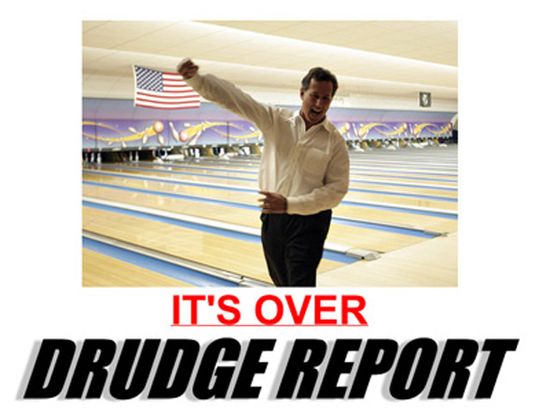
Santorum Leaves The Race: Reax

Rick-santorum-drudge

by Maisie Allison

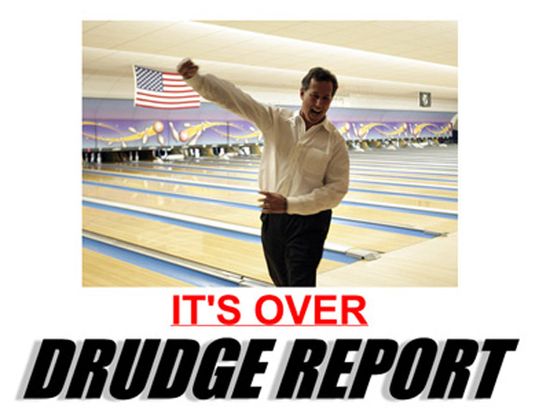
Santorum has officially suspended his campaign before Pennsylvania votes in two weeks, quietly acknowledging Romney as the nominee (without mentioning him) and referring to his daughter Bella's illness. Steve Benen admits that Santorum's run was "one of the most impressive things I've seen in presidential politics in quite a while":

For months, Santorum failed to raise money, failed to hire a campaign staff, failed to create a campaign structure, failed to create a base of supporters, and failed to impress in the endless stream of candidate debates. A couple of weeks before the Iowa caucuses, Santorum was in the low single-digits in national GOP polls — he was neck and neck with Huntsman — and was generally considered an afterthought, when he was considered at all. And yet, despite having very little money, no staff, no organization, few endorsements, an unimpressive legislative record, and a weak message, Rick Santorum managed to beat Mitt Romney 10 times during the Republican nominating race (Iowa, Colorado, Minnesota, North Dakota, Oklahoma, Tennessee, Kansas, Alabama, Mississippi, and Louisiana). 

Philip Klein likewise deems Santorum's unexpected campaign a professional success:

Nobody gave him a chance to do much of anything, given that rival candidates had more money and more sophisticated organizations. But he ran a tough, grassroots campaign, building off of a surprise victory surge in Iowa to drag out the race a lot longer than anybody thought he could, eventually winning in 11 states. Now he'll come out of the race with a much higher profile when he started and with an image as a tenacious campaigner.

Mataconis echoes:

What nobody accounted for, I think, is the impact that SuperPACs were going to have on the race and the manner in which they let a shoestring candidate like Santorum go much further than he otherwise would have. That, combined with the fact that the conservative base in the GOP spent much of January and February still wanting a way to voice their uneasiness with Mitt Romney, is what ended up helping Santorum get as far as he did.

Chait doubts Santorum will be viable in 2016:

Santorum’s success was entirely the function of his being a Republican not named Romney who happened to be there when every other alternative had either been destroyed by Romney’s money or collapsed on its own. It is truly rare for a campaign to feature both a wildly vulnerable front-runner and a long list of candidates who could probably have the nomination but chose not to run. In 2016 (or 2020, if Romney wins) one of them — Mitch Daniels, Jeb Bush, Chris Christie, Paul Ryan, Marco Rubio, or someone else with political talent — will be on the ballot. The notion that Santorum might position himself as next in line is comical.

Ed Kilgore's view

There will be some what-ifs expressed about Santorum, particularly from those who think he self-destructed by getting a little too theocratic. I’m personally already on record as disagreeing. He danced with the ones that brung him: the people who think legalized abortion is a Holocaust, that same-sex relationships are a sign of moral collapse, that “traditionalist” Catholics and evangelical conservatives represent the only line of resistance against a Satanic takeover of the West, that a Middle Eastern Holy War is America’s destiny. 

Erick Erickson has already moved on

Romney’s campaign has used a money advantage to shut out the competition. As I said when he won Ohio, Romney will be the nominee. The way forward for Romney depends on the economy. For the longest time I did not think he had much of a shot against the President, but as I’ve said several times recently, the economy seems to be struggling, which gives Romney an opening.

Weigel downplays Santorum's efforts to stymie Romney's path: 

The first credible Mormon presidential candidate, a former pro-choicer who passed a mandate-based health care reform in his state, was never going to waltz to the nomination. If it wasn't Santorum taking Deep South states, it would have been someone else — a Rick Perry with the ability to make his synapses crackle from time to time, maybe.

Josh Barro wonders if Mitt will now abruptly tack to the center: 

Romney has shown an unusual ability to slide seamlessly from one position to the opposite. And even in the primaries, when he saw a political advantage in moving to the left–as he did with Rick Perry and Social Security–he did. With Santorum out of the way, the calculus will change sharply and Romney will have a lot more to gain from being a “moderate” than he did a month ago. We’ll see how much he changes as the weather warms.

Alex Seitz-Wald offers something of a Santorum highlight reel. Foreign policy highlights here