by Chris Bodenner
No, not "Your Moment Of Andrew":
by Chris Bodenner
No, not "Your Moment Of Andrew":
by Patrick Appel
Just under 15 percent of presidents have died in office:
I think the typical party (and chattering class) goals — pick a person who “balances” the ticket, or adds some geographic pull, or shakes up the narrative — are wrongly forwarded over the more basic idea of picking someone who would be a competent President and a compelling leader for the party and its ideological goals if they were at the top of the ticket. Because there’s a serious chance — much higher than most people assign at any rate — of them actually being the President at some point in the following eight years.
by Zoë Pollock
You're getting one all the time:
At a given moment, if you’re breathing through your nose, the lion’s share of the air is going in and out of one nostril, with a much smaller amount passing through the other. Every few hours, your autonomic nervous system, which takes care of your heart rate, digestion and other things you don’t consciously control, switches things up and your other nostril does all the heavy lifting for a little while. The opening and closing of the two passages is done by swelling and deflating erectile tissue – the same stuff that’s at work when your reproductive organs are aroused – up in your nose.

Tripoli, Libya, 3.30 pm
by Zack Beauchamp
If Jonathan Levine is right, then it's peace in East Asia:
Though China now has the largest military in the world, nuclear weapons and the second-largest economy, fear and distrust of Japan is primal. Though the idea of a resurgent Japanese threat to Asia may be laughable in the West, it is very real in Beijing—and this paranoia should not be dismissed so blithely. In the East, it has long been an article of faith that the U.S. security umbrella keeps a lid on Japanese militarism.
When Xi Jinping calls for an American role in East Asia, his sentiments seem genuine. If American soldiers were to leave Japan, or the Japanese-American security treaty were allowed to expire, the Japanese would likely reconstitute their military: exactly what Washington hopes for and Beijing dreads. Withdrawal of U.S. protection would lead to the emergence of a classic security dilemma, with Japan racing to narrow a glaring imbalance of capabilities with China.
This is an important point. People often wonder why, given the relative peacefulness of our time, why the United States needs to maintain a global military presence. Part of the answer is that said military presence helps maintain said peacefulness, oftentimes in ways we can't entirely entirely understand or predict. That's not a blanket justification for our currently absurd levels of defense spending, mind you, but it is a warning about against the unintended consequences of mass base shuttering or overbroad, poorly targeted cuts. Hans-Inge Langø goes in-depth on how China's military growth might alter this dynamic.
by Chris Bodenner
As one of the most prolific conservative writers in the blogosphere, Rubin needs no introduction to the regular Dish reader, but you can read about her background here. See what she's blogging about today here. You know the drill by now: Submit a question in the Urtak poll embedded above (ignore the "YES or NO question" aspect in the text field and simply enter any open-ended question). We have primed the poll with questions that you can vote on right away – click "Yes" if you are interested in seeing Jennifer answer the question or "No" if you don't particularly care. We will air the answers in daily segments soon.
By the way, even if you initially responded to the Tyler Cowen poll we posted yesterday, readers have added many more questions since then, so have another go if you haven't already:
by Patrick Appel
Bruce Barlett endorses a clever way to simplify the ridiculously complex tax code:
One idea is to do what Gen. Douglas MacArthur did during World War II — bypass enemy strongholds, leaving them isolated and relatively harmless. Prof. Michael Graetz of Columbia Law School has proposed what I believe is a MacArthur-like solution to tax reform. He would abolish the income tax for the vast bulk of Americans and replace the revenue with a 12.5 percent value-added tax. People would pay their taxes when they buy things and wouldn’t need to worry about keeping records or filing tax returns at all.
The brilliance of the Graetz plan is that no tax expenditures need to be repealed. He would simply give every family a tax exemption of $100,000, which would eliminate the income tax for 90 percent of those now filing returns.
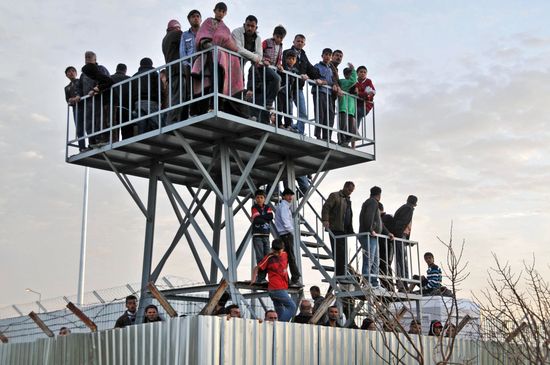
Daniel Serwer proposes a list of nine alternative options the international community could use to end the violence. His takeaway:
Splits in the opposition, including a Kurdish walkout, will give [Bashar al Assad] renewed confidence. But the Syrian regime is on the economic ropes and will not be able to eliminate a resistance that is now widespread and broadly (but not universally) supported by the population. We need to hang tough for the long haul, as we did in Burma, making sure time is not on Bashar al Assad’s side.
David Blair worries that the opposition's heavy use of social media is increasingly self-defeating:
Assad’s security men can identify their enemies simply by hacking their Facebook and Twitter accounts. Once compromised, these will obligingly yield reams of conveniently listed “friends” and “followers”. Worse, the activists will probably have no idea what has happened, allowing Syrian intelligence to learn all about what they are doing, before choosing the moment to strike. And social media can also be turned against its users, with the creation of fake activists, stolen identities, lies and disinformation.
(Photo: Syria refugees watch the border from Oncupinar Refugee Camp on April 9, 2012 in Kilis. Two other Syrians and Turkish translator were wounded near a refugee camp in the same area when shots were fired from Syria, as border tension escalated ahead of a visit by top international mediator Kofi Annan. 'There are too many wounded, we brought only as many as we could,' said one of the people from the group that carried the wounded into Turkey. By IHA/AFP/Getty Images.)
by Zoë Pollock
A novel approach to the explosion of student loan debt:
The company [SoFi] is creating university-specific funds for alumni to invest in, and those are used to make loans to students. SoFi says it’s offering to cover the full cost of attendance for participants, with loans ranging from $5,000 to $200,000. The loans are 6.24 percent fixed rate, and they can drop to 5.99 percent, lower than federal Stafford and PLUS loans and many private loans. So students get relatively low interest rates, while alumni get a significant financial return.
Walter Russell Mead is optimistic:
SoFi doesn’t just connect students with alumni money; it also allows alumni to play an active role in mentoring the students they support. Students get guidance to go along with their loan, and the alumni get a chance to help the next generation, as well as play an active role in making sure students are equipped to pay the loans back after they graduate. … [B]y giving students access to experienced mentors it can help students avoid some of the worst pitfalls of the present system.
by Patrick Appel
A new paper considers the future of marijuana regulation:
Perhaps a better analogy than prohibition is, oddly, file-sharing. For years, the recording industry pursued in court those it believed were illegally sharing copyrighted music and videos online. Armed with a federal statute that permitted damages of up to $150,000 per violation, the industry sought to collect not just from entities like Napster and Grokster that facilitated file-sharing, but also from those individual consumers it believed were doing the actual sharing.
The industry sued as many as 35,000 people between 2003 and 2008 including, according to the Wall Street Journal,"several single mothers, a dead person, and a 13-year-old girl.", The result of this campaign was terrible publicity, relatively modest recoveries, and a steady drop in album sales." In November of 2008, the industry had had enough, announcing it would stop suing individuals and would seek to enforce its copyrights by other means. Facing a yawning gap between the legal definition of copyright infringement and the way the activity was perceived by consumers (particularly young ones)," the industry was forced to acknowledge that it had lost the war on the ground.
As with file sharing, the disconnect between the law as written and the conduct on the ground may simply have gotten too great to be tenable going forward. Although the federal government continues to assert that marijuana is a drug with no acceptable medical uses, majorities in more and more states are coming to the contrary conclusion.
 The Dish