The View From Your Window Contest: Winner #97

Vfyw_4-7

by Chris Bodenner

A reader writes:

Could this be Gibraltar’s airport? My husband and I went there in 2001. It was a “roots” trip: my paternal grandparents were born in Gibraltar and we hoped to get more info. The clerk at the government office that handles birth records suggested that we see if someone at a nearby church could help us, which turned out to be excellent advice. The church archivist went through book after book of records, constructing a family tree that went back seven generations. It was thrilling! We left Gibraltar on 9/8/01 and drove to Seville, a gorgeous city. And three days later, we turned on CNN in our hotel room and watched the Twin Towers collapse. We flew to Madrid and were so distracted that a pickpocket was able to remove my wallet on the elevator trip to our room in the Westin Hotel. Whether or not this photo is Gibraltar, you brought back memories of the most emotional vacation we ever had.

Another writes:

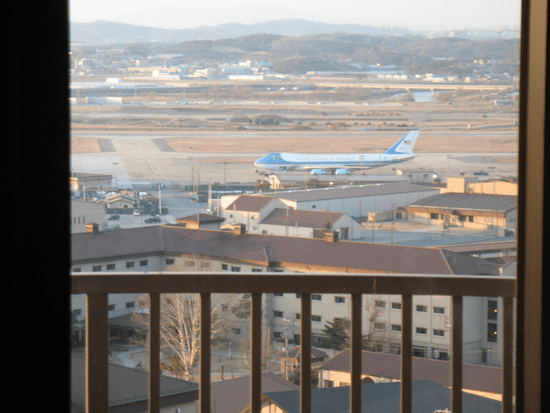
I’m a longtime Dish reader, but never played this game. That’s got to be somewhere on Andrews Air Force base in Suitland, Maryland.  I think that 747 parked on the runway there is Air Force 1, no?

Yes. Another:

Airport, river, bridge, mountains, Air Force Friggin’ One. So many clues and yet I could not positively identify the VFYW. This week’s contest was maddening.  I’m going with Burlington. I searched google maps for hours, looking at Tulsa, Phoenix, Las Vegas, Dayton, and Burlington. I though Burlington was the closest, but I still think I’m wrong. But hey, I guessed Puerta Vallarta and I got that right.

Another:

Capture

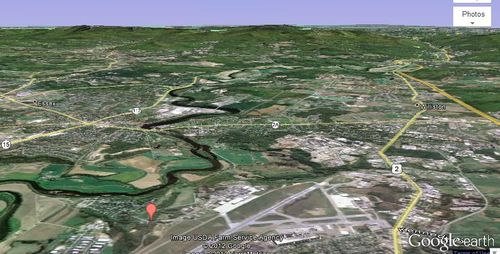
This is my first time entering VFYW but I think I got it.  Seeing Air Force One and using the White House schedule, I narrowed the possibilities to Burlington, VT or Portland, ME.  Since Portland doesn’t appear to have mountains in the background of the airport, I will guess this is the Burlington Air National Guard Base.  The attached map (couldn’t figure out how to drop it in!) shows the closest view I could get since street view isn’t allowed on a military base.  So here’s to guessing!
Another:

I believe this is Air Force One having landed at the military air base side of Galeao international airport in Rio de Janeiro, most likely during President Obama’s visit in March 2011.

Another:

Ramstein Air Force Base, Rheinland-Pfalz, Germany. The buildings look identical to those at Ramstein, and only at an Air Force Base would you see the airfield so close to such buildings.  My guess is that this picture was taken from the Tower and that it was taken during the President’s trip there in 2009.

Another:

This could be Ramstein Air Force Base in Germany. Why? I used to live in SW Germany. The hills look a lot like it. Air Force One on the runway without lots of guarding vehicles. Green painted trucks on the parking lot on left center picture. So it should be a secured US Air Base. The buildings in the front look like standard issue Army barracks. Ramstein is located in high hill country in SW Germany (see background) with seasonal moderate climate tree vegetation. Looks like fall or winter colors on the trees on the hills. Spring comes late to the German high country.

Another nails it:

I have been teaching English in South Korea for the past two years, and was waiting for a Korean VFYW!

Like every picture taken outside of Seoul, there are mountains in the background.  The trees have yet to blossom due to our drawn-out winter.  President Obama was just in town.  Osan Air base. Pyeongtaek, Songtan-dong, South Korea. Final answer.

An aerial view from a reader:

Vfyw-4-7-osan1

Another writes:

Being raised an Air Force brat the monochromatic buildings immediately made me think air force base.  Air Force one, winter-bared trees, hills, and river locate near runway made me think of Osan, though I was only there once on a stop over returning from Thailand during the Vietnam war.

Another:

I wonder how many military readers your blog has but count me among them. The view is from one of the residential towers on Osan Airbase looking out over the Turumi Lodge transient quarters toward the runway, probably from the 8th or 9th floor, as the apartment block is up on a hill. I’ve spent many nights in the Turumi while deployed to the Air Operations Center supporting various Seventh Air Force exercises, and many lost evenings in Songtan just outside the gate. Could probably pinpoint the exact date that Air Force One was there but I’m busy on shift at Kandahar AB right now.

Another:

061409af_korea_housingw_800

Because the White House helpfully lists the places the President has visited, including airports, it wasn’t too hard to determine that the photo was taken at the Osan Air Base in South Korea. And I’m pretty sure the photo was taken from one of three high-rise apartment buildings:  Seoraksan Tower, Hallsan Tower, or Jirisan Tower.  I attached a screenshot shows the building from which the photo was taken, with the arrow pointing toward the apron where Air Force One was parked.  But I couldn’t figure out the building’s name or address.  My guess is that the photo was taken from an apartment on the 7th floor of the west (or south-west) wing of the building.
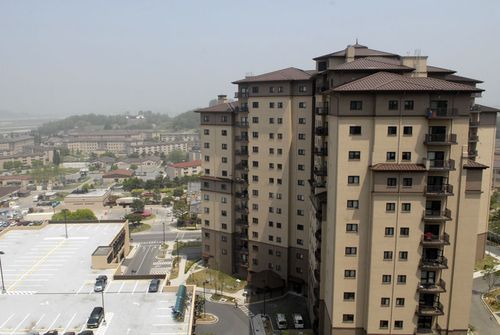
Another sent the above image, of the Hallsan Tower. Another gets the right building:

Apparently information about U.S. military bases – including buildings, street names and the like – are hard to find online, especially when the base is located near a hostile Jirisan Tower2country.  That makes sense, I guess, but it cost me a couple extra hours to finally figure this out.  Using the Google Maps view of Osan Air Base, I identified the buildings in the foreground (the gazebo helped), and the area where Air Force One was parked.  I then needed to find a high-rise building that was positioned just right to make that shot possible. The Osan Air Base website mentions three military housing towers, Hallasan, Seoraksan and Jirisan.  I couldn’t find anything on Seoraksan, so I moved on.  After spending way too much time locating the other two towers, I decided against Hallasan, as the angle didn’t work.  So I’m going with the Jirisan Tower. I believe the photo was taken in the western-most wing of Jirisan Tower.  I’m going with the 10th floor (the top), though it could be the 8th or 9th floor too.

Another:

This was simple to track down with Air Force One sitting on the ramp, as president Obama attended the Seoul nuclear summit late last month. The photo was taken from the balcony of the Jirisan Tower Family Housing at Osan Air Base, Korea. Here’s a video of the ribbon cutting ceremony, provided by Armed Forces Network (AFN).

I spent many years in Europe working with the military. Few Americans realize the extent of the infrastructure provided to American service members and their families. Housing, restaurants, movie theaters, hospitals, shopping centers, and athletic facilities abound. You really don’t have to leave the base to keep yourself entertained.

Another creates an impressive animated GIF, a VFYW first. Another reader:

I’ll probably lose to someone who has lived in the building and knows the numbering system.  But no matter.  My hat’s off to the photographer and other service members and their families serving in South Korea and around the world, never knowing when a nut job like North Korea will shatter the peace, but standing ready on our behalf, just in case.

It was especially difficult this week to break the tie, but the prize goes to the reader who has gotten several difficult views in the past without quite winning:

I suspect this is going to be another battle for the exact window; Air Force One is a mighty big clue! So … this looks like a military base rather than a commercial airport. A scan of the President’s schedule on the White House website shows that, sure enough, he was at Osan Air Base near Seoul during his recent trip to South Korea. A Google Earth satellite image reveals a lot of rust-colored roofs like the ones in the photo. I used the bridge in the background to orient myself and soon found the general location on the base from which the photo was taken. After a bit more snooping, I was able to find the foreground building with the courtyard. The courtyard building has three chimneys or vents on top that line up with more distant points that I was able to identify on the Google satellite image. When I drew these sight lines, they converged at what appears to be a base housing tower. This turns out to be the recently-built Jirisan Tower. I believe the photo was taken from the tenth floor, north-facing balcony in the west arm of the tower.

I’ve now correctly guessed or gotten close to (off by one floor last week!) several of these windows. Maybe this will be my week!

Tis. One more entry for posterity:

IMG_5496

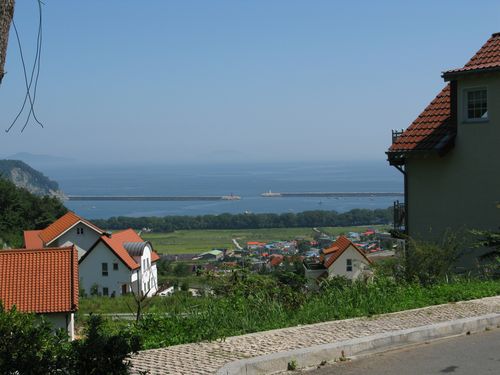
As soon as I saw the mountains, I thought Korea. I lived there for many years. The American buildings gave pause, until I recognized Air Force One and remembered Obama’s recent summit in Seoul. A retired Air Force colonel in my graduate program confirmed that this is Osan Base in Pyeongtaek. No time to locate the exact building, so I’m probably out of the the running. Still, I’ve wanted to submit the attached photo for a long time and here’s the chance. In the ’70s many Korean miners and nurses emigrated to West Germany. Many are choosing to retire in their homeland, and this is the “German Village” they are building on Namhae Island (Namhae-gun, Gyeongsangnam-do, South Korea).
(Archive)
The Student Debt Disaster

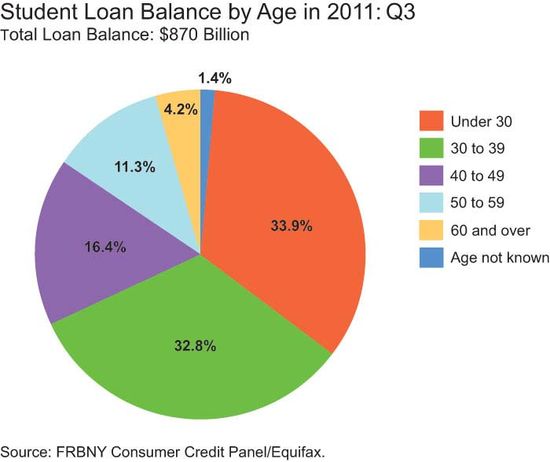
StudentDebt by age

by Maisie Allison

snapshot

It is likely that there are at least as many adult Americans with student-loan debts outstanding as there are living bachelor’s degree recipients who ever took out student loans. That’s right: as many debtors as degree holders! How can that be? First, huge numbers of those borrowing money never graduate from college. Second, many who borrow are not in baccalaureate degree programs. Three, people take forever to pay their loans back.

Meanwhile, total debt has now surpassed $1 trillion, which eclipses what Americans owe on credit cards and car loans. Andrew Leonard discusses the larger implications – and fraught politics – of the issue: 

[O]ne of the things that makes this crisis different from previous financial disasters — like, for example, the subprime mortgage debacle — is that it actually hasn’t been ignored. … The story of how President Obama has worked to help borrowers pay off their student loan debt and ease the path to affording a college education is a case study in how the current administration has worked to fix a broken system in the context of a political process that makes achieving any kind of progressive change almost impossible. 

As the above chart illustrates, many seniors are still on the hook.

The View From Your Recovery

by Patrick Appel

A reader writes:

I just finished my 99 weeks of unemployment and I am glad to be done. I sent out over 70 resumes and had only three job interviews in all of that time. I hated to be tied to looking for work and "wasting" away. I am now 64 years old, I have a Master's degree and over 30 years of experience in computer technology, but I couldn't even get a damn job answering telephones and doing document copying! To top it off, I am in a very affluent area of California – north of the Golden Gate, not in the middle of Wyoming or Kansas. There are tech firms all over the area.

Since I knew my unemployment was running out, I filled for Social Security and it starts next month. I am grateful that my wife and I are sort of "set". We have no major debt that we can't cover, a healthy portfolio and enough equity in our house to withstand any major decrease in value.

What scares us is medical.

Fortunately, I start Medicare in August and my wife has a small pension (and I mean less than $600 a month) that also pays for her medical expenses. That's been a lifesaver for us. She has MS, diabetes, high blood pressure and now we think she has a possibility of heart disease. She is not obese, and in fact, has been losing weight which means her diabetes is acting up.

Without the assurance of medical care, we would be sunk. We both had dental problems this year (not covered by Medicare, by the way) and the bill along this year will total around $7,000. That will be about what I have been paying for my private medical insurance.

If Frum wanted me to work for my benefits, which in practice I don't mind (even from my progressive self), then put in me in a position where I can provide service to people with my skill set. I would have loved to teach in a school or provide after school training or even doing routine computer work for our county government. That way I could have proved to employers that I can work, work hard and have relevant up-to-date skills. For those 99 weeks, I watched as my skill set started to fade as newer technologies came on board and I didn't have the work experience to match when I sent out my resumes.

But, if you want me to work, figure out how you're going to pay for my medical expenses. For the last 7 years, I have had private medical insurance as I was an independent contractor. I commanded a six figure income and as such, I could afford it. When the bottom dropped out 99 weeks ago, my income went to zero. $450 a week (my unemployment) was barely enough to cover our expenses. We had to draw against our savings, but thankfully only a small amount. Since that money wasn't subject to state income taxes, nor payroll taxes, it was barely sufficient.

I don't know what I would be doing now, if I wasn't approaching Medicare and my first Social Security check. To be honest, I'd be depressed and angry at someone.

All of the stimulus packages that I can recall were all constructive related. That's good if you're a truck driver or a mechanic, but me – a white collar mid-line tech professional? Not going to help.

We need a stimulus that will grab everyone. Not just a few. Can you imagine the impact that would have? I am sure there would be plenty of things that a bi-partisan group could agree on that could use more people. Why isn't anyone proposing this?

I'd go back to work in heartbeat, if someone would hire me.

Why Aren’t Neoconservatives Liberals?

by Zack Beauchamp

David Bosco pinpoints "a fundamental difference between the neoconservative worldview and the liberal interventionist one:"

[It is] the role of international institutions and law. Those of a neoconservative persuasion aren't much interested in global architecture; they're intent on achieving liberal, democratic governance at the national level whenever and wherever possible. Indeed, they believe that consensus-based international organizations and procedures tend to obstruct that enterprise as often as facilitate it.  Liberal interventionists share the desire to spread freedom and the conviction that outsiders can help do so, but they also care deeply about building international architecture (almost always) and respecting international rules (usually).

This is the most commonly cited difference between the two intellectual camps, but I'd add another: attitudes towards war. While both liberals and neoconservatives are often supportive of military interventions, the former group doesn't require a belief in the general efficacy of military force as a condition of entry.

Liberals often differ sharply about, for example, humanitarian intervention: it's entirely coherent to self-describe as both a foreign policy liberal and believe that humanitarian intervention usually does more harm than good. Neoconservatism, by contrast, makes a belief in the morality and efficacy of preventative wars against rogue states (Iraq, Iran), nation-building endeavors (Afghanistan post-2009), and overwhelming US military dominance more broadly into bedrock principles. While liberals might endorse any or all of those three, it's not at all requried by liberal commitments that they do so.

In other words, liberalism simpliciter leaves the utility of force as an open, contextual question, while neoconservatism makes belief in it central to its vision of American foreign policy.

Boxing On Ice

by Chris Bodenner

A reader pivots off the football debate:

Something that hasn't been brought up yet, probably because the sport has a much smaller audience in the US, is the way in which the NHL has dealt with head injury and brain damage issues.  Hockey, like football, involves large men colliding with each other intentionally at a very high rate of speed.  Hockey, unlike football, also involves the occasional bare knuckle brawl between two (or more) players on the ice.  Because of the nature of the game, malicious hits are far more obvious than in football, and the fisticuffs are front and center. 

"Enforcers," or guys who are on a team primarily for their fighting skills and not their grace with the puck, are on every pro team, and their job is to protect star players from "dirty" hits, which the refs often can't see.  They protect players by fighting other enforcers (who often aren't even the ones who perpetrated the hits). Last summer, there was a rash of tragic deaths involving current and former NHL enforcers.

Two active players committed suicide.  One active player died of an alcohol and prescription drug overdose.  He had come to rely on the pills over the course of his career to ease his anxiety and pain due to fighting.  Another retired player died at 45 of a heart attack.  The Times did an excellent series on Derek Boogaard, the young man who overdosed, examining the complexity of being an enforcer in the game of hockey, also going in depth about Chronic Traumatic Encephalopathy's effect on the brain.  The deaths left the community of players, fans, and franchises reeling as they happened in such rapid succession.

The NHL this season has taken some steps to make the game safer.  First, it has ramped up its efforts to punish dirty hits.  With the use of video technology, questionable hits are reviewed by a league office headed by a former NHL tough guy named Brendan Shanahan (though he was not himself an enforcer, it should be made clear).  There are now stringent financial penalties for illegal hits, due to multi-game suspensions.  Hits to the head or where one "launches," leaving the ice to launch oneself at an opposing player, are the most strictly penalized. 

Second, they have become much stricter about players being able to return to the ice after suffering a concussion.  Concussions are extremely frequent in hockey.  Anyone who follows the game knows that players of all levels of ability and toughness routinely miss long stretches of games with concussions. 

Third, they've tried to breed a culture where the game is more about skill and grace that brute toughness, although this runs counter to what many see as the game's roots.  This is an especially big issue in Canada, where hockey and national identity are so intertwined that elements of the game have become major political issues.

As a fan of both games, I have to say that while the fixes have not been perfect, I'm much impressed by the NHL's tackling of these issues head on.  To some extent, they were forced to by the rash of surprising deaths of players, but there has been real soul-searching not just by the league, but by the community at large.  An older generation who really prized fighting and hard hitting and "getting your bell rung" as just a part of the game is giving way to a younger generation that is looking for a better balance between speed, finesse, and brute strength. They will soon eliminate fights out of junior hockey leagues.  (I, like I imagine you do, cannot believe it has taken this long to outlaw fighting at a level of the game played primarily by teenagers, but it goes to show how entrenched theses institutions are.)  

The NFL, by contrast, has merely paid lip service to the damage being done by the game, while still trying to exploit their players for larger profits.  They have debated adding two more games to the regular season, which would definitely increase head injuries by extending an already grueling season.  They have instituted rules to protect star players, like quarterbacks, from getting hit and injured while doing nothing to examine the players whose bodies bear the real cost – the linemen. 

Until NFL fans start mobilizing to push back the way NHL fans have done, I fear that the only thing that will change the league's position is a rash of tragic deaths like there have been in hockey.  I hope it doesn't come to that.

But what about reforming the most superfluous form of violence tolerated on the ice – fighting?

Yet Gary Bettman, the N.H.L.’s commissioner, refuses to take the natural and necessary we-can’t-have-this step for his sport: banning fighting. Fighting is not the only source of brain damage in the game—but it is an inevitable one. … No sane argument can be made that fighting contributes anything of value to the sport. The proof, definitive, is that both Olympic hockey and women’s hockey are played without any fighting at all, and delight far more than the N.H.L’s ever-more corrupted form of play. The great Hall of Famer Ken Dryden has called for a ban on fighting…

Fighting The IRS

by Maisie Allison

 Elizabeth Dwoskin profiles Nina Olson, the director of the Taxpayer Advocate Service, who negotiates the IRS's "hall of mirrors" from within. What she's up against: 

In 2006 the IRS studied 46,000 audits of taxpayers. Among those returns that were flagged for misreporting income, IRS auditors reported 67 percent of the problems were unintentional errors; 27 percent were computational errors either caused by the IRS or the filer; and 3 percent of mistakes were intentional. Olson helps them all, even the ones who aren’t entirely innocent. “You take your taxpayers as you find them,” she says.

The errors aren't entirely the IRS's fault:

Congress is … making the tax code more complicated every day: In 2010, lawmakers voted in 579 changes to the code. Right now it tops out at 3.8 million words, four times as long as War and Peace. The IRS doesn’t have the manpower to manage the scads of credits and changes to the code it is required to enforce. And computer glitches are entangling more people in audits than ever before—millions in just this year.

Put Down Your Blackberry

by Zack Beauchamp

It's hurting your work:

Harvard Business School professor Leslie Perlow provides insights on this fraught relationship with smart devices. In an experiment that focused on mandating time off for consultants for at least one night per week, she noticed that — over time — their work lives improved, and they were largely more productive. For the research subjects who followed her policy of disconnecting from work at night, 78% said that they "feel satisfied" with their jobs, compared to the group of people who ignored the policy, where only 49% noted the same sense of satisfaction. Her results show that we're creating a self-perpetuating perception that working faster is better — even when speed may not be necessary.

Hold The Glamour Shot

by Zoë Pollock

For attractive women, attaching a headshot to a resume isn't recommended:

For men, the results were as expected. Hunks were more likely to be called for an interview if they included a photo. Ugly men were better off not including one. However, for women this was reversed. Attractive females were less likely to be offered an interview if they included a mugshot. When applying directly to a company (rather than through an agency) an attractive woman would need to send out 11 CVs on average before getting an interview; an equally qualified plain one just seven.

Is Libya Sliding Into Chaos?

GT_LIBYA_120406

by Zack Beauchamp

In a piece assessing the state of the Arab Spring more broadly, Mohammed Ayoob worries:

The situation in Libya is even more precarious than in Egypt with the very unity of the state in jeopardy. Unlike Egypt, which is a relatively homogeneous society, regional and tribal rivalries exacerbated by the chaos accompanying the fall of the Qaddafi regime threaten to tear Libya apart. The writ of what passes for the central government does not run too far and already voices have been raised in the eastern part of the country demanding autonomy, a possible code word for independence. The fact that foreign intervention played a critical role in regime change in Libya also detracts from the legitimacy of the successor government and makes it more susceptible to domestic challenges.

Alex Warren gives a more optimistic take:

Libya has not descended into anarchy or some kind of ‘meltdown’, as some have concluded. Rather, recent events are symptomatic of a weak state structure, a surplus of guns, a long history of feuds and an atmosphere of suspicion and confusion, and a long history of feuds between different local groups which are now free to escalate alarmingly quickly. They are problematic but do not pose an existential threat to the country…unlike many other fragile states – the government theoretically has the financial means to buy stability, whether by integrating former fighters into the armed forces or purchasing weapons at inflated prices. But to persuade many people to give up their guns, the nascent government will first have to prove it can provide security – and resolving the situation in Zuwara is another big test in that process.

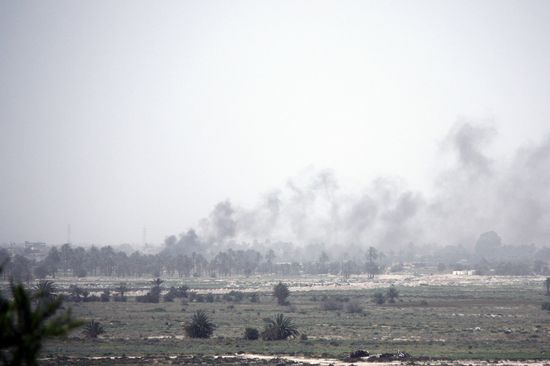
(Photo: Black smoke is seen rising from the Libyan village of Regdalin on April 4, 2012 at the front line after clashes the day before between Zuwara fighters and neighboring villages in western Libya. Former rebels from the western town of Zuwara have clashed sporadically with fighters from the nearby towns of Regdalin and Jamil since April 2, despite efforts by the interim Libyan authorities to mediate a lasting truce. The clashes have left up to 18 people killed, according to officials. By Imed Lamloum/AFP/Getty Images.)

Privacy In A Cashless World

by Zoë Pollock

problem we would have to address:

Imagine if the only way to support unpopular causes was with easily controlled e-money. Certain transactions could be disallowed by law, political pressure or corporate fiat, and anonymous giving would be impossible. Each of your transactions would be tied to your identity. One could not make a purchase at a gay bookstore or a pregnancy clinic without knowing that somewhere there's a permanent record of the transaction. And there might not be any transaction that couldn't be subpoenaed in a divorce or other legal proceeding.