The Science Of Ideology, Ctd

by Patrick Appel

Chris Mooney defends his new book, The Republican Brain:

When you talk about the psychological, physiological, or biological underpinnings of political views, you have to understand that such dispositions are inherently content free. They clearly “push” individuals towards accepting certain views and certain arguments that feel right to them—thus, a person highly sensitive to fear threat may be less likely to worry about civil liberties in the wake of 9/11, or to naturally feel support for the death penalty. But the precise views that feel appealing to such a person would also be very different in the U.S. at the present moment than they would be in, say, China. And they would also change over time in the U.S. itself.

Your Hard-Earned Dollars

Screen shot 2012-04-03 at 12.39.13 PM

by Zoë Pollock

Where they are going:

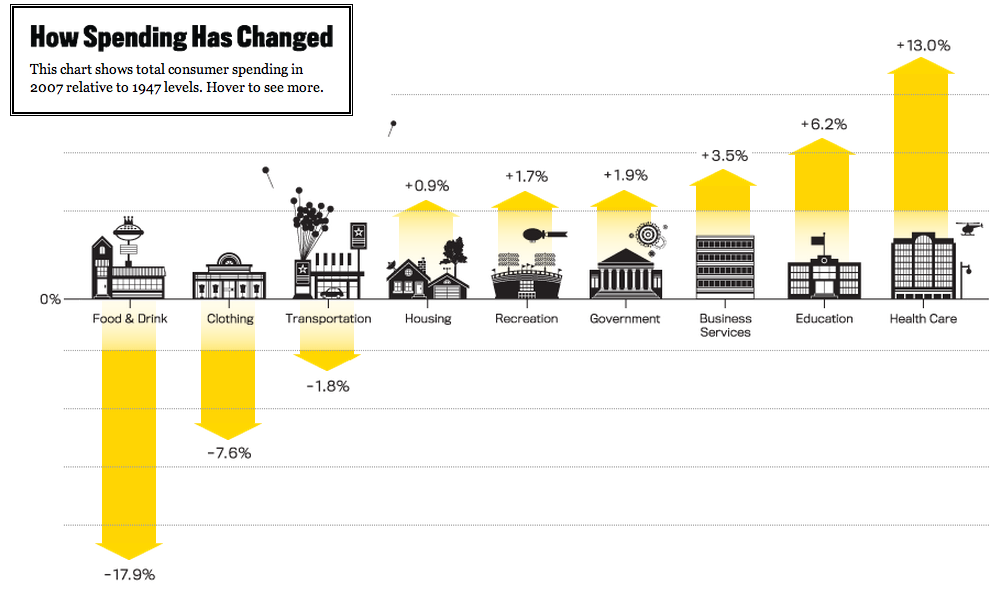
Taking 1967 as our starting point, 30% of the cost of the things we consumed that year went to manufacturing them; by 2007, that figure had fallen to 16%. In contrast, what we spent on business services over the same period jumped from 12% to 26%. That’s because baked into the price of everything we buy is the rising cost of advertising, accounting, legal services, insurance, real estate, consulting, and the like—jobs performed by the high-wage workers of our modern economy. These days, 52% of all compensation goes to office workers. 

A Breather

I'm taking the next week off. Patrick, Chris, Zoe, Maisie and Zack will be manning the fort, and you'll likely see again how much they contribute to this evolving Dish experiment. Also: less God next week. I know we've been very theo-centric recently, but if you can't be that in Holy Week, when can you? Charles Murray is our Ask Anything guest this week as well.

Have a wonderful Easter season. See you soon enough.

Missing The Person For The Neurons

Dew-2

Richard Holloway reviews Roger Scruton's The Face of God:

He argues that, just as the human person disappears from the world when we look for the neurological explanation of his acts, so God disappears from the world when we hunt only for the cause and never for the reason of things … In religious discourse, we too quickly move from the illuminating suggestions of parable, metaphor and myth into quasi-scientific claims about the nature of the mystery that we are hunting. The irony here is that religions end up doing to the elusive person of God what biological determinism does to the elusive person of the human: they void it of mystery. This is why intransigents on both sides of the current debate about God increasingly sound like each other.

(Dew-soaked dandelions by Sharon Johnstone via Colossal)

Jesus vs Power

Dali2_1247555c

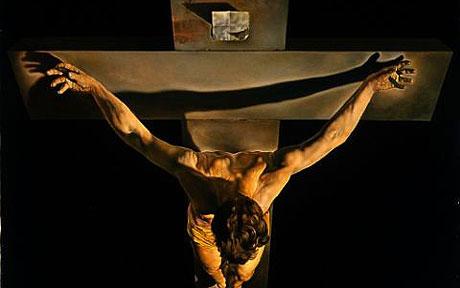
One part of my case against Christianism, against Christians wielding political power to control the lives of others, is that the core of Christianity is power through powerlessness. This is a paradox, of course. But it is paradox of Easter, where a death becomes life, where giving up oneself entirely to power in the world is the only way to transcend it.

H. Richard Niebuhr puts it better than I ever could:

"[T]he thought of deity and the thought of power are inseparable. Deity must be strong if it is to be deity.

We meet the God of Jesus Christ with the expectations of such power. If his power be less than that of the world and he be at the mercy of the world, of nature, fate, and death, how shall we recognize him as God? Yet we do not meet this God…how strangely we must revise in the light of Jesus Christ all our ideas of what is really strong in this powerful world. The power of God is made manifest in the weakness of Jesus, in the meek and dying life which through death is raised to power. We see the power of God over the strong of earth made evident not in the fact that he slays them, but in his making the spirit of the slain Jesus unconquerable.

Death is not the manifestation of power; there is a power behind and in the power of death which is stronger than death.

We cannot come to the end of the road of our rethinking the ideas of power and omnipotence. We thought that we knew their meaning and find we did not know and do not know now, save that the omnipotence of God is not like the power of the world which is in his power. His power is made perfect in weakness and he exercises sovereignty more through crosses than through thrones."

(Painting: Salvador Dali.)

Deus Caritas Est

IMG_4450

A reflection on love at Easter:

"…Is true love possible without belief in God, as Nietzsche thinks, or does it require God’s existence, as Augustine believes?

"Such a love must differ from so much of what passes by that name among us. We are no creator God: we are weak and needy creatures. Our love usually stems from this neediness. We feel a lack, and experience a passionate longing for whatever we believe will fill it. But sometimes, at our best, we seem capable of more: we could absorb disappointments and failures, misunderstandings and sufferings, betrayals and lies, and still forgive, only if our love were giving rather than taking, a covenant rather than a contract, an expression of strength rather than the desperation of weakness. 

Think of the loves in your life. Think of how you have loved, as well as how you have been loved. What were the mixtures of these elements? No human could rightfully claim to have given unfailingly and unconditionally from the superabundance of a strong spirit. But could we do so ever? What I am arguing is that we are capable of doing so only if we believe two things: first, that we have a beloved who will not disappoint us; second, that our love is never unrequited. In other words, our perfect beloved must also be our perfect lover. No human could play that role. These conditions are met only by an omnipotent, benevolent, and eternal God…

… I have not argued that God exists, only that He must, if we are to perfect the fledgling love of our needy hearts. In the end, I must confess, I agree with Camus: 'There is God or time, that cross or this sword.'"

Face Of The Day

Vanessa-arnade

Vanessa from the series “Faces of Addiction” by Chris Arnade. Arnade, a banker by day, explains his project:

I post people’s stories as they tell them to me. I am not a journalist, I don’t verify, just listen. … What I am hoping to do, by allowing my subjects to share their dreams and burdens with the viewer and by photographing them with respect, is to show that everyone, regardless of their station in life, is as valid as anyone else.

In an interview, Arnade shares what he’s learned:

When you don’t talk to someone, it’s very easy to judge them. You can build up a narrative where they kind of deserve what they got. When you talk to someone, it’s much harder. Jamie, one guy I’ve gotten to like a lot, lived underneath the Bruckner Expressway. Whenever I’d go back to see him, I’d bring him whatever he needed because the winters are tough. We’d smoke a cigarette and just talk. He had a cat, Mimi. Mimi was a female and looked like she was going into heat and I asked him if I could get Mimi spayed. Then I asked some people for help trying to get Mimi spayed. I kind of got more offers to help Mimi than I did to help Jamie. I appreciate all those offers, in both cases, and people have been very helpful for Jamie, but there’s the mentality that an animal doesn’t deserve what it’s gotten but a person does, because maybe they’ve done something to deserve that.

He’s just started a “Faces Of Recovery” series as well.

When War Borders Crime

Embedded with NATO troops in Afghanistan, Neil Shea is disturbed by the anger and hatred voiced by soldiers in his platoon:

“This is where I come to do fucked-up things,” [Staff Sergeant James Givens] said. “So I don’t do them at home.” … [W]e require our fighters to be ready hurricanes, on-call combat machines. We want them held easily in check, and we expect light-switch control over their aggression. Yet the Afghan war no longer relies so much on combat. The mission is nuanced, and future success, even sane withdrawal, demands Afghan cooperation. Soldiers like Givens, so barely restrained, their switches unreliable after years of war, undermine this. But we have no good method for dealing with men who grow too dangerous. We vaguely hope their anger does not spill over, or come home. It is not simple.

Larkin’s Legacy

Later this month, I'll be taking part in a celebration of the publication of Philip Larkin's complete poems in the Great Hall at Cooper Union on Tuesday, April 24th at 7PM. It's organized by the Poetry Society of America. Michael Dirda reviews the book in the New Criterion. It doesn't just have all the poems, but also painstakingly assembled "commentaries" on the poems, culled from Larkin's own letters, notebooks, and drafts. Money quote from Dirda's review:

[Larkin's] reputation has risen and continues to rise. There may have been a slight blip when Larkin’s private life was first revealed, but posterity is concerned with art, not morals. As Auden observed of Yeats: 'You were silly like us; your gift survived it all.'

Larkin may have been lustful, vulgar in his correspondence with friends, casually racist, stingy, and deceptive with the women he loved and two-timed. But he was a man of his age, and not very different from you or me, except that he could write 'The Whitsun Weddings' and we can’t. A recent article in The Times proposed a list of 'the 50 Best British Writers since 1945': Larkin was number one, George Orwell was second."

I have to say it cheered me to find out that Hitch was reading Larkin right up to his death (along with Wodehouse). Larkin's brutal bleakness always gathers depth from a sliver of light. And somehow the cumulative effect of his poetry, for me at least, is to generate hope. And every time I read Larkin now, I think of Christopher. It's the closest I can some to a prayer without hearing his disapproval across eternity.