Mental Health Break

A timelapse of an astronomer's paradise, in Chile's Atacama Desert:

Creator Babak Tafreshi explains:

Walking on the desert near Paranal between the scattered stones and boulders on the pale red dust feels like being on Mars, but under the Earth sky. One of the most astonishing experiences under such a starry sky is the view of the Milky Way. In several scenes of the film, the setting arc of the Milky Way is captured over the cloud-covered Pacific coastline.

The UnGoogleable

What will happen to mystery in the age of Wiki-knowledge?

Instead of a system where the collection of facts is an end, where knowledge is equated with accumulation, where ignorance is rarely discussed, we will have to provide the Wiki-raised student with a taste of and for boundaries, the edge of the widening circle of ignorance, how the data, which are not unimportant, frames the unknown. We must teach students how to think in questions, how to manage ignorance. W. B. Yeats admonished that ‘education is not the filling of a pail, but the lighting of a fire.’

Which Jesus Do You Follow?

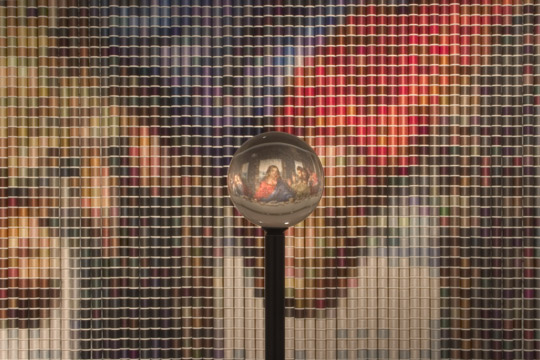
The_Last_Supper_Spools

David Sessions offers a thoughtful reply to my essay. It deserves to be read in full, but here are a couple paragraphs to grapple with:

Andrew describes Jesus’ ideas as "truly radical," for example, "love your enemy and forgive those who harm you; give up all material wealth." His project is to convince us that these "radical" ideas are also "apolitical," that when salvaged from the tangle of theological and political movements that have distorted them, they are something pure, spiritual and otherworldly. Like a good liberal individualist, he reads all of these virtues as a kind of private interior experience, something I’m not sure Jesus ever intended them to mean.

Jesus’ ideas are not anti-worldly in the sense that they help guard ones inner peace against the chaos of the Internet, but in the sense that they challenge the way most human societies work. This is certainly why Jesus was executed, and why the spread of Christianity was met with bloody resistance: he claimed to have a kingdom, threatened to "destroy the temple and rebuild it in three days," and preached a kind of forgiveness and self-sacrifice that upended and undermined established Jewish law. It is almost impossible to imagine Jesus "without politics," as Andrew would have him, or that practicing his "pure" ideas would be anything less than an affront to an established political order—as they are invariably perceived wherever they manifest themselves.

So the pure, radical Jesus does not seem to be the one Andrew is really recommending. I would argue that there is another Jesus in the picture who is as much a modern political construction as the god of Rick Santorum. He goes without a name in Andrew’s essay, much like he does in America’s founding documents. Most often when Andrew is describing "good" Christianity, his Jesus seems to dovetail with pragmatic moderate-liberal politics. He wants Christians to be "faithful in a religious space and reasonable in a political one." It is immensely revelatory that he opens with an admiring retelling of Thomas Jefferson’s cutting out the "good parts" of the New Testament—leaving only the words of Jesus that amount to, in Jefferson’s words, a "benevolent code of morals." I would argue that it’s this Jesus, not the historical, radical one that Andrew is most interested in.

I wish I understood David's argument better, but we're both reduced to making arguments about vast subjects in short essays and posts. But I disagree on a couple of core points. David writes:

Jesus’ ideas are not anti-worldly in the sense that they help guard one’s inner peace against the chaos of the Internet, but in the sense that they challenge the way most human societies work. This is certainly why Jesus was executed, and why the spread of Christianity was met with bloody resistance: he claimed to have a kingdom, threatened to “destroy the temple and rebuild it in three days,” and preached a kind of forgiveness and self-sacrifice that upended and undermined established Jewish law. It is almost impossible to imagine Jesus “without politics,” as Andrew would have him, or that practicing his “pure” ideas would be anything less than an affront to an established political order—as they are invariably perceived wherever they manifest themselves.

I don't buy this. The Romans executed Jesus reluctantly in the Gospel account, and the Gospels tell us they did not regard him as a political threat. Moreover, his injunction to give to Caesar what is his, and to God what is God's under imperial rule couldn't be less political. It shocked his contemporaries that he was indifferent to the distinction between colonist and colonized. He even made a point of hanging out with the empire's most reviled apparatchiks, the tax-collectors; and declared the faith of a Roman centurion as remarkable. He was executed at the behest of the Jewish authorities who rightly regarded Jesus as a threat to their faith. What Jesus did at the last Seder meal was blasphemous enough. Pope Benedict is right that the political actor before Pilate was not Jesus but Barabbas – and it was Barabbas who was freed.

Lastly, of course the ideas underpinning modern liberal democracy have Christian roots. But they also have very anti-Christian ones as well. Machiavelli pioneered a politics divorced from morality and metaphysics. Locke insisted that Christianity required liberalism because only in such a state could religion be genuinely held without coercion. And my view is that our political crisis is due to the re-emergence of metaphysical claims in the political space. The direction I'm pointing in is away from that space toward, yes, an interior faith but also a practice of Christianity in the social/civil sphere: helping the poor, tending to the sick, visiting prisoners, abandoning materialist motives.

Is there tension here? You bet there is. But my liberalism has no metaphysical foundations, just conservative ones. A few societies in history have been lucky enough for all sorts of reasons to have devised liberal polities over the centuries. Life for most of us is more comfortable, less fearful and remarkably stable in this order, compared with theocracies or totalitarianisms. That's all I need to defend it. And although it failed in late nineteenth century Germany does not mean that it has failed in America or England or France.

Some think this requires a tame form of religion. I actually think Jesus' radicalism is in his anti-political insistence on a kingdom not of this world. Politicians coopt this at their peril. They know not what they do.

(Image by Devorah Sperber)
A Reverse Pietà

Frederic Bonnaud explores the theme of redemption in the work of world-renowned filmmakers Jean-Pierre and Luc Dardenne:

Collision, fall, and rescue: this is the Dardenne Brothers’ Holy Trinity. They have long been reluctant to acknowledge the obvious Christian inspiration of their artistic sensibility. But interviewed recently about their new film, they compare the moment when Cyril (Thomas Doret) and Samantha (Cécile De France) run into each other, causing an impassioned bond to form, to a “reverse Pietà.” This isn’t an acknowledgement of their possible Christian faith but an invaluable indication of the principal source of their fictional and formal inspiration: the inexhaustible body of Christian tales and their iconography. Today, the Virgin Mary is a childless young woman who cohabits with her boyfriend. And she adopts a lost child, who has lost his father and who rides around and around on his bicycle. In saving him, she commits herself fully to an act that is irreducible and mysterious. 

Jeffrey Overstreet is on the same page

More than one critic has called The Kid with a Bike “minor Dardennes.” Apparently Samantha seems too good, too forgiving. One calls her “the mom nobody in this world ever had,” and says her actions do not seem very “grounded in the realities of human interaction.” … I don’t share their bewilderment. Have you never been blessed by a gesture of undeserved love? Have you never witnessed grace that confounds you, or felt compelled to reach out and help someone without knowing why?

A Poem For Sunday

471544684_0a86fbacc1_b

"Seven Stanzas at Easter" by John Updike:

Make no mistake: if He rose at all

it was as His body;

if the cells’ dissolution did not reverse, the molecules

reknit, the amino acids rekindle,

the Church will fall

It was not as the flowers,

each soft Spring recurrent;

it was not as His Spirit in the mouths and fuddled

eyes of the eleven apostles;

it was as His flesh: ours.

The same hinged thumbs and toes,

the same valved heart

that–pierced–died, withered, paused, and then

regathered out of enduring Might

new strength to enclose.

Let us not mock God with metaphor,

analogy, sidestepping transcendence;

making of the event a parable, a sign painted in the

faded credulity of earlier ages:

let us walk through the door.

Continued here.

(Photo by Mark Barkaway)

The Next Generation Speaks

Dan Savage highly recommends this long presentation by Matthew Vines (preview above):

Matthew Vines is a young gay man who grew up in Kansas. His family is Christian and very conservative. After coming out, Vines took two years off college to research and think deeply about what the bible says—and doesn't say—about homosexuality. You could argue that what Vines has to say is irrelevant to non-Christians. But Vines' argument and his insights are highly relevant to gay Christians, to their families, to Christians who point to the bible to justify their bigotry and the pain they inflict on LGBT people (including their own LGBT children), and to anyone who happens to live in a country that is majority Christian.

A reader writes:

I only watched bits and pieces of the video, but while reading the transcript – as the 22-year-old gay only son of a Latino minister (with all the Pentecostal-leaning and intransigent tendencies that implies) – I had one thought running through my mind: This is what I always wanted to do.

In my heart of hearts, while tearfully struggling with my confusion and the clashing of mental schemata during my freshman year of college, I wanted to leave everything behind and just study this as critically as I could … and although I did, to a certain extent, I ended up dealing with my doubts by gradually shifting towards secular agnosticism, which made an honest, non-cynical study of the Bible somewhat unnecessary ("Well, it's written by men who didn't know even the first thing about astronomy, so what the hell do I care what they have to say about my sexuality?")

Over the course of the past two years, however, I've been trying to find a balance between the Christianity of my recent past and my current amorphous beliefs (a journey that, for the record, has been aided by writers like yourself; thank you, epilogue to Virtually Normal!) – and that is where my reaction to this comes in. Matthew's video is groundbreaking not by virtue of its arguments – these facts can be found elsewhere – but by the intelligent way they've been compiled and the way they are presented. Its power lies in the sincere, Jesus-loving, millennial face it puts on the issue.

For a few moments, it brought me back to the person I was lying on my bed in my freshman dorm, and made me believe what I used to believe: that God can speak through any human being. It reminded me that, although I don't regret my particular journey, maybe I didn't need to step away from Christianity as far as I did. I know there are many others who need that message. (And I'll be spending my Spring Break translating it into my parents' native Spanish.)

The Deeper Debate

Benjamin Dueholm ponders Marilynne Robinson's new collection:

As a book about who we are and what we owe each other, When I Was a Child I Read Books is more urgently political than any treatise on the shape of entitlement programs or the proper government share of GDP. Caustic as our public debates may be, they mask a convergence on the bigger questions that animate those debates. What Robinson calls “our tendency to create definitions of human nature that are small and closed” can be found virtually anywhere on the American political spectrum today.

We are drawn to these self-effacing definitions—whether we get them from Darwinian biology, neoclassical economics, or postmodernity’s generalized suspicion—because they appear to be rational, scientific, or progressive. They liberate us from the oppressions and illusions we imagine constitute our collective past. 

But what if we succeed in convincing ourselves that they’re true? If what we experience in both our own consciousness and in the palpable but hidden reality of another’s is just an accident or an illusion, a thin crust floating atop the magma of evolutionary adaptations or historical resentments that constitute our truest selves, it’s hard to imagine a future for the American liberal democratic project.

People convinced of their own smallness will not know how to open their hands wide to each other.

Heaven On Earth

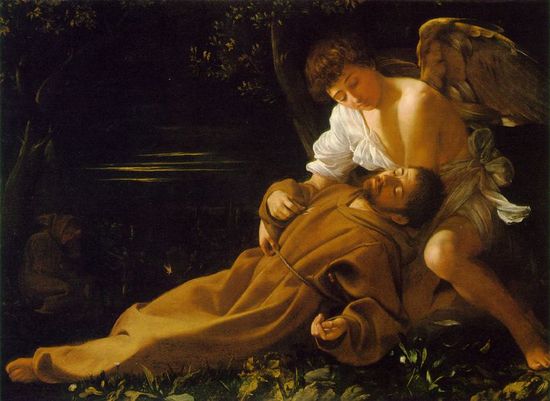
Caravaggio_stigmatizing_of_saint_francis

Jon Meacham searches for it:

If heaven is understood more as God’s space on earth than as an ethereal region apart from the essential reality we know, then what happens on earth matters even more than we think, for the Christian life becomes a continuation of the unfolding work of Jesus, who will one day return to set the world to rights. If you begin to think about the drama of life in such terms, you begin to invest more meaning in the here and now — not in the “eat, drink and be merry, for tomorrow we die” pagan way, but as a way of infusing everything with potentially sacred meaning. The love of friends, the brush of your spouse’s hand, the eyes of a young child — these become not hints or glimpses of what heaven may be like as a posthumous region but of what earth may be like if light and love achieve dominion over darkness and envy.

Beautifully put. The task, as Oakeshott noted, is to find a definition of salvation which has nothing whatsoever to do with the future. I should probably note what only a handful of people will know that the kind of Christianity I wrote about in last week's essay is deeply indebted to Oakeshott whose hints and guesses about religion were the final focus of my dissertation 22 years ago; and to TS Eliot, whose Four Quartets have been Christian touchstones for me since my teens. Oakeshott believed that the dignity of religion lies in part

in the poetic quality, humble or magnificent, of the images, the rites, the observances, and the offerings (the wisp of wheat on the wayside calvary) in which it recalls to us that 'eternity is in love with the productions of time' and invites us to live so far as is possible as an immortal.

Thy kingdom come. But it is already here, if we have faith and live it. And faith is something in which

the fugitive adventures of human conduct, without being released from their mortal and moral conditions, are graced with an intimation of immortality: the sharpness of death and the deadliness of doing overcome, and the transitory sweetness of a mortal affection, the tumult of a grief and the passing beauty of a May morning recognized neither as merely evanescent adventures not as emblems of better things to come, but as aventures, themselves encounters with eternity.

That's Oakeshott again in a sublime passage that is echoed by Eliot:

Men's curiosity searches past and future
And clings to that dimension. But to apprehend
The point of intersection of the timeless
With time, is an occupation for the saint.

(Painting: Caravaggio, on Saint Francis receiving the stigmata.)