Another look at movie stars' first scenes:
Video Essay: "Encore" from Flavorwire on Vimeo.
Another look at movie stars' first scenes:
Video Essay: "Encore" from Flavorwire on Vimeo.
By Jack Gilbert:
We find out the heart only by dismantling what
the heart knows. By redefining the morning,
we find a morning that comes just after darkness.
We can break through marriage into marriage.
By insisting on love we spoil it, get beyond
affection and wade mouth-deep into love.
We must unlearn the constellations to see the stars.
Continued here. An interview with Gilbert in The Paris Review here.
![Cara-barer-snow[4]](https://dish.andrewsullivan.com/wp-content/uploads/2012/04/6a00d83451c45669e20168eaa77e34970c.jpg "Cara-barer-snow[4]")
Some historical perspective:
According to one estimate, if Homo sapiens had existed for 24 hours, writing only came along after 11 p.m. Thus spoken language is fundamental, while written language is an artifice.
In that light, John McWhorter defends informal speech in email and texting:
Keyboard technology, allowing us to produce and receive written communication with unprecedented speed, allows something hitherto unknown to humanity: written conversation. In this sense, they are not "writing" in the sense we are accustomed to. They are fingered speech.
A sense that e-mail and texting are "poor writing" is analogous, then, to one that the Rolling Stones produce "bad music" because they don’t use violas. Note that one cannot speak capital letters or punctuation. If we accept e-mail and texting as a new way of talking, then their casualness with matters of case and commas is not only expected but unexceptionable.
On the other end of the spectrum, Lewis Lapham rants against Internet writing:
The strength of language doesn’t consist in its capacity to pin things down or sort things out. "Word work,” Toni Morrison said in Stockholm, "is sublime because it is generative," its felicity in its reach toward the ineffable.
(Book art by Cara Barer via Amusing Planet)
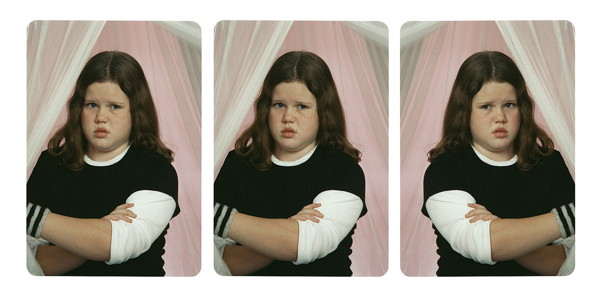
For her series "Free Sitting", Nora Herting infiltrated a portrait studio in a JC Penney department store in Ohio:
Images programmed to be evidence of happiness or prosperity become painful, ugly or embarrasing, possibly revealing something unseen before. As Andre Tarkovsky wrote of bringing audiences through an experience in film, "hideousness, then truth." In addition, Herting embarked on this undercover project for a more simple reason, perhaps put most succintly in the famous first line of Tolstoy’s Anna Karenina: "Happy families are all alike; every unhappy family is unhappy in its own way."
(Image: "Carnation", Nora Herting)
"There is a Laffer curve, but revenue is maximised at high rates, not low ones," – Martin Wolf.
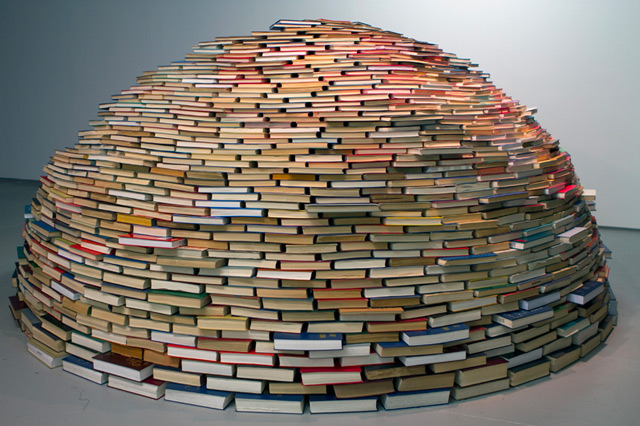
After a failed settlement last year, Google's goal of scanning the world's books has stalled, with many libraries and authors distrusting the company's intentions. Nicholas Carr tracks Harvard's attempt to build a truly democratic version, the Digital Public Library of America:
[Harvard library director Robert Darnton's] inspiration for the DPLA came not from today's technologists but from the great philosophers of the Enlightenment. As ideas circulated through Europe and across the Atlantic during the 18th century, propelled by the technologies of the printing press and the post office, thinkers like Voltaire, Rousseau, and Thomas Jefferson came to see themselves as citizens of a Republic of Letters, a freethinking meritocracy that transcended national borders. It was a time of great intellectual fervor and ferment, but the Republic of Letters was "democratic only in principle," Darnton pointed out in an essay in the New York Review of Books: "In practice, it was dominated by the wellborn and the rich." With the Internet, we could at last rectify that inequity.
He hopes to launch by April of 2013, and progress has already begun.
(Image: "Home", a self-standing igloo of books, by Miler Lagos via Colossal)
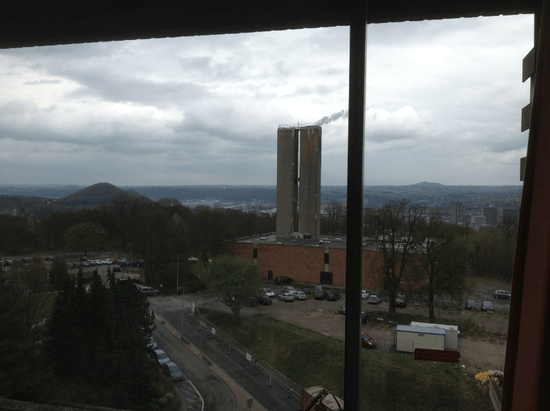
You have until noon on Tuesday to guess it. City and/or state first, then country. Please put the location in the subject heading, along with any description within the email. If no one guesses the exact location, proximity counts. Be sure to email entries to VFYWcontest@gmail.com. Winner gets a free The View From Your Window book. Have at it.
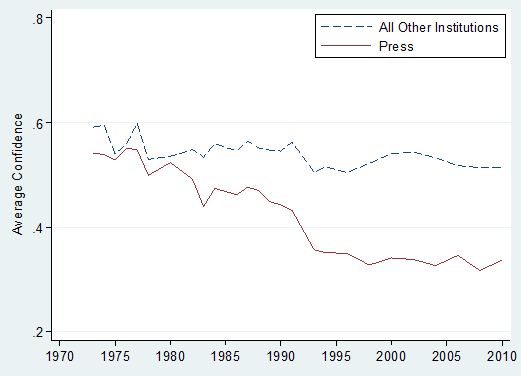
Jonathan Ladd explains why:
Party polarization has raised the stakes in elections. And polarization combined with the growth of partisan media options has created an incentive for party leaders and activists to discredit the mainstream media among their supporters. Party leaders convince their partisans in the mass public to resist informative messages from the mainstream media and ideologically hostile outlets, and instead rely more on ideologically friendly new outlets. In doing this, they can help to inoculate their supporters against voting for the other side.
The trouble with this trend:
Political scientists have documented the tendency of people from different parties to have perceptions of reality that reflect their partisanship. Put simply, when a Democrat is president, Democrats tend to think that national conditions are better than Republicans do, and vice versa. I find that this trend is much larger among those who distrust the institutional media.

Lincoln Turner reveals the centuries-old trick behind the super-realistic resurrection of Tupac:
Tupac, in fact, appeared courtesy of a very old stage-craft technique known as "Pepper’s Ghost". A thin, transparent plastic sheet, ten metres across and four metres high, was lowered across the stage, slanting from the stage up towards the audience. While Snoop Dogg and Dr Dre rapped behind the mylar film, Tupac was projected on it using high-definition video projectors reflecting off mirrors below the stage. By carefully avoiding any stage lights glinting on the plastic, technicians kept the audience unaware they were looking at the (living) performers through the screen. Most of the light from the projector passed through the screen, but a few percent reflected from the front and back surface of the film; the same partial reflection that lets you see yourself in a shop window.
Because the projectors were very bright, and the spotlights on Snoop and Dr Dre well-controlled, everyone appeared with the same brightness, adding to the realism of the illusion. But Tupac had as much depth as any other 2D projection – none – and the illusion only worked because the audience was too far back to see this.
(Poster via John Coulthart)
 The Dish