The Real Game Of Thrones

Laura Miller delves into the history behind the HBO series, which is loosely based on England's War of the Roses. Kelly Devries compares the series to reality:

A medieval peasant working in the fields or a laborer toiling in the towns certainly had a more onerous life than a farmer or blue-collar worker today, but the degree of misery should not be overstated. Mundane and boring does not necessarily mean harsh, and harsh does not necessarily mean unhappy. Contemporaneous literary depictions such as Chaucer's Canterbury Tales do not portray the daily existence or mindset of the lower classes as terrible, and the merciless brutality regularly suffered by the lower orders in fantasy works such as Martin's does not reflect reality — not least because it would have been economically ludicrous for nobles to so abuse the people on whose productivity their own livelihoods depended.

Charli Carpenter draws lessons for contemporary world politics:

To be sure, life in Westeros is poor, nasty, brutish and short, and Martin's A Song of Ice and Fire series and David Benioff and D.B. Weiss' television program are laced with Hobbesian metaphors, Machiavellian intrigues, and Carr-like calculations of power. But the deeper message is that realism alone is unsatisfying and unsuccessful — that leaders disregard ethical norms, the needs of their small-folk, and the natural world at their own peril. Jockeying for power by self-interested actors produces not a stable balance but suboptimal chaos; gamesmanship and the pursuit of short-term objectives distracts players from the truly pressing issues of human survival and stability.

Why So Few Women In Congress?

Not enough female candidates, claims Lexington:

Even now, fewer than two out of ten members of Congress are female. For this, women have only themselves to blame. Plenty of research shows that women who stand for election do just as well as their male counterparts: they raise as much money, scoop up as many votes and are no less likely to win. The problem, according to a recent study and survey by Jennifer Lawless of American University and Richard Fox of Loyola Marymount University, is that so few choose to run. Even though a record number are running for the Senate, women are competing in fewer than a third of congressional races this year.

Taxes Are Low

Low_taxes

A reality check:

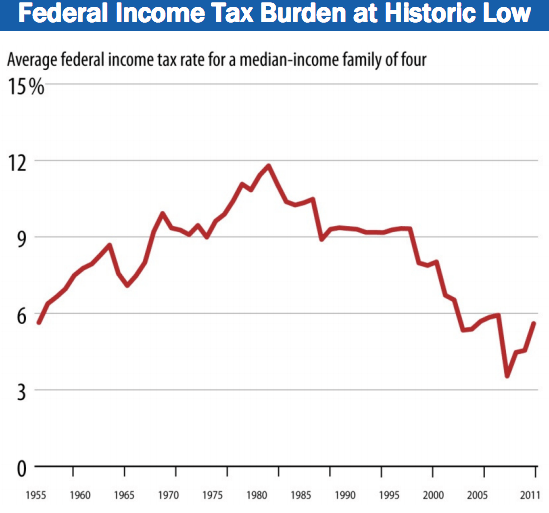
When it comes to income taxes, a family of four in the exact middle of the income spectrum will pay 5.6 percent of its 2011 income in federal income taxes, according to new estimates from the Urban Institute-Brookings Institution Tax Policy Center.  Federal income taxes on middle-income families have fallen significantly in recent decades, and they have been lower under Presidents George W. Bush and Obama than at any time since the 1950s.

And Romney is campaigning both to slash the deficit and to cut taxes on the wealthy, while ramping up defense to levels beyond even the Cold War. It's as if he wants to repeat Reagan – when Reagan came to office at peak taxation and we are now close to the trough. This is what happens when ideology simply doesn't shift to adapt to reality, and when one party refuses to tell people that they cannot have their cake and eat it too. 

Why Not Use Every Part Of The Cow?

Marion Nestle is squeamish about "pink slime." What it is:

Pink slime is the pejorative term for "lean finely textured beef," a product designed to recover useful bits from carcass trimmings. These are warmed, centrifuged to remove the fat, treated with ammonium hydroxide gas to kill pathogens, and compressed into blocks that are frozen for later use. The final product is pink; therefore, it's meat — or so says the meat industry. And from a strictly nutritional standpoint, it is.

And I honestly can't see why there's been all this fuss about it. "Waste not, want not," was my mother's constant refrain. But then I love steak and kidney pudding and liver and bacon. Adam Ozimek defends the substance:

While the environmental impacts of getting rid of pink slime aren't certain, intuitively we should not find it too surprising if it turns out getting less food out of each cow is bad for the environment. With no health or nutrition gains to be had, I don't see how the pink slime critics claim the moral high ground here. This is another example of society engaging in potentially costly signaling just to show each other that we care.

From The Annals Of Chutzpah

"[T]here is something invasive and tawdry in reposting someone’s Facebook photos. We should criticize her for her support of organizations such as J Street. Let’s debate the Democrats’ dangerous and failed policies on the Middle East and leave the college photos out of it," - Nathaniel Botwinick, NRO, while reposting one of said photos of the DNC's new Jewish outreach liaison. 

Predicting Unemployment

It's a very dry science of sorts with big political implications. This is a fascinating analysis of what has happened in this recession – essentially an unnecessarily steep rise in unemployment and then a matching steep decrease caused by all sorts of odd factors (mainly the huge rise in working hours by people in employment). But the bottom line is that it's unlikely we're going to get the rate that much lower any time soon: a drop of only 0.4 percent over the next two years looks likely.

Even At Brigham Young University …

The gay awakening is accelerating. It doesn't surprise me. I have spoken to huge crowds in Salt Lake City, organized by the very strong PFLAG group there. Another small anecdote: I was debating Maggie Gallagher last night at Washington and Lee University in Virginia, the state where gay couples are formally discriminated against the most. Maggie asked the crowd who backed marriage equality. Almost every hand in the room went up. We were standing above the crypt of Robert E. Lee.

The Jewish Vote

Bill Kristol is still wrong. Serwer puts the meme under a revealing microscope:

This reoccuring non-controversy and speculation about the American Jewish vote has little to do with its actual influence on elections, which is fairly small. Instead it's about constraining the political space any American president has to pursue an equitable and peaceful solution between Israelis and Palestinians. That's why, despite being repeatedly debunked, the narrative that American Jews are about to defect en masse to the Republican Party will never permanently be put to bed. There's a funny irony here, though: If Republicans ever actually succeeded in getting pro-Israel Democrats to abandon their party, bipartisan support for Israel in Congress would be adversely affected.

How Weak Is Romney?

BOBBLEMITTAlexWong:Getty

Ezra Klein sticks up for Mitt:

For the last, oh, six years, Mitt Romney has been running in Republican presidential primaries. Those are, arguably, the elections he’s least suited to win, for all the reasons listed above. But now he’s about to get a shot at a general election. And while the promises he’s made and the positions he’s taken will surely make it more difficult for him to swing to the center, he’ll nevertheless be able to run a very different kind of campaign going forward. Maybe he’ll be better at it. And it’s easy to imagine his greatest weakness in the primary — the fact that conservatives believe he’s a secret centrist — becoming his greatest strength in the general.

I'm not buying. Romney's strength as a candidate is his aw-shucks, all-American voice and affect, which helps smoothe the rough contours of his platform, which will – by a mile – be further to the right than any candidate who has ever run for the presidency in modern times. His embrace of the Ryan budget confirms this. He can't backtrack on that now, or the already ornery base will explode. The mellifluous, paternal tone works best when he's persuading liberals he's not that radical. But the fall campaign will require him to be very harshly negative toward a president a lot of people still like, and arguing for even more tax cuts for the wealthy like himself.

And Romney will be painted – probably brutally – as a plutocrat's plutocrat. I suspect his perfect fit was, actually, Massachusetts, when he could run as a reformist Republican outsider but legislate universal healthcare in a monolithically Democratic state. Hey, I'd have voted for him as a check on the Democratic machine in that state and as a moderate able to nudge the state to the right – as he did, in my view, because the individual mandate is a conservative proposal at its core. Joe Klein, as often, is on the same page as I am:

[Romney] seems a figure from the Great Depression, a combination of Daddy Warbucks and Old Man Potter. He celebrates creative destruction at a time when the destruction has been a bit too creative. He talks a lot about firing people. He just can't help himself. In Wisconsin, he talked about his father firing people in Michigan. After he won the Wisconsin primary, Romney wandered incomprehensibly into the steel-plant closings on the South Side of Chicago in the 1970s. The President, he said, became a community organizer because "he saw free enterprise as the villain and government as the solution." The man simply does not understand that most people do not see plant closings as progress.

Along the same lines, Charles Blow doubts Romney will out-campaign Obama:

Obama can be scintillating on the campaign trail. Romney has shown himself to be nearly catatonic. Obama is such an impressive speaker that it sometimes feels as if he’s trying too hard to prove something; Romney is such an awkward speaker that it often feels as if he’s hiding something.  But when framing a vision, even magniloquence beats ineloquence.

And look how many completely unforced errors Romney has made so far – all confirming his image as a mega-rich Wall Streeter with an inability to connect to many voters. It's also worth noting that Romney didn't run for re-election as governor. In every campaign since, he has lost. This time, every other candidate lost first.