No, I'm not referring to the fifth pregnancy.
Month: April 2012
The Crisis Of Christianity, Ctd
A reader writes:
As a guy who has been become convinced in recent years that the Christian walk is a call to non-violence, I really enjoyed your Newsweek piece. In that spirit, I thought I'd zap you an excerpt from a talk given at a Pax Christi event:
Another way Christians discount Jesus’ teachings is to find snippets in the Gospels that they think justify the use of violence. They may cite Jesus’ healing of the Centurion’s servant and point out that Jesus didn’t tell the Centurion to give up his occupation as a soldier (Mt 8:5-13). But that was an example of Jesus loving a representative of his people’s enemy, the occupying Roman army, a pagan. When Jesus teaches his disciples, his message is clear. Or they may cite Jesus’ mentioning the sword as a metaphor (Mt 10:34, Lk 22:36) and conclude that Jesus approved of the use of weapons in self-defense. But Jesus did no such thing. When the disciples in Luke misinterpret Jesus’ saying and think he is referring to real swords, he rebukes them. And in the garden, he rejects the use of a sword in his own defense.
Or they may cite Jesus’ making a whip of cords when he cleansed the temple (Jn 2:13-16), as if that justified our building nuclear arsenals. But the possibility that Jesus used a whip to drive animals out of the temple is hardly a justification for the use of lethal force against other human beings loved by God.
The early Church resorted to no such dodges to justify the use of violence even in legitimate self-defense. They accepted suffering and death, in imitation of Jesus, with the result that—as Tertullian said in the 3rd Century—the blood of martyrs was the seed of the Church. Their response to persecution also seemed impractical and ineffective in worldly terms, but God was able to use their faithfulness to build his Church.
Many modern readers who wish to justify Christian violence are especially interested in finding violence in the Temple cleansing scene. I think it's important to note that Scripture doesn't mention any harm coming to anyone or anything during that narrative. Since the audible "crack" of a whip was, and is, a common animal herding technique, that seems the most logical assumed use of the whip. Jesus used the whip to quickly drive the animals from the Temple "marketplace."
Also, we should consider an elephant in the room: The authorities who executed Jesus made no mention of violence having occurred at the Temple. For a group that was eagerly seeking trumped up charges against him, a conspicuous event in which Jesus had whipped people at the Temple would have been a gift-wrapped legal charge. But there is no mention of it in their justifications for sending him to the cross.
The Horserace Ends With A Meh

Bill Kristol, not exactly a Romney fan, begins to come around:
Rick Santorum is entitled to stay in the race, and to offer voters in the remaining states an alternative. But it's probably time for him to do what Mike Huckabee did in similar circumstances in 2008—basically to stop attacking the almost inevitable nominee, and instead to adjust his own message going forward to a positive and issues-based one.
Conn Carroll agrees:
That is fair. Santorum fought hard to establish his last-not-Romney-standing status. He has earned the right to continue building his post-election brand in much the same way Huckabee did in 2008. He’ll get his own book deal, his own Fox News contract, and maybe even his own show. But he will not be the nominee. And he needs to start acting like he knows that now.
Jonathan Tobin, on the other hand, bets that the race will only get uglier:
[A]s Santorum made clear in his speech last night, a win in his home state — even if it is narrow and even if he doesn’t actually win a majority of the delegates at stake there — will be used as a launching point for continuing an insurgency whose aim will be more to tear down Romney than to actually supplant him as the nominee. … That means the next three weeks are likely to be the nastiest yet in what has been a long, nasty Republican race. Romney knows he must squelch Santorum now while he has a chance to humiliate him at home or else face a difficult couple of months that will undermine his chances of victory in the fall.
Matt Lewis adds:
Santorum’s goal, of course, is to make it to May, where he could possibly win states like Texas and North Carolina. But can he make it to the south after having been humiliated in what is considered his home state? He may be up in the Pennsylvania polls today, but he was also up in Ohio and Wisconsin, too — before he was vastly outspent and outmaneuvered. What is more, it’s not like Santorum is the Keystone State’s most beloved favorite son. He’s from Virginia, he lives in Virginia, and he lost his last re-election campaign in Pennsylvania by a huge margin.
(Photo from the Meh Romney tumblr, which captions, "This is the lonely cabin where all of Romney’s ideas go to die.")
Why Is It OK To Suck At Math?
Jonathan Wai notices a double standard:
I'll be the first to admit that my math skills are worse than when I was in the seventh grade. That's probably why I ended up as a psychologist rather than a mathematician. However, I don't think being willing to admit you are bad at math is limited to lawyers and psychologists, it's pretty much everyone. In fact, I've noticed that it's quite socially acceptable to say that I'm not good at math. On the other hand, I would never admit that I was bad at reading because, well, that would just make me look really stupid.
Which clearly raises the question: Why is it socially acceptable to say that you're bad at math but not socially acceptable to say you're bad at reading?
Maybe because math is useless to the vast majority of us.
The View From Your Window

Bodrum, Turkey, 11.42 am
Why Continue To Build The Settlements? Ctd
Daniel Levy, who disagrees with Beinart's boycott proposal, nevertheless praises the book:
Palestinian shortcomings can only justify ignoring settlements if Israel itself were faultless or if we blind ourselves to any possible Israeli transgressions or mistakes. And, in any case, past Palestinian faults don't somehow forgive current or future Israeli faults.
Joe Klein is troubled by the criticism Peter has gotten:
Beinart’s is, essentially, the same position as every American President since Nixon.
It was, furthermore, the position of the three Israeli Prime Ministers who preceded Benyamin Netanyahu. And finally, it is the position of the overwhelming majority of former leaders of the Mossad, Shin Bet and Israel Defense Forces. Given that near-unanimity, you’d think right-wing American Jewry would tread softly here. But no, as with most bullies who have no reasonable case, they stomp about decrying Beinart and the more moderate Jewish lobbying group, J Street, and, well, people like me.
My thoughts on the book here.
Obama Defines The Republican Agenda
Ezra Klein ponders Obama's new line of attack:
Obama is trying to increase the visibility of Ryan’s budget. He’s attacking it precisely because that will make Republicans rally around it. He’s trying to make everyone agree that Ryan’s budget is the Republican agenda. And, ultimately, he’s trying to make Romney answer for it. If the White House has its way, they’ll spend the rest of this year campaigning against Paul Ryan even as they run against Mitt Romney.
Frum agrees that Obama is planning on campaigning against Ryan and that "Republicans have decided to make it as easy as possible for the Democrats to do it." First Read considers the GOP's response:
Their reaction seemed to be: How dare the president campaign against us!!!! And as we pointed out yesterday, Obama isn’t necessarily running against Mitt Romney; he’s running against the Republican Party brand — and making sure that Romney owns that brand. In fact, Romney’s biggest challenge over the next two or three months will be for him to differentiate himself from the brand. There’s been a lot of focus of late on how damaged Romney has become in this process (his high negatives with indies, etc). But we’ve noticed a larger trend: The brand of the GOP is what’s been damaged; Romney may simply be collateral damage. And this is why he has to figure out a way to either improve the GOP’s brand or differentiate himself. Which can he achieve?
Paul Ryan's response to Obama is here.
Quote For The Day
 "I need to reclaim my American spiritual roots. This website has been about Jewishness for me because the neoconservative project for the Middle East made me Jewish (as I have said many times) but I will have a Jewishness that is authentic to my experience. I love the Passover deliverance story only if it is shared. I hate the Purim story, I don’t even know what my Torah portion was about. The story of the binding of Isaac has helped me understand my relationship with my father, and all authority, but honestly I was more thrilled by getting to the place it took place in Minnesota when I was 21 — Dylan’s Highway 61– than by Mount Moriah in occupied East Jerusalem. I don’t need Jewish sovereignty over the Temple Mount to believe in the binding …
Religion is the thing that gives your life meaning. It’s the codes and ideas and koans and dreams and stories that sustain you and give you purpose and explain your responsibilities to yourself and others and the land. It’s not a book in a church.
Emerson said the dead books scatter your force, lose your time and blur the impression of your character. My codes are American ones, shot through with Jewish diaspora yearnings and my wife’s mystical explorations, and my story is American and my guides are American pantheists from Thoreau to Joan Osborne.
I honor Rabbi Hillel who understood that life is right under your feet when he said, If not now, when. I honor my Eastern European integrationist ancestors who spoke of “doykeit”– hereness. I am going to be here and now, honor the place I stand and stop helping anyone locate meaning in fantasies about somebody else’s olive trees thousands of miles away," – Philip Weiss.
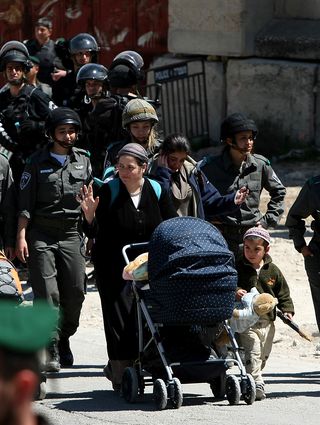
(Photo: Israeli forces evict a group of settlers from a disputed house in Hebron on April 4, 2012, a day after they were ordered to leave the Palestinian property in the occupied West Bank. Police spokesman Micky Rosenfeld indicated that 15 people had been escorted off the premises, among them women and children, one of them seen in the picture holding a teddy bear and a plastic toy gun as he walks next to family members. By Hazem Bader/AFP/Getty Images)
The Right’s Obama, Ctd
A reader writes:
I think
party of Klansmen. What drives them is resentment.
The Republican world falls apart at each of its ascendent moments. We see it again and again: the Right organizes, wins, shows its ugliest feathers, and is then rejected. The wound from each rejection is cauterized by the Limbaughesque smug satisfaction of being right all along! Smarter than their rejectors, who have been brainwashed, are privileged elitists, or are insufficiently informed by a biased media / educational / entertainment complex.
This is how they felt in 2008. They didn't hate Obama because he's black; they resented him because he was beloved. The nation had fallen in love, and it wasn't with them. Who could overlook the Nixon-like contempt for the Other? If the rejection carries with it an identifying characteristic (a history of racism, elitism, fiscal mismanagement) it becomes ammunition to hurl back. Hence "racist hatemonger", "he made it worse", and so on. They resent being called racist, so Obama's the racist. They resent their own Big Governing, so Obama is a socialist. They resent the stain of Bush's 5-4 election, so the fix was in for Obama '08.
The Right is poised for another big, historical dive, but it won't be the last we hear from them. Resentment is a strong motivator, and it will continue to pick them up off the mat.
Another writes:
I think you are correct re: the unhinged nature of the modern Right in response to Obama’s election, but I don’t think Michael Walsh’s claim of a "rigged" 2008 election is a sign of anything new or especially alarming. I am a historian of 19th century America and I can tell you that accusations of fraud were absolutely rampant in the first century of American democracy.
I’m not talking about cases of actual fraud and ballot-box stuffing that made the Tweed Ring so famous. I’m talking about completely unsubstantiated, sour-grapes claims of fraud, stemming from the epistemic closure of a partisan 19th-century news media where readers simply could not imagine that legal, American voters would freely choose the opposing party’s candidate. What’s more, this was true in landslide elections as much as in razor-thin contests where actual fraud may have made the difference.
As much as we love to celebrate the legitimacy of democratic victory – the willingness of the loser to accept the winner – the reality is that American voters and political parties have always challenged the propriety of the election process when the favored candidate loses. This extends to the pre-election process as well. That’s why we have to see all the "photo ID" laws appearing in GOP-run states not as a legitimate attempt to curb "fraud" but as a tactic to change the electorate itself.
Historically, liberals have sought to change the electorate too – by expanding the polity to include the poor and marginalized – or, less conscientiously, by tying an electoral outcome to the distribution of basic government services (the spoils system). We have always sought to game the system. When our side’s candidate wins, it’s a historic repudiation of everything the other side believes. When our side loses, it’s because the other side cheated. This was true in the 1830s, the 1860s, the 1890s, the 1920s, the 1950s, the 1980s and the 2010s.
The National Review crowd cannot accept Obama because he effectively refutes the ideology at the heart of what passes for modern conservatism. Any more praise – beyond an episodic congratulations for killing Osama bin Laden, for example – would amount to ideological and political “treason”.
(Image: Barack Obama Incredible Hulk action figure by Ron English)
Bush And Cheney vs The West

Finally, Spencer Ackerman gets his document. It's Philip Zelikow's 2006 State Department memo arguing that the interrogation techniques already authorized by Bush were clearly illegal – and way outside the bounds of American precedent:
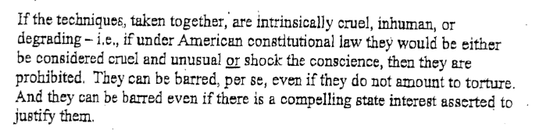
Zelikow knew that this torture violated core values in American history:
“We are unaware of any precedent in World War II, the Korean War, the Vietnam War, or any subsequent conflict for authorized, systematic interrogation practices similar to those in question here,” Zelikow wrote, “even where the prisoners were presumed to be unlawful combatants.”
Other “advanced governments that face potentially catastrophic terrorist dangers” have “abandoned several of the techniques in question here,” Zelikow’s memo writes. The State Department blacked out a section of text that apparently listed those governments.
“Coercive” interrogation methods “least likely to be sustained” by judges were “the waterboard, walling, dousing, stress positions, and cramped confinement,” Zelikow advised, “especially [when] viewed cumulatively.” (Most CIA torture regimens made use of multiple torture techniques.) “Those most likely to be sustained are the basic detention conditions and, in context, the corrective techniques, such as slaps.”
(I presume "advanced governments" refers in part to Israel whose Supreme Court struck down the torture the Israelis once inflicted on Palestinian terror suspects.) But what's crucial here is that while I think there's no doubt that what was authorized was torture, the legal bar against cruel, inhuman, and degrading interrogation techniques which also "shock the conscience" is and was much broader. The Reagan-signed Convention Against Torture is not pulling a Yoo, trying to parse legitimate forms of torture from the illegitimate. It is insisting on the broadest definition possible. Here is a passage from Reagan's signing statement:
The United States participated actively and effectively in the negotiation of the Convention. It marks a significant step in the development during this century of international measures against torture and other inhuman treatment or punishment.
My italics. Note that the law is very clear that no national emergency can trump this prohibition – precisely because torture is invariably defended as an emergency. Zelikow clearly understood this. As presumably did Condi Rice. And let me repeat what was actually done to the prisoners in plain English:
using dogs to terrorize prisoners; stripping detainees naked and hooding them; isolating people in windowless cells for weeks and even months on end; freezing prisoners to near-death and reviving them and repeating the hypothermia; contorting prisoners into stress positions that create unbearable pain in the muscles and joints; cramming prisoners into upright coffins in painful positions with minimal air; near-drowning, on a waterboard, of human beings—in one case 183 times—even after they have cooperated with interrogators.
The gut test: if an American were subjected to these techniques in an Iranian prison, would we regard it as torture? It's not really close, is it?
(Photo: a Khmer Rouge waterboard, preserved in Cambodia's Genocide Museum.)
 The Dish