Your Marriage Or Your Country? Pick One.

141665128

Some readers may know that my own legal marriage in Massachusetts five years ago made no difference whatever to my ability to become a permanent resident, because of my HIV status. The HIV ban is now history (thanks to Bush and Obama). But it's worth recalling that if I had married a woman instead of a man, my marriage license would have trumped the HIV ban immediately, granting me an automatic waiver for permanent residence. When Jesse Helms and then Bill Clinton put the HIV ban into law, they exempted the married and heterosexual. The reasoning was the same as it is for general US immigration policy: family trumps everything. The US government does all it can not to split up immediate families in immigration law. But when it comes to gays and lesbians, we have no recognized family under federal law since DOMA, and therefore bi-national couples are literally strangers to one another in the law.

Readers may recall my time in London fundraising for Immigration Equality earlier this year (I am on the board). At one meeting that was filled with same-sex couples doomed to divorce by deportation, or joint emigration, I looked out at a sea of eyes. The intensity of the pain was a little too much to bear, because I remembered it so well. To fall deeper in love, knowing there is no security for the future at all; to put down deeper roots in the knowledge that one day, they may have to be uprooted; to see your relationship have an expiration date on a visa; to have HIV actually stamped in code in my passport as a final stigma; to stand in separate lines if we re-entered the US, since gay couples were deemed a particular immigration risk, since the USCIS understandably assume that couples in love might be tempted to overstay visas.

Yesterday was the first legal step to ending this injustice. Glenn Greenwald highlights a new lawsuit (pdf):

[T]housands of U.S. citizens are barred from living in their own country with their same-sex spouse. The “luckiest” among them are able to move to their spouse’s country, but that’s a choice available to only a small percentage: for that to work, the foreign spouse’s nation must grant immigration rights to same-sex couples (only a minority of countries do) and the American partner must be able to find work while living outside the U.S.

(I’ve written and spoken previously about how this discriminatory framework forces me to live in Brazil with my Brazilian partner, who cannot obtain immigration rights to live, work and/or study in the U.S.). But the vast majority of same-sex couples in this situation do not have even that limited option: instead, they are faced with the horrifying choice of (a) having the foreign partner live illegally in the U.S. (which means they face the constant threat of deportation, cannot legally work or study, and cannot ever leave the country to visit their family back home), or, worse, (b) living thousands of miles apart — continents away — from the person with whom they want to share their life.

Glenn downplays his own strain. But what does it say about a country that one of its brightest intellectual stars has to live thousands of miles away from his own country, because he is committed to another man for life? As Western countries increasingly allow for these immigration rights, a diaspora of gay Americans and their spouses is growing around the world. For the rest, the agonies of separation and family destruction endure.

Why is the US government actively attacking family life in this country? And doing so by some of the cruelest punishments imaginable – the choice of divorce from the person you love and exile from the country you were born in?

(Photo: Tens of thousands of same-sex couples in the United States live under the threat of separation because federal law prohibits immigration authorities from treating them the same as married opposite-sex couples. Joy Hayes, right, and Lujza Nehrebeczky were married in Connecticut last year. On the advice of an attorney, Nehrebeczky won't attempt to travel to Hungary to see her mother, who has cancer. She fears her student visa might not be renewed. By Mark Cornelison/Lexington Herald-Leader/MCT via Getty Images.)

The Crisis Of Christianity, Ctd

A reader writes:

When Dali_Crucifixion_hypercubespiritual transformation that can in the end transcend" our current dilemma, do you mean to emphasize the essence, the sheer – or the Christianity? There is a world of difference, you know.

Or let me put it in the form of a more formal philosophical question: Is Christianity itself essential or accidental? That's the question you left unanswered (indeed unasked) in The Conservative Soul, and it remains unanswered here. And yet everything in the arguments you present depends on the answer.

If Christianity itself is essential, we have one world, and one set of answers. But if Christianity itself is accidental – whatever essence it may point to, or even at times embody – then we have another world, and another set of answers altogether is required. For instance, I personally have no doubt whatsoever that, in the breach, and when politics and doctrine and pride recede, "sheer essence" will indeed rise again.

I do doubt, however, that the form it will take will necessarily be Christian – or that of any other known religion – or even of religion itself, as we've known it.

Obama vs SCOTUS, Ctd

I repeat what seems pretty obvious to me: the president's remarkable attack on the Supreme Court yesterday was not, it seems to me, an attempt to persuade. It felt like the first speech of a presidential campaign when Obama will rail against the vested interests that have tried to destroy his presidency: the intransigent Republicans and a radical right court. I suspect he knows the mandate went down last week, and is framing things for the election.

Secondly, is it not passing strange that the same court that seems intent on striking down the individual mandate to ensure universal coverage has just removed what shred is left of the Fourth Amendment? I mean: we get irritated by airport scans, but there is no outcry that any cop who arrests any citizen on any charge can strip that individual entirely before jailing him or her.

Yes, our own government has the right to do to any of its citizens what was done to the victims at Abu Ghraib as a first step to help break down their self-respect. And it can do so for any arrest whatsoever, on even the most trifling of questions. Put yourself in that position for a moment. Not just a mug-shot but a full strip down in front of total strangers in uniform. Most human rights groups view this as problematic for developing countries' legal systems' compliance with human rights.

And yet I hear no outcry from the Tea Party. A mandate devised by conservatives to prevent healthcare free-loading is an outrage to everything America stands for. The police's right to strip search any of us, even if there is no evidence of any contraband? Move along now. Nothing to worry about here.

The View From Your Window Contest: Winner #96

Vfyw_3-31

A reader writes:

The highway in the photo appears to be a US Interstate. And the location appears to be non-mountainous. The foiliage indicates an area that is south of the northern US, but north of the southern US. Having just got back from a semi-cross country drive, the area reminded me of a particular city we drove through: Kansas City, Missouri.

Another writes:

This looks a lot like Oklahoma City, specifically the Bricktown portion of the city. If I had the time, inclination, and ability, I'd zoom in on the overpass section of the photo to see if there's a minor league baseball park hidden among those buildings and a rip-off of San Antonio's Riverwalk; but I don't. So that looks like I-35 running through the city, crossing the north fork of the Canadian River.

Another:

Oooooh, oooooh! Pleasant Point, West Virginia! It's the location of the Mothman sightings. This guess is based on the overall stubbiness of the buildings, the nearby river and bridge, and the fact that it would make for an interesting VFYW contest location.

Another:

My guess: Memphis, Tennessee.  The photographer is looking south at the I-40 bridge that crosses the Mississippi River (on the right) and lands in Arkansas.  You can see Mud Island and the old downtown.  We're also looking toward Beale Street and, beyond that, well beyond view, the Lorraine Motel where Dr. King was shot, which is now the National Civil Rights Museum.  To the right, outside the frame, is the Pyramid, which, in my opinion, mars the Memphis skyline.

If I am right, I owe it to the fact that I just visited Memphis for the first time on a work trip.  I stayed at the Peabody Hotel (with the twice daily March of the Ducks), ate ribs more than once a day, and walked along the Mississippi.  And enjoyed the hospitality that is uniquely a feature of the American South.

Not Memphis, but we did feature the city a few months ago. Another reader gets it:

Thanks for throwing us an easy one.

I knew at first glance that this was Richmond, Virginia, a city I have never spent time in but have driven through many times and always marveled at the beautiful old train station right next to the interstate after the curve.

A visual entry:
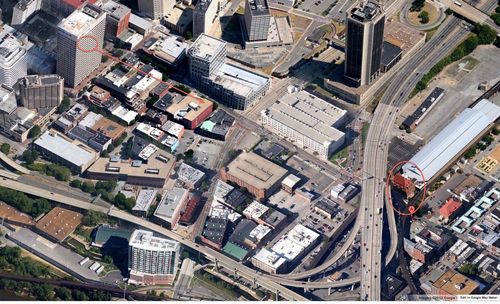
Screen Shot 2012-03-31 at 12.28

Another reader:

Finally, one that I recognized within 30 seconds of viewing. This is an eastern view from the Bank of America building in downtown Richmond. Quiet a coincidence: I was on the phone with my dad, who lives and works in the area, when I saw the view. I used to live past the interstate on 18th and Main. The old train station is the red building to the left; just by the interstate. Jefferson's VA Statute of Religious Freedoms was signed in that first parking lot. There is a plaque commemorating it on a building nearby. The Virginia capitol building is just to the north west of the building. The James River is to the right. In 2003 there was tremendous flooding in the area by the interstate.

Another:
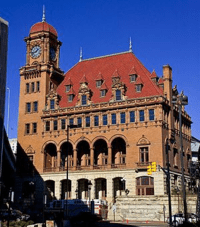
Screen shot 2012-04-03 at 11.39.39 AMI know this area well, having lived here after college before moving to DC. That area is known as Shockoe Slip – the downhill slope into Shockoe Bottom where all of the tobacco warehouses are and now the high-end lofts and restaurants. The clocktower of the old mainstreet station sits beside I-95 and welcomes people to the city. I was lucky enough to ride into the station when it reopened in 2003 working for then-Senator George Allen. Beautiful station.

Another sends the above photo. Another reader:

In the upper left, there is the steeple of St. Johns Church where Patrick Henry gave his "Give me liberty or give me death" speech.  It's hard to point out, but the oldest Masonic Hall in the US is in the shot too. I've looked at this contest for years and would LOVE to finally have a shot.  Please, oh please!  Choo, choo, choose me!  (It is a train station after all that gave it away and I'm a coveted female reader.)

Another view of the station:
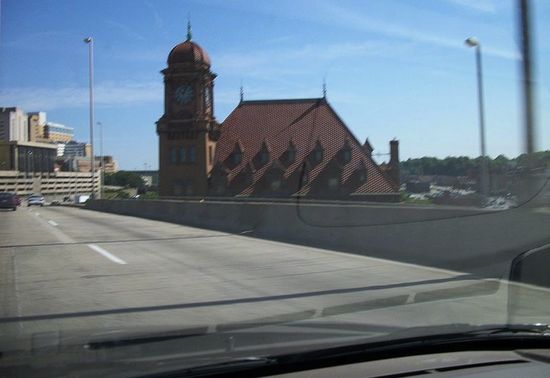
View from the car window - Richmond_Main_Street_Station_from_I-95_in_Virginia

The photographer adds, "As a kid driving with my family south to Florida, I was convinced we could indeed touch it as we drove by." Another reader:

Holy S*#t I GOT ONE!!!  Crap … you know what, I just realised … I got this one. That means it must be really easy and EVERYONE WILL and they all got their answers in way before I did.

A few hundred, in fact. Another reader goes for the exact window:

While I'm a long-time reader of the Dish, and an occasional e-mailer, I've never entered this contest before. I'm continuously amazed at your readers' ability to discern the exact window of a building with just the most miniscule of clues. But this 679408-Mediumone just seems impossibly easy.  Older American city meant East coast. On a river. Major highway, elevated, running through it. It took me all of 15 seconds of looking at the picture to realize that's I-95 right in the middle of downtown Richmond, VA. It was the red brick building with the steeple overlooking the highway that did it. I live in North Carolina and once or twice a year drive up to D.C. Downtown Richmond is one of the highlights of the trip as it breaks up the monotony of highway driving.

A couple more minutes of Google maps searching took me to the Bank of America Tower, looking Southeast, from one of the top floors. It's a 26-story building, but I'm not about to get into geometric calculations to figure the angle to the forebuildings. The only way to win this particular contest out of the myriad of really close entries is to make a non-obvious guess. So I'll say it's not from the top floor, or even the next, but the 24th floor. There's a law firm on the 24th floor, and I'm guessing that lawyers are more apt to read the Dish than other professions. It looks to be one of the skinny windows.  So I'll guess the middle skinny window in the third set of skinny windows from the left side of the building (see attached photo).

So close. Another nails the right floor:

Never responded before, but I grew up there, used to work a few blocks over and the shock of recognition was too much not to respond. So this is the view looking East at I-95 and Shockoe Bottom from the Bank of America building at 12th and Main. You can even see the ugly, beige aggregate material that they used for the façade of the building at the bottom of the photo. I'll just guess on the floor – 23rd?

Two other readers correctly guessed the 23rd floor, but only one of the three has gotten a difficult view in the past (last week's view of Puerto Vallarta, in fact) without winning. That reader writes:

Sometimes you get lucky.

I swore the reddish-brown building on the left was a church and scoured Google images for it, including going through a list of every Catholic cathedral and basilica in the southern half of the US.  The low-res image looks quite close in style to the Basilica of St. Lawrence in Asheville, NC.  My wife saw the train tracks, but we didn't put the two together.  Since the vantage point had to be at least 20 stories up and the trees were fully green, we finally just darted around big cities in the southern US on Google Earth until spotting the whitish domed structure that is the Richmond Main Street Station, of which my "church" is actually the main entrance.  The window itself is clearly in the Bank of America building at 1111 E. Main Street, facing southeast.  We think 23rd floor to get that kind of vantage point.

Oh, and based on the reflection, the photographer looks to be married.

The photographer is also a history buff:

The view is looking east from the 23rd floor of the Bank of America building – the offices of Sands Anderson PC law firm. 

The Union Army came along this route on the morning of April 3, 1865 after the Confederate Government, and Lee's Army, fled the City the day before.  The road on the left side of the frame is State Route 5 – in the City of Richmond it's Main Street, turning into Williamsburg Rd. and then, outside the City, it becomes New Market Road which is what it was when Grant's troops marched down it 147 years ago.  Retreating Confederate soldiers were ordered to set fire to armories and bridges on their way out of the City.  The resulting fires engulfed much of the City and much of the capital was lost.  City leaders made their way to Union lines and pled for help saving the City.  The Union Army put out the fire.

The highway cutting left to right across the frame is I-95 (south-bound travel is heading to the right).  Main Street Station, built in 1901, is the orange brick and teracotta roofed building just on the other side of the highway.  The little strip of water on the right-middle of the frame is an old canal that carried tobacco to warehouses along Tobacco Row.  They're mostly offices and condos now, but one of them is the Virginia Holocaust Museum.

The river on the far right is the James River named for King James I.  The James is navigable from the Chesapeake Bay right up to Richmond at which point the falls in Richmond, the country's only Class 5 urban rapids, made the river impassable to commercial shipping.  Richmond, you may know, got its name from planter William Byrd in 1737 who was struck by the close resemblance of the view from the falls of the James River to that of the River Thames from Richmond Hill.

(Archive)

The Crisis Of Christianity, Ctd

1333181310738

Kyle Cupp questions the celebration of powerlessness in my essay on Jesus and the Church:

We only know of the “pure message” because a network of self-described religious authorities (i.e., those with power) wrote the words, attributed them to Jesus, and incorporated them into a sacred text–a text that has developed and changed, that has been reinterpreted and re-translated, all works of power.

Well: duh. I did not write that Christians live in an unfallen world in which power doesn't exist. Of course we don't. We are constantly exercizing power in different ways, and the Gospels are, of course, a product of the struggle for power between various sets of Jesus' followers. But that was Jefferson's point! His project was to try to extract from the New Testament those words of Jesus that he believed were the least infected by this. And my modest proposal is to return to that spirit in seeking a faith as far removed from power, violence and coercion as humanly possible. In another vein, although he decries the "the politicized nature of Christianity in the West," Trevin Wax, the managing editor of The Gospel Projectbelieves Jesus was political in his own way:

Despite his protests against a politicized faith, Sullivan is saying we should follow a Man whose primary message concerned a kingdom. You can’t get more political than that. It’s interesting to see how those who advocate a return to the words of Christ often display a frightening ignorance of what Jesus actually said. The primary message of Jesus was not love – at least, not love in our sense of the world. The message of Jesus was Love with a capital “L” – meaning, His message was about Himself. It was about His kingdom, His identity as king, and the cross that became His throne.

But we know that this metaphor of kingdom was a metaphor on earth. When asked directly if he sought worldly power during his interrogation, Jesus answered:

"My kingdom does not belong to this world. If my kingdom belonged to this world, my servants would fight to keep me from being handed over to the Jews. But for now my kingdom is not from here."

And that is why the crucifixion remains the great central symbol of the Christian faith. It is a total renunciation of worldly power. Jesus did not want such an outcome, but he accepted it and loved those who murdered him. One of Jesus' key temptations in the desert was earthly power – offered to him by the devil, just as it was offered him by the crowds that sought him out and which he often fled. Jesus refused all such earthly power. They put the sign above his head in mockery – in the same way they gave him a purple robe and a crown of thorns. He had never sought this regal role, but he accepted it as part of his final humiliation.

Wax later argues that Jesus' message is consistent with opposition to abortion and marriage equality. It can be – but even Wax acknowledges that this has to be inferred, and that Jesus' emphasis was on other things. Freedom at Bethsaida, a Christian blogger, remains hopeful:

[Y]es, Mr. Sullivan, “the church” does face a crisis – and pretty much always has. It has always been the case that there are those in this faith who draw attention away from Jesus and toward themselves – whether it is accolades or power. They cover up abuse (as you note) to maintain their power. They talk smoothly to maintain their power. But they have never found a way to hold sway indefinitely. The light of the gospel has always broken through. We’ve had reformations, and splits, and revivals. We’ve seen people turn away from organized churches and form house churches to break free from the “structure” of it all. Those who hunger and thirst for righteousness will always be filled. Those who crave a true and unmitigated relationship with God will find a way to have it, and will find that they are helped along the way.

I agree. But hope is not the same as optimism. Or apathy in the face of abuses.

The Entangling Alliance

142050463

Dana Goldstein defends The Crisis Of Zionism:

I am grateful for this book. Younger American Jewish writers like myself, Matt Yglesias, Ezra Klein, Spencer Ackerman and Kiera Feldman have been writing for six years about our increasing alarm regarding the Israeli occupation, only to be derided as the "juice box mafia" by our elders. Beinart is a lot harder to belittle. He is the former editor of The New Republic—a magazine not exactly known for progressive foreign policy positions—and an observant Jew who once supported the Iraq war. He has demonstrated an admirable ability to rethink his opinions in the face of evidence, and as a member of Generation X, he serves as an ideal interlocutor between younger Jews and our Baby Boomer parents, many of whom continue to see Israel through the rose-colored glasses of their own youth, when the Jewish state was far less established and more threatened by its neighbors than it is today.

Another young American Jewish writer, Jordan Hirsch, is more receptive to Beinart's core argument than the older writers of Tablet and the WaPo but nevertheless knocks the book:

[Beinart presents] a specific narrative that will appeal most to the young, liberal Jews who naturally find it easier to associate with the Judaism of humanitarianism than with the Israel of occupation. [But this] proposal for American Zionism is the very mirror image of the simplistic establishment line that he devotes his whole book to tearing down. In his attempt to offer young Jewish elites a Zionism that allows them to skip the "messy, frightening debate over Israel's future," he substitutes the old model of one-dimensional support with a new model of one-dimensional criticism. Having fled right-wing simplicity, Beinart loops directly back to its twin on the left. In doing so, he fails to establish the balance that American Jews so desperately need in their approach to Israel. And he alienates Israelis, who know and live a very different reality from the one he presents. That's why those who embrace The Crisis of Zionism – especially the young, liberal elites for whom it is intended – risk dooming themselves to irrelevancy.

Why cannot Peter's book be seen for what it plainly is: an attempt to rebalance and shift the debate so that the peril of both Israel's long-term occupation of another people is more baldly laid bare? Of course such a book will ruffle feathers, and alienate some in Israel. But everyone in Israel?

My fear is simply this: that younger, more liberal American Jews will continue to drift away from interest in an increasingly indefensible Greater Israel (as they should); that the older generation has enough money and clout and paranoia to prevent any external pressure being brought on Israel to halt its assisted suicide in the foreseeable future; and that the Greater Israel lobby certainly has enough clout, when added to its total embrace by the GOP and its evangelical base, to defend all Israel's future wars and periodic "lawn-mowing" of regional rivals.

I'm not Jewish so I do not feel Peter's pain on this. But as a permanent resident of America, concerned primarily with this country's defense and interests, I do feel anger that US foreign policy as a whole pivots on this now "unbreakable" entanglement. My position vis-a-vis Israel at this point is best reflected by Jefferson's famous definition of a truly American foreign policy: "peace, commerce, and honest friendship with all nations, entangling alliances with none."

We are not so much entangled with Israel, but fused with it. And this is a function of empire, a form of global governance the original Americans fought a revolution to end.

(Photo: An Israeli settler prays by the window of an occupied Palestinian house after dozens of Jewish settlers took over the Palestinian property overnight, claiming they have legal ownership, in the occupied West Bank city of Hebron on March 29, 2012. By Menahem Kahana/ AFP/Getty Images.)