The Right’s Obama

It has long befuddled me – the way so many on the right view him not with disagreement or discernment, but with contempt. Contempt is a strong word; and it is built on some notion of his illegitimacy as president. They called Clinton illegitimate as well, of course, because of his plurality victory in 1992 (he never quite made it to 50 percent of the vote in 1996 either). But Obama? A clear electoral victory by a black candidate after one of the most brilliant underdog campaigns in our lifetimes. I suppose the right's view that racism no longer exists in America defuses the racial barrier. But it's telling, is it not, that very, very few Republicans have hailed the election of a bi-racial man as president, if only to celebrate the progress this country has made.

Why not fear of Obama's charm? Or suspicion of his cunning? Why not coopt this oh-so-willing-to-be-coopted figure to move his policies to the right (as if the individual mandate, extension of Bush tax cuts, and escalation of the war in Afghanistan could get further right)?

No. Instead we have contempt. A president who can be shouted at during a State of the Union address; a president whose birth certificate, readily available, is still questioned; a president who is regarded by an unthinkable chunk of Republicans as a Muslim; a president who allegedly cannot speak a full sentence without a TelePrompter; or, in Glenn Reynolds' immortal words, "a racist hatemonger."

Every now and again, they tip their hand in further weirdness. One of the more Kinsley-esque moments in contemporary Washington is the spectacle of every liberal in the town now bemoaning judicial activism, and every conservative celebrating the courts as a vital part of our constitutional system. Why, it's enough to make someone a little jaded. In that vein, comes one Michael Walsh who just had a conniption about the president's attack on the Supreme Court yesterday. It speaks to the right's view of this president:

Obama’s only tough contest came in the 2008 primaries, when he ambushed the fat and complacent Clintons by rabbit-punching Hillary and hanging on in the face of her furious counter-attack to eke out a split-decision victory. Of the general election that year, the less said the better. As the gangster, Johnny Caspar, says in Miller’s Crossing, “If you can’t trust a fix, what can you trust?”

But there inevitably comes the time when the fix isn’t in, when the opponent didn’t get the memo to take the dive, or when the mob simply tires of a champion who’s outlived his usefulness and seeks another tomato can.

Walsh is clearly implying that the election of 2008 was "fixed" or "rigged." And when you think about it, this has to be the case, or else their contempt for Obama would have to be leavened by at least some respect for one of the most brilliant underdog presidential campaigns in modern times. But not even that. Not even in the killing of Osama bin Laden could they give him any credit.

Is this rank racism, pure partisanship, class resentment, or some toxic combination of them all?

Not-So-Weird Post-Liberalism

David Goodhart surveys the emerging political landscape:

Post-liberalism, like the promised land of a post-racial politics, does not seek to refight old battles but to move on from victories won. Its concern is not to repeal equality laws, or reject the market economy, but rather to consider where the social glue comes from in a fragmented society. To that end, it acknowledges authority and the sacred as well as suffering and injustice. It recognises the virtues of particular loyalties—including nations—rather than viewing them as prejudices. And it seeks to apply these ideas to the economic as well as the social sphere.

Much of this goes against the grain of an increasingly WEIRD [Western, Educated, Industrialised, Rich and Democratic] and legalistic politics in Britain.

The problem for the left has not so much been "rights without responsibilities" as rights without the relationships that help sustain them. If we are to be entangled in one another’s lives, for example as funders or recipients of social security, it helps to identify ourselves as part of a group. Meanwhile the right remains attached to its own form of abstract universalism, more concerned with the procedures of the market than what kind of society they have helped create. Some of the notions of loyalty, civility and respect that conservatives are so comfortable with in politics need to be reintroduced into the economic sphere.

Curveball Confesses

He lied to get rid of Saddam, and I believed him:

The chemical engineer claimed to have overseen the building of a mobile biological laboratory when he sought political asylum in Germany in 1999. His lies were presented as "facts and conclusions based on solid intelligence" by Colin Powell, US Secretary of State, when making the case for war at the UN Security Council in February 2003.

But Mr Janabi, speaking in a two-part series, Modern Spies, starting tomorrow on BBC2, says none of it was true. When it is put to him "we went to war in Iraq on a lie. And that lie was your lie", he simply replies: "Yes."

Are Animals Superstitious?

Yes, for the same reasons humans are: 

Superstitions take over behaviour because our brains try and repeat whatever actions precede success, even if we cannot see how they have had their influence. Faced with the choice of figuring out how the world works and calculating the best outcome (which is the sensible rational thing to do), or repeating whatever you did last time before something good happened, we are far more likely to choose the latter. … This explains why having personal rituals is a normal part of being human. It is part of our inheritance as intelligent animals, a strategy that works in the long-term, even though it clearly does not make sense for every individual act.

Would Iran’s Nukes Be Contagious?

Steven Cook calms fears that Iranian nuclearization would cause its neighbors to follow suit:

Most important to understanding why the Middle East will not be a zone of unrestrained proliferation is the significant difference between desiring nukes and the actual capacity to acquire them. Of [Turkey, Saudi Arabia, and Egypt], the one on virtually everyone's list for possible nuclear proliferation in response to Iran is Turkey. But the Turkish Republic is already under a nuclear umbrella: Ankara safeguards roughly 90 of the United States' finest B61 gravity bombs at Incirlik airbase, near the city of Adana.

Is Big Football The Next Big Tobacco? Ctd

More readers feed the popular thread:

Even the worst player on the worst team at the professional level is so far off the right side of the athletic bell curve that it's as if he's playing a different game entirely than the one played in high school or college. They're freaks – and I use this word in the most positive way possible. This is more pronounced in the NFL, I think, than any of the other major American sports leagues.

Football players are simply universally strong and fast. I mean, look: the heaviest man in the NFL right now is probably Vince Wilfork, who is listed at 340 pounds. (This is a polite fiction; he's probably closer to four bills.) Most people who weight that much are barely mobile, but here is Wilfork intercepting a pass against the Chargers last year. 

This is a mountain of a man moving with lateral quickness, jumping to tip the pass, balancing himself in order to haul in said tip, and then running down the field at a speed you and I will never dream of reaching unless you have a track background I'm not aware of. He ran the 40-yard dash in about 5.21 seconds – that's a almost 400 pounds of person moving at a little less than 16 miles per hour. And he's considered somewhat slow.

You can't just find a guy like that without a massive talent pipeline. Right now, you have thousands of high schools sending athletes to hundreds of colleges, all funneling their best athletes (after four years of pretty high-end training) to 32 football teams. If people start getting scared away, maybe the Vince Wilforks of the world will decide to take up basketball or baseball instead. The quality of play will decline – slowly at first, but eventually it'll become noticeable. Maybe this will take 25 years to become an existential threat to the league, but it's certainly not out of the realm of possibility.

Another writes:

This link is to a TERRIFIC Frontline episode on high school football, and it has a segment on brain injuries. The most frightening part is a team of doctors who set out to do a study of changes in cognitive functions of high school players in the hours and days after a concussive head injury. But there weren't any significant episodes in their first couple days so they decided to put their time to use by doing some baseline studies of cognitive functions of the players before any injury.

One of the things they learned was that there was a measurable decline in cognitive function just from the ordinary helmet-to-helmet impacts on every play, even when there was no concussion suffered by the player. They tracked this group of players for several weeks of practice, and measured the decline in their brain function – thinks like short term memory, pattern recognition, etc.  The concluded that the cumulative effect of all these sub-concussive impacts of the brain on the inside of the skull lead to the same conditions as a concussion.

I've watched it a couple times now, and one decision I've come to is that my very athletically talented 10 year old will never play football. 

Why Are Job Training Programs So Bad?

Ben Casnocha wonders:

For every 14 people laid off in the Great Recession and now rehired, only one has recovered the same or greater salary. To maintain as good or better wages in a competitive economy, you need better skills. The federal government spends $18 billion a year on 47 job training programs run by 9 different agencies. But, according to the Government Accountability Office, "little is known" about the effectiveness of the programs. How the heck do we design job training programs that actually work? How do we measure success? These are vital questions, and while there's plenty of agreement that the topic is important, I haven't seen as much on the nuts and bolts.

Taxing The Economy To Save It

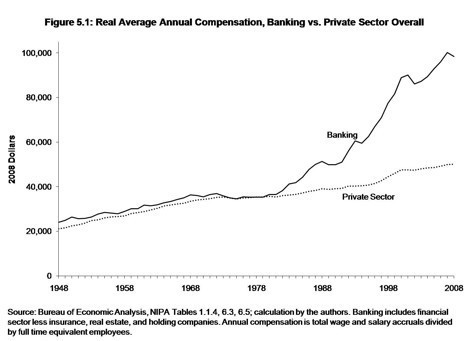
Compensation-graph1

It's a theory at least:

I am inclined to conjecture that over the last 30 years, reductions in top marginal tax rates may have provided a huge incentive to expand the financial services industry. The increasing importance of finance also seems to have been a significant factor in the increasing inequality in income distribution observed over the same period. But the net gain to society from an expanding financial sector has been minimal, resources devoted to finance being resources denied to activities that produce positive net returns to society. So if my conjecture is right — and I am not at all confident that it is, but if it is – then raising marginal tax rates could actually increase economic growth by inducing the financial sector and its evil twin the gaming sector — to release resources now being employed without generating any net social benefit.

(Chart from Bernard Finel)