Walter Russell Mead looks ahead:
Hollande now has a delicate few weeks. French legislative elections are scheduled in June, and Hollande must steer between twin dangers. On the one hand, if it turns out that all his talk about reform and growth was just so much election verbiage and once he’s in office he plans to continue French policy more or less as before, then disillusioned voters could turn on him next month. On the other hand, if he pushes against Germany and the financial markets too forcefully, a crisis of confidence in France and in Europe could develop in the markets. That, also, would not be good for his prospects in the legislature.
Markets are down this morning, but Buttonwood blames Greece, which also voted over the weekend:
Mr Hollande's victory was expected … and it is the Greek result that is rattling investors today. It would seem to bring the prospect of a euro exit much closer. In addition either the Greeks will attempt (and probably fail) to renegotiate their bail-out or new elections will be called; either outcome will provoke another period of uncertainty. Time for the traditional European summer of crisis?
Yglesias lowers expectations:
If the [European Central Bank] signals that it will only support the French banking system and the French economy if Hollande sticks with the status quo program, then Hollande may well have no choice. Elections in Europe aren't necessarily what they used to be. Nobody's crying over Silvio Berlusconi but he was Italy's elected Prime Minister and he lost power not in an election but it a made-in-Frankfurt call by the central bank.
Christopher Dickey reminds us:
France is going to have to borrow about €180 billion ($240 billion) before the end of the year. Under Sarkozy it already lost its AAA credit rating. If borrowing rates start to climb dramatically, the hope of clawing out of the slump will fade very quickly.
Ezra Klein adds:
Perhaps the reality of the euro zone right now is that this isn't just about what Hollande does now. It's about what Merkel wants to do now, and what the ECB wants to do now. The old consensus is no longer politically sustainable. The regime changes in France and Greece, and Hollande's presence at the negotiating table, offers an excellent opportunity to change course if that's what the euro zone's leaders want to do. But is it? What do the euro zone's leaders want to do now?
Tyler Cowen thinks trust between Eurozone nations has taken a beating:
It is painful to admit this, but things still could get much worse and now they are likely to do so.
A seventeen-member currency zone (scary just to type those words) has to be based on trust and this one isn’t, least of all now. There is little reason to think that Hollande can browbeat the Germans into picking up more of the bill, and if the Germans perceive their former French partner as an unreliable ally, this becomes all the less likely .
Joyner compares Sarkozy's situation to Obama's:
The Eurozone crisis is front and center in France; it should be here, but it’s an afterthought in the minds of the voters. Sarkozy was in office when the global financial collapse hit; Obama was merely running for office–and the opposition party was there when the crisis started. Obama can claim several foreign policy successes, whereas Sarkozy’s leadership in the Eurozone situation hasn’t paid off–and was saddled with the Afghanistan mess. And Obama is well liked whereas … Sarkozy irritates even his supporters.
And Yannis Palaiologos sees Hollande's election as a possible gift to the US president:
[Hollande] is expected to announce the withdrawal of French troops from Afghanistan by the end of 2012, a year earlier than Sarkozy’s plans envisaged. Barack Obama, who has already invited Hollande to the White House, will likely not be thrilled by this. But if the new French president can be a catalyst in pushing Europe away from its asphyxiating austerity regime and towards a vigorous recovery, Obama will be more than compensated for, given that the weak European economy is one the main threats to his re-election in November.
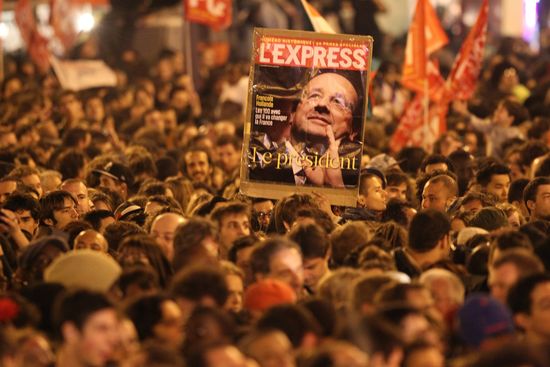
(Photo: Francois Hollande supporters celebrate at Place de la Bastille after Francois Hollande wins the French Presidential Elections on May 6, 2012 in Paris, France. By Sean Gallup/Getty Images)
 The Dish