A reader writes:
Can you please explain, statistically, your readers' repeated notions that a different voter turnout would have changed the outcome of Amendment One? 958,909 Democrats voted Tuesday, and 966,609 Republicans voted. You don't have to be Nate Silver to see your readers' false claims; the turnout was split 50/50. There was NOT over-representation of GOP voters.
Update from another reader, who has a very different interpretation:
Your reader is absolutely wrong in saying that GOP voters were not overrepresented in Tuesday's vote in NC. Using the data he/she linked to, you can see that registered Republicans make up 31% of registered voters in NC, while Democrats make up 43%. In a representative sample, you would expect the absolute number of Democrats voting to be higher than the absolute number of Republicans voting, but the proportion to be roughly the same as the proportion in the total electorate. Additionally, if you look at turnout as a percentage of registered voters in each party, 49% of registered Republicans voted, while only 35% of registered Democrats did. By this metric, a representative sample would include about the same proportion of each relative to the total registered voters.
I'm not sure the difference is enough to swing the outcome, because clearly some Democrats voted for the amendment, but GOP voters were pretty obviously statistically overrepresented in this election. This is particularly interesting because the Democratic primary for governor was more closely contested than was the Republican race, which we thought would impact turnout more than it did.
Another with on-the-ground experience agrees:
I’ve done work in North Carolina, and I can tell you, like Kentucky and West Virginia, NC has a much higher Democratic registration rate compared to its political leanings, left over from a bygone era. Overall, party registration is 43 percent Democrat to 31 percent Republican. In reality, the state is now pretty evenly divided, but there are a lot of reliable GOP voters who are registered as Democrats.
Take the last couple elections as an example. In 2010 Democrat Elaine Marshall lost the Senate race 43 – 55 percent to Republican Richard Burr. These two candidates were awfully generic, so if party registration was a good indicator of partisanship or ideology, Marshall should have won by 13 points instead of losing by 12. Similarly, in 2008 with a similar registration advantage, Obama managed to eek out a win by less than a percent even with an electrified base and everyone voting.
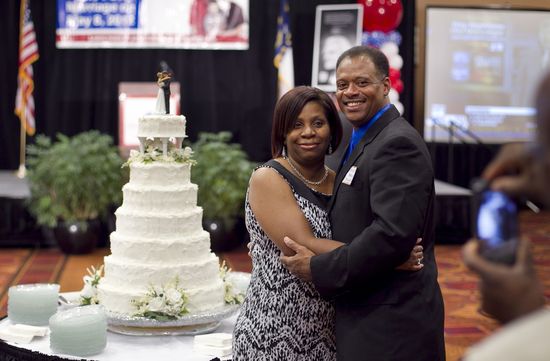
(Photo: Bishop Bruce Rogers of Raleigh, North Carolina, poses for a photo with his wife, Beverly Rogers, beside a wedding cake during an election party at the North Raleigh Hilton on Tuesday, May 8, 2012. Organizers plan to cut the cake if Amendment One – which would ban gay marriage, civil unions and domestic partnerships – passes. By Robert Willett/Raleigh News & Observer/MCT via Getty Images)
 The Dish