Syria's war is spreading into Lebanon. Walter Russell Mead gets scared:
The worst case scenario is not difficult to envision: the conflict in Syria reignites civil war in Lebanon and merges with sectarian violence in Iraq to destabilize the Fertile Crescent from Beirut to Basra. Given Turkey’s concerns with the Kurds in this region and the religious divisions inside Turkey itself, Istanbul would have a hard time staying out of this conflict. Tehran also would feel a strong pull to engage. The United States on both humanitarian and geopolitical grounds might also be pulled into a conflict of this kind.
Exum worries that the conflict won't end anytime soon:
Modern insurgencies have an average lifespan of 10 years, and even if the Syrian opposition groups are degraded, their principle advantage – that of low visibility – paradoxically goes up as the conflict drags along, allowing them to better evade the regime. U.S. diplomats have spoken of their desire for a negotiated political settlement to end the conflict, but that too is unlikely. Historically, civil wars go on for years before parties grow interested in a negotiated settlement as a means to end the conflict, and right now, the regime itself must feel that although the costs of the conflict have been heavy, the odds of a regime victory remain high.
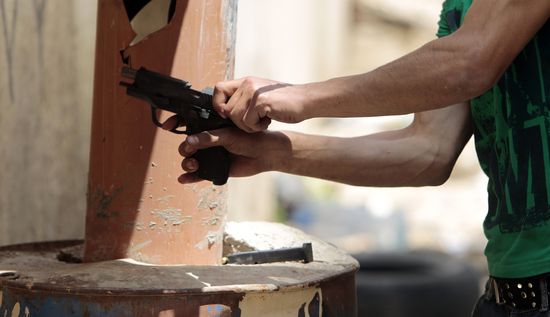
(Photo: A Lebanese Sunni Muslim man reloads his gun on Syria Street during fighting in the Bab al-Tebbaneh neighbourhood of the northern Lebanese city of Tripoli during the second day of clashes between factions supporting and opposed to the revolt in Syria on May 14, 2012. One man had been killed and nine wounded at this point in the clashes between residents of the predominantly Sunni Muslim Bab al-Tebbaneh district, hostile to the Syrian regime, and residents of the Jabal Mohsen district belonging to Syrian President Bashar al-Assad's Alawite community, a source in the security forces said. By Joseph Eid/AFP/Getty Images.)
 The Dish