Yglesias believes that economic changes have made "acquisition by an existing firm rather than an IPO the best route forward for most growing companies":
[T]he basic issue is clearly illustrated by Facebook’s recent $1 billion acquisition of Instagram. There’s just no way a company with literally $0 in revenue could obtain that kind of valuation as a stand-alone publicly traded company. But as a Facebook target, Instagram probably was worth $1 billion. Sharing photos is Facebook’s most popular use case. Mobile is the future of computing. And Instagram is the most popular and fastest-growing mobile photo-sharing service in the world. All billion-dollar investments are risky, but paying a premium to bring that technology in house rather than making the investment to try to build a competing service makes sense.
Henry Blodget puts Facebook's valuation in context:
For Facebook to actually be worth $125-$150 billion or more today, it will have to be worth, say, $300-$400 billion in a few years. Otherwise, the downside risk in ths stock simply isn't worth taking. And to actually be worth $300-$400 billion in a few years, Facebook will have to be earning about 10X-20X as much money as it earned last year.
Felix Salmon likewise deflates the Facebook IPO hype:
The press loves IPOs, because they’re one of the few occasions when the stock market delivers a significant news event which can be prepared for in advance. But the public? The whole investing-in-IPOs thing just feels so late-90s to me, and the performance of stocks like Groupon and Pandora is hardly likely to spark another feeding frenzy.
Kevin Drum's two cents.
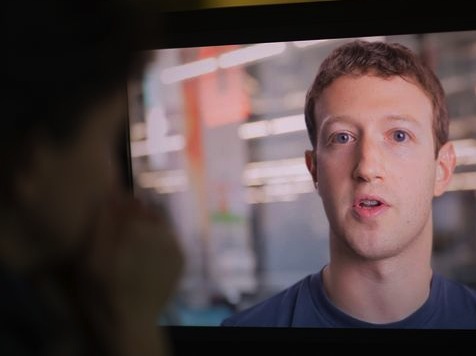
(Photo: A woman watches Facebook founder and CEO Mark Zuckerberg speaking in a promotional video ahead of the company's IPO, in Washington on May 8, 2012. By Mladen Antonov/AFP/GettyImages)
 The Dish