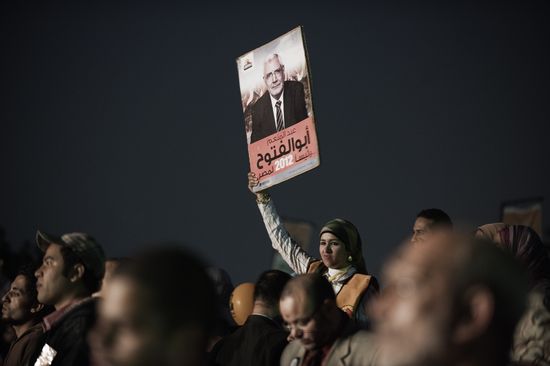
Shadi Hamid profiles Abdel Moneim Aboul Fotouh, the contradiction-filled Egyptian candidate propelled towards the presidency by a bizarre coalition of liberals and ultra-conservative Salafis:
[T]he same attacks that follow Aboul Fotouh's counterparts in Turkey and Tunisia will be used against him: that he is a proponent of "stealth Islamization" and that he remains faithful to the project of applying sharia. The critics might be right. If Aboul Fotouh becomes president, there will be a battle — between his liberal, revolutionary supporters and his Islamist backers — over the direction his presidency takes. Now that the major Salafi organizations have endorsed him, they are likely to have significant influence in an Aboul Fotouh administration, pushing his presidency to the right on social and moral issues. But though Salafists are a critical bloc of support for the Aboul Fotouh campaign, they have little presence in the candidate's inner circle and campaign organization.
Marc Tracy worries about the implications of an Aboul Fotouh administration for the Egyptian-Israeli peace treaty:
Aboul Fotouh has had some pretty dispiriting things to say about Israel and the Israeli-Egyptian peace. He has used Israel as a symbol of Moussa’s devotion to the old ways, challenging the former Arab League secretary to agree that Israel is the "enemy" (he wouldn’t) and even spread the false rumor that Moussa has an Israeli half-brother. Israel is a "racist state," he has said, the Camp David accords a "national security threat." There’s also the matter of Aboul Fotouh receiving the hardcore Salafists’ backing despite being further toward the middle on matters of mosque and state (more Brotherhood fatigue). Will President Aboul Fotouh keep the peace in Sinai? More likely, the military rulers will not give him the power not to.
Those not given to watching these events entirely through the prism of what's good for Israel might be cheered by the story in today's NYT. The Egyptians, it appears, have taken to democratic life with what can only be called verve:
Even at a cellphone shop, the store clerk was asking each customer to name their candidate of choice, said Shadi Hamid, the Egyptian-American research director of the Brookings Doha Center. "People are just obsessed," Mr. Hamid said. "Apparently, as we are finding out, Egyptians like to vote." Compared with Egypt right now, he said, the level of voter interest in the American election "is not even close."
(Photo: A female supporter holds up a placard of Egyptian former Muslim Brotherhood member and now presidential candidate Abdelmoneim Abul Fotouh, as she attends an elections campaign rally on April 2, 2012 at the Azhar park in Cairo. By Gianluigi Guercia/AFP/Getty Images.)
 The Dish