Sex For The Simple-Minded

Screen shot 2012-05-06 at 2.56.44 PM

Jo McGowan takes on the crude view of sex peddled by some Catholic priests as the contraception debacle unfolded. In particular, she addresses Father Roger Landry (celibate, of course), who thought the use of contraception amounted to the rejection of the "paternal and maternal leaning" that, for him, defines, or is the point of, sex:

He is wrong, though, to assume that using contraception automatically makes “pleasure the point of the act.” This is how adolescents think. Teenagers dream of constantly available sex, uninhibited by any possibility of pregnancy. That priests would talk the same way about sex between a husband and wife who have chosen to use contraception reflects inexperience and adolescent projection.

Adults understand that good sex, with or without contraception, goes deeper than pleasure. It is complex and demanding. And pleasure isn’t necessarily a part of it. Any human encounter requiring honesty and surrender has the potential for both revelation and pain. The communication, healing, and strengthening that good sex ensures is foundational to a marriage. Pure pleasure the point of the act? What is Fr. Landry talking about?

The word "adolescent" is the key one here. That is where most priests' sexual understanding began and ended. It may be why some find themselves attracted to adolescents. Until we have female and married priests, Catholic sexual teaching will remain as abstract as it is immature.

(Photo: Dana Dunham, Zenfolio.)
“Big Government” Obama?

So how do you explain this?

Screen shot 2012-05-05 at 2.52.25 PM

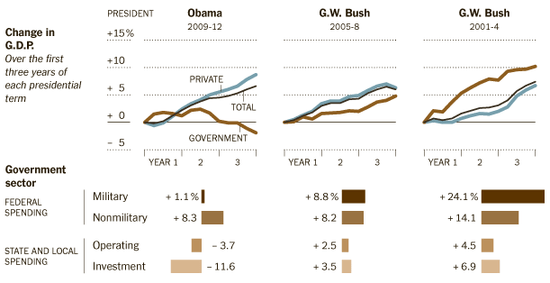
A great deal of this has to do with local and state governments slashing spending, of course, but:

Of the administrations shown, overall growth in Mr. Obama’s first three years has been the slowest. But that is largely because government spending did not accelerate as it normally does when the private sector is weak. The private sector grew faster in the first three years of the Obama administration than it did in three of the previous five administrations — the exception being Bill Clinton’s administrations, when private sector growth was more rapid. In both of George W. Bush’s terms as well as in the first three years of the George H. W. Bush administration, though, the private sector grew more slowly.

No administration has reduced aggregate government spending as a precentage of GDP as much as Obama’s in forty years. If you look at the full chart, back to George HW Bush, you reach an inescapable conclusion: the biggest spenders and borrowers are Republicans and the most fiscally conservative presidents have been Democrats. Given the last two decades, the Tea Party, if they really want to shrink government, should be voting for Obama.

Quote For The Day

Light_Installation 

"In our culture, we have all accepted the notion that the right to know is absolute and unlimited. The gossip column is one side of the medal; the cobalt bomb is the other. We are quite prepared to admit that, while food and sex are good in themselves, an uncontrolled pursuit of either is not, but it is difficult for us to believe that intellectual curiosity is a desire like any other, and to recognize that correct knowledge and truth are not identical. To apply a categorical imperative to knowing, so that, instead of asking, 'What can I know?' we ask, 'What, at this moment, am I meant to know?' — to entertain the possibility that the only knowledge which can be true for us is the knowledge that we can live up to — that seems to all of us crazy and almost immoral," – W.H. Auden.

(Photograph by Lee Eunyeol showing at the Gana Art Space in Seoul. Hat tip: Colossal)

The Old Testament Dodge

Dan Savage expands his critique of Christian hypocrisy. He notes that anti-gay crusaders often cite Leviticus 20:13 and Sodom & Gomorrah from the Old Testament:

[I]t's only when gay people bring up a passage like Deuteronomy 22:20-21 that you hear anyone say, "Oh, that stuff about stoning daughters to death on their wedding nights if they're not virgins is in the Old Testament, you goof! That's not in the New Testament!" If it's out-of-bounds—totally not kosher—for gay people to bring up what the Old Testament says about clams and farming and personal grooming and tattoos and menstruation and virginity and adultery, then it shouldn't be kosher for conservative Christians to bring up Leviticus and Sodom & Gomorrah. Which they do. Constantly. And it's not like they have to: there are, courtesy of Paul, plenty of anti-gay verses in the New Testament. But those verses aren't anywhere near as hateful or murderous as what you'll find in Leviticus, of course, which is why they're nowhere near as popular with anti-gay bigots who call themselves Christians.

And, of course, the story of Sodom and Gommorrah has nothing to do with homosexuality but with being unwelcome to strangers.

The Cartoonist Writer

It may not come as a surprise to anyone who has read Mystery and Manners, but the great American writer, Flannery O'Connor, was also a cartoonist, and she believed it helped her work:

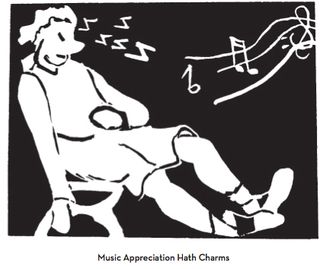
Many disciplines could help your writing, she said, but especially drawing: “Anything that helps you to see. Anything that makes you look.” Why was this emphasis on seeing Music-appreciation-hath-charms2and vision so important to her in explaining how fiction works? Because she came to writing from a background in the visual arts, where everything the artist communicates is apprehended, first, by the eye.

She had developed the habits of the artist, that way of seeing and observing and representing the world around her, from years of working as a cartoonist. She discovered for herself the nuances of practicing her craft in a medium that involved communicating with images and experimenting with the physical expressions of the body in carefully choreographed arrangements. Her natural proclivity for capturing the humorous character of real people and concrete situations, two rudimentary elements she later asserted form the genesis of any story, found expression in her prolific drawings and cartoons long before she began her career as a fiction writer.

Prepared For The Worst

Stuart Armstrong runs through five ways unpredictable technological and climate changes could transform our political world. My own nightmare scenario:

Here it turns out that as barriers to trade are removed and transaction costs go to zero, the natural state of the economy is one of perpetual crashes. Celebrity and fame feed upon themselves: everyone demands the best, and the definition of the best is shared widely: niche markets don’t exist. Incomes follow such a sharp power law that only a few percent of the population have any wealth at all. Automation means that most people can’t earn enough to sustain themselves: their income drops below the costs of keeping them alive. Hence a large, bloated, over-regulating government becomes a matter of survival.

I guess that's what you get if you extrapolate the trends of the last four years indefinitely. Yikes. He has other less horrifying possible futures, if you're into that kind of thing. 

The Bible In The Arctic

Here's a fascinating nugget about the making of the first "Inuit Bible":

[A]dapting the Old Testament, with its litany of desert vegetation and animals, to an Arctic readership presented challenges. For one, there are no words in Inuktitut for "goat," "sheep" or "camel." Those had to be written phonetically. And what to do about the 30-plus types of trees mentioned in the Bible when there are no trees of any kind for hundreds of miles in the Arctic?

"We used a general term for tree," explained Allooloo, "and then explained it in the footnotes." The translation brims with footnotes and explications. The same word was used for "shepherd" as for someone who tends a dog team. "It's like 'baby sitter,'" said Arreak. Similarly, "pomegranate" is described as a sweet fruit with many seeds.