The Real Bucket List

William Deresiewicz contemplates it:

Look at lists of “100 Things to Do Before You Die,” and you’ll find them dominated by exotic sensations of one kind or another (“Skydive”; “Shower in a waterfall”; “Eat jellied eels from a stall in London”). Really? This is the best we can do? This is what it’s all about? These are the things that make our lives worth living? When I think about what really makes me happy, what I really crave, I come up with a very different list: concentrated, purposeful work, especially creative work; being with people I love; feeling like I’m part of something larger. Meaning, connectedness, doing strenuously what you do well: not sights, not thrills, and not even pleasures, as welcome as they are.

A Wave Of Dementia

Louis Theroux glimpses the future:

It's reckoned that one in eight Americans aged 65 and over has Alzheimer's – the most common cause of dementia. Nearly half of the over 85s has the disease. As medical science has become better and better at prolonging our lives, the mental side of things hasn't kept pace. Nowhere is this more in evidence than in Phoenix. For years Phoenix has been a mecca for America's elderly, who are attracted by the year-round sun and dry desert heat.

Now increasingly it is a kind of capital of the forgetful and the confused.

(Clip from "Away From Her," a film based on an Alice Munro short story about a couple dealing with Alzheimer's)

What Do Atheists Want?

Anthony Pinn considers the mission:

What is the basic concern – the destruction of religion? Or, more specifically, the destruction of the poor patterns of thinking, communication, and practice supported by theistic religion? Does the development of human societies that are reasonable and more progressive require the end of religion or simply the containment of its most harmful dimensions? It’s the latter that matters most.

Healing Prayers

Tulips

Ashley Makar, who has been diagnosed with cancer, contemplates prayer:

I don’t think I believe my prayers will do a thing to help Sudanese refugees get home, through conflict zones and rainy seasons. I don’t think I believe my prayers for psychiatric patients will diminish their post-traumatic stress, their paranoid psychosis, their fears of life inside and outside locked wards.

But I believe in the healing power of prayer. I can feel the anonymous prayers of strangers in the shawls around my shoulders. I can feel the morning prayers of my friend’s mother, also living with cancer, buoying me up to embrace each day and celebrate life. I can already feel the unction of last rites—the repose that lets you rest, and die, when you need to.

Why Churches Matter

Dueholm explains:

For one thing, a church, or any religious community, is a sort of first responder to social problems. Churches have stepped in where housing policy has failed, providing badly needed beds for homeless people in the Chicago suburbs. Church professionals are front-line mental health care providers, usually intervening in family crises more quickly (and cheaply) than a therapist can. Churches are the major cultural institution for a lot of Americans, the only place we sing or play instruments or absorb something like a public lecture. They provide space for all kinds of hermit-crab community groups, from Alcoholics Anonymous to after-school tutoring. And they offer access to social capital to people whose schools and extended families aren’t as helpful as they could be. Churches are, for many people, the only place where they mingle on equal terms with those of different generations, economic classes or political ideologies (though we don’t mingle too much across racial lines, unfortunately).

The Art Of Unthinking

Ian Leslie praises it:

Unthinking is the ability to apply years of learning at the crucial moment by removing your thinking self from the equation. Its power is not confined to sport: actors and musicians know about it too, and are apt to say that their best work happens in a kind of trance. Thinking too much can kill not just physical performance but mental inspiration. Bob Dylan, wistfully recalling his youthful ability to write songs without even trying, described the making of "Like a Rolling Stone" as a "piece of vomit, 20 pages long". It hasn’t stopped the song being voted the best of all time.

In less dramatic ways the same principle applies to all of us. A fundamental paradox of human psychology is that thinking can be bad for us. When we follow our own thoughts too closely, we can lose our bearings, as our inner chatter drowns out common sense. 

The Difference Between Porn And Art

It doesn't matter, says Michael Stabile, reviewing the obscenity conviction of porn producer Ira Isaacs:

Obviously Hollywood Scat Amateurs #10 was never intended to be art, and that’s the real problem with the art argument: it covers up what’s truly valuable about these films, which is that they allow us to critique of the notion of obscenity itself. The California obscenity statute defines "prurience" as "a morbid, degrading, unhealthy interest in sex." But this sells all sexual minorities down the river. Is it more degrading to see a representation of your desire, or be deemed "perverted" by the state? In 2012, should the state still be passing judgment on the consensual sex lives of others?

A Poem For Saturday

From "In Praise of Feeling Bad About Yourself" by Wislawa Szymborska, translated by Stanislav Baraczak and Clare Cavanagh:

The buzzard never says it is to blame.
The panther wouldn’t know what scruples mean.
When the piranha strikes, it feels no shame.
If snakes had hands, they’d claim their hands were clean.

A jackal doesn’t understand remorse.
Lions and lice don’t waver in their course.
Why should they, when they know they’re right?

Though hearts of killer whales may weigh a ton,
In every other sense they’re light.

On this third planets of the sun
Among the signs of bestiality
A clear conscience is Number One.

Lawrence Weschler remembers when Szymborska won the Nobel Prize for Literature in 1996:

She lived very modestly in this apartment and hadn’t travelled much and she goes to Stockholm and they put her in the nicest hotel in town, in the penthouse, which is a whole city block, and she spends the night before the Nobel speech sleeping in the bathtub because the bathroom is the only room in the penthouse where she can figure out how to work the lights. She was not a terribly worldly person, but her poetry encompassed worlds.

Dustin Rowles comments on the video above:

If I were the parent, I wouldn’t be nearly as trusting as these guys were about the impenetrability of that glass. That lion looked pissed

Do No Harm

A commencement speech for the One Percent:

I know that I'm supposed to tell you to aspire to great things. But I'm going to lower the bar here: Just don't use your prodigious talents to mess things up. Too many smart people are doing that already. And if you really want to cause social mayhem, it helps to have an Ivy League degree. You are smart and motivated and creative. Everyone will tell you that you can change the world. They are right, but remember that "changing the world" also can include things like skirting financial regulations and selling unhealthy foods to increasingly obese children. I am not asking you to cure cancer. I am just asking you not to spread it.

Face Of The Day

Mandel7

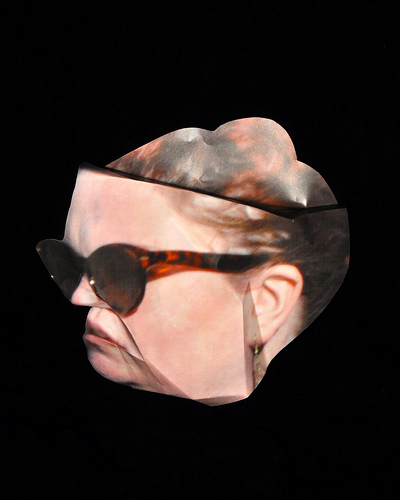
From Levi Mandel's series "Good Morning!":

Mandel photographed unsuspecting strangers, then crumpled and re-photographed the printed images against a black background. The resulting portraits are at once ordinary, unsettling and grotesque.

Jonathan Cherry interviewed Mandel about his influences and inspirations:

For the amount of slack photographers get for using and/or posting on Flickr, I’m constantly surprised and impressed with the work I happen to stumble across while killing time online. Many are from Russia for some reason. I also throughly enjoy family Flickr accounts, the ones that more or less appear to be used as storage and not meant to be shared – it’s like finding the modern day discarded family photo album.