The Science Of Begging

Dogs can tell that human food is better:

Researchers let pet dogs choose between two plates, one with a single piece of food and the other with six pieces. Unsurprisingly, the animals generally went for the larger portion. But when a human being showed a clear liking for the smaller plate, the canines likewise went for the skimpier choice. The dogs apparently recognized and responded to the humans’ social cues.

Second World Nations

Parag Khanna emphazises their importance:

[P]recisely how will this collection of nations influence the course of world events? It is important to note that not all of these emerging states are on a linear path toward regional-power status. Some will rise while others stumble. But collectively, the ones that rise will exercise a significant pull on events. One reason I repurposed the term Second World for these countries was to emphasize their internally divided nature, embodying both First World and Third World attributes. Of the approximately two hundred states in the world today, only thirty are members of the First World club of the Organisation for Economic Co-operation and Development (OECD). Meanwhile, the bottom forty-eight (mostly in Africa) are formally labeled Least Developed Countries (LDCs). In between lie the Second World nations.

There are about a hundred of them, and there is little certainty these days over which ones will rise into the First World and which will descend into the bottom category. 

The Second Coming Of The Boy Bands

Alyssa Rosenberg strolls down a dark, dank version of memory lane:

The current contenders for the hearts and dollars of American girldom, One Direction and The Wanted, espouse a love-beats-all philosophy that's actually squeakier, cleaner, and simpler than that of the generation of manufactured, male teen idols that preceded them a decade or so ago…both 'N Sync and Backstreet Boys frequently sang songs aimed at undermining the self-confidence of their listeners, full of the sort of negging that would make pickup artists beam with pride.

She follows up on some specific songs here.

Why Lie Without Reason?

Shep Smith balked at Romney calling Gingrich a "friend." Waldman gives the Republican nominee some free advice:

[P]oliticians, particularly those like Romney who struggle to convince voters that they're normal, everyday folks, could do themselves a favor and stop saying things that are so patently false, even small things. Why would it be so hard to say, "Newt ran a spirited campaign, I'm sure he'll be a strong voice for our party, and I wish him all the best"? That would be no less kind, and no one would notice the difference. But by trying to toss in something to humanize their relationship ("Ann and I are proud to call Newt and Callista friends"), he makes himself seem not human at all.

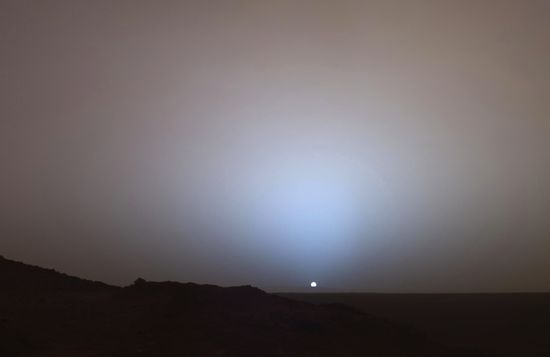
Why Are Martian Sunsets Blue?

GT_MARS-SUNSET_120502

Because the Red Planet's atmosphere "scatters red": 

Martian dust is exactly the right size to absorb the blue wavelengths of light and scatter red wavelengths all over the sky. That's why if you are standing on Mars and look away from the setting sun, most of the sky is rosy, pink, and various shades of red. But now look straight at the setting sun. On Mars, the beams of light streaming toward you, having lost their red waves, show the wavelengths that haven't scattered off. That remaining light is predominantly blue. So when you look straight at the sun on Mars, you see a haze of blue. Look away from the sun, and the light is red. It's exactly the opposite on Earth.

(Photo: Mars Exploration Rover Spirit captured this stunning view as the sun sank below the rim of the Gusev crater. The filter combination used to take this image allows false colour images to be generated that are similar to what the human eye would see, but with the colours slightly exaggerated. Because Mars is farther from the Sun than Earth is, the Sun appears only about two-thirds the size that it appears in a sunset seen from Earth. By SSPL/Getty Images)

Obama’s Negative Campaign

Alec MacGillis reminds us that Obama's "new tone" isn't all that new:

I think that all of us political reporters need to be careful not to overstate the contrast between the two [Obama] campaigns. Yes, Team Obama just put out a tough ad attacking Mitt Romney for outsourcing jobs at Bain Capital and for his Swiss bank account. But let’s not forget—they were putting out some pretty tough, and arguably unfair, ads and mailings back in 2008, as well. … All told, tallies after the 2008 campaign found that at least two-thirds of Obama’s ads in the general election were negative attacks on McCain. So even in ’08, hope and change went only so far.

Is There A Loneliness Epidemic? Ctd

A reader personalizes the post:

Today is my birthday, and I was hit hard by how lonely I've become in the the age of Facebook. I got like 57 birthday wishes on FB – many from people I barely know. These messages depressed me because they were so meaningless. Meanwhile, I got a record low number of phone calls – or even personal emails – from friends. Part of this was because, hey, they could just post "Happy Birthday! Have a great day!" on FB. Many of my real friendships have faded away in the Internet age.

I'm a freelance writer, and I used to be on the phone all day long interviewing sources and, in between, chatting with my freelancer friends around the country. Now, we all just email each other – sources don't want to be bothered with interviews ("Can you just email me the questions?" is a request I get all the time) and most of the time I'm lazy enough to comply. There's no conversing, no small talk, no schmoozing, so I never get to know anyone.

But this hasn't just happened with sources; it's happened with my friends, too. We used to just pick up the phone and, you know, talk. Before caller ID and cell phones, you never knew who'd be on the other end of the line, and it was usually a pleasant surprise. Now, we just email, and we've lost our connection.

Interestingly, with one exception, the only phone calls I got today were from relatives and from friends I made three decades ago, back in school. The more recent friendships I've developed have not withstood the FB/email era. On my birthday, my phone used to ring off the hook. Today, even my sister emailed me. Though at least she didn't post "Happy Birthday! Have a great day!!!" on Facebook.

Community Colleges Are Failing? Ctd

A reader defends community colleges:

I work full-time and teach part-time at one of the largest community colleges in the nation. The broad focus on completion annoys me and overlooks a key purpose of community colleges: for many students, we are the proving grounds of post-secondary education. We are open entry institutions. We take everyone whether they are ready for college or not; over two-thirds of entering students test into at least one developmental (sub-100 level) course in English, math or reading.

Students testing into these low-level courses are adding even more semesters on their path to college completion. We make huge effort to reach out and hand hold these students through their developmental climb, but the unfortunate truth is that many students just are not cut out for the rigors of college.

It may be a cynical way to look at this, but the community colleges offer a low cost college trial for many students to discover that college isn't their cup of tea; however, it is the community college "success rate" that suffers as a result. 

Another reader adds:

The included comment from Kay Steiger echoes much of what is being said about public school at the k-12 level. They're failing the poor and minorities and they "need to figure out a better way to serve these communities". While this statement isn't untrue, it's not the whole truth either. The pool of students matters. A lot. When you're dealing with a group of students who are already academically weaker and then add poverty to the mix, of course they're going to drop out of community college more frequently. They have to work. They have to take care of families. They can't afford the opportunity costs or the actual costs of education. We don't need to fix the schools so much as we need to fix poverty.