My reflections on the interaction of Mormon faith and contemporary politics here.
Month: May 2012
Obama’s Drug War About-Face
Frum defends Obama's medical marijuana crackdown:
Not hypocritical to experiment w drugs in early life, recoil, and as a mature adult favor prohibition.
— davidfrum (@davidfrum) May 29, 2012
Sure, but as Mike Riggs notes:
Obama did not turn against pot smoking as an adult, he turned against it at the point in his political career when he had the most power to change policy. As a state congressman in Illinois, Obama declared the drug war a failure. He said the same thing as a U.S. Senator. As a candidate for president, he condemened (and promised to stop) medical marijuana raids. Really, Obama did not come to favor prohibition until he became president.
Sonny Bunch also counters Frum:
It’s not so much that people think he’s a hypocrite for turning against pot smoking as an adult—it’s that people think he’s a hypocrite because they don’t actually think he thinks smoking pot is a big deal. He’s continuing the crackdown on weed for purely political reasons and ruining people’s lives in the process. He lacks the political courage to change an obviously broken system despite the fact that he has personal experience with the product being debated.
Can America Save The Euro?
William Galston wants Obama to act:
Until now, the ability of the United States to influence Eurozone policy has been modest, and many of our efforts to do so have produced resentment. So what is President Obama to do? If he believes, as I think he should, that the global economy, U.S. economy, and his own electoral prospects all hang in the balance, then he should call Merkel and propose a quick summit between the two leaders and their respective economic teams. He should come armed with a menu of concrete steps that the United States and major international institutions would be willing to take if Germany were to change course.
He should appeal to Germany's self-interest as the major beneficiary of the expanded export market the Eurozone has created. He should remind Merkel of the sacrifices that the United States made over many decades to help build a Europe that is free, whole, and united. And he should make it clear in private, and announce in public, that from the American standpoint, what touches all concerns all: Chancellor Merkel is not free to proceed as though the current crisis affects only Germany (or Europe) and the rest of the world has no legitimate say in the outcome.
Felix Salmon calculates the chances that a Grexit decides the 2012 election.
Every Servicemember A Hero?
Over the weekend, MSNBC host Chris Hayes got pummeled by the right for saying this:
Hayes later apologized. Beinart defends Hayes:
I don’t share Hayes’ queasiness about the using the word “hero” to describe those Americans who died in Afghanistan and Iraq. In America today, where self-gratification is practically a national religion, there is something heroic about voluntarily placing your fate at your country’s service. But Hayes’ larger point—that in honoring the dead we should not surrender our critical faculties about war—is not only correct; it’s crucial.
For more than 10 years now, the Coulters and Dick Cheneys of American politics have used the pain and pride of a nation at war to cow those who might have questioned our post-9/11 wars. In 2002, many congressional Democrats were too afraid of Karl Rove to vote against authorizing the invasion of Iraq. In 2009, Barack Obama acquiesced to an escalation in Afghanistan about which he had grave doubts, in part because of the political pressure he felt from the military brass and their allies in the congressional GOP. And even now, with most Americans convinced that the Afghan War is a waste of money and blood, it remains perilous for a television host to use Memorial Day to ask why our troops are still dying there.
Freddie DeBoer likewise backs up Hayes:
I will simply say what I have always said about soldiers and the police: there is no such thing as praise that does not recognize the individual character of the person being praised. What our post-9/11 national conformity insisted was that we heap praise on the police, firefighters, and the military without any discrimination between individuals or any judgment of their particular characters. This, in fact, is not praise. It's actually a profound assault on the possibility of real praise; it denies the existence of moral differences and squashes all actual praiseworthy conduct into a homogeneous, bland affirmation.
Ari Kohen develops the most nuanced criticism of Chris Hayes to date:
Military service — and death in action, which was the subject of Hayes’ show on Memorial Day weekend — isn’t necessarily heroic. But it can be. And here’s Hayes’ problem: It’s not necessarily the case that calling someone a hero means lending full-throated support to the war in which the person acted heroically, nor is it necessarily the case that admitting that military service opens up a space for heroism lends rhetorical justification for any further wars. It’s possible to fight valiantly for a bad cause, just as it’s possible to act badly in pursuit of a just cause. And, most importantly, it’s possible to understand the value (and even the virtue) of military service without supporting particular military engagements; it’s not necessary to shy away from saying that something heroic is, in fact, heroic simply because you wish the context in which it occured hadn’t existed in the first place.
Paul Campos gets angry about the simplistic broadsides that dominated the backlash:
We live in a culture in which someone like Hayes cannot suggest, even in the most diffident, nuanced, and self-deprecating way, that automatically labeling every American soldier who dies in war a “hero” might be an oversimplification of a difficult set of moral and political questions without thereby releasing such a storm of indignation that he is forced to immediately recant such a terrible heresy.
The Dish debated whether American soldiers are automatically heroes here and here.
Romney vs Obama On Job Creation
If you don't blame Obama or Romney for their first years in office, before their own policies had had time to take effect, the result is this:
Obama has created a net 3.635 million jobs. Applying the same rules to Romney’s numbers through the same time period—that is, through April of his fourth year in office, 2006—we credit Romney with 64,500 jobs. So he grew jobs by 1.9 percent. Obama’s job-growth rate is 2.35 percent.
But Romney wants to blame all the job losses in 2009 on Obama – and the stimulus! And he will. Because he can.
Veterans For Romney?
The latest from Gallup shows that veterans support Romney by 24 points (the group is older and male), though Obama dominates in military campaign contributions. Beth Reinhard and Kevin Baron note that the "military vote" is not a monolith:
Veterans and active-military members vote as voters. When it comes to picking a president, they care about jobs, health insurance, and other kitchen-table issues – just like everyone else. Consider that veterans narrowly favored Bill Clinton, who some called a draft dodger, over World War II hero George H.W. Bush in 1992, while Bush’s son won the military vote in 2004 by 16 percentage points against decorated Vietnam veteran John Kerry.
Republican John McCain, who survived captivity in Vietnam, won the military vote in 2008, but only by 10 percentage points. “There’s this idea that veterans have a shared outlook and interests, but voting behavior is usually explained by other factors, like party affiliation, ideology and religion,’’ said Benjamin Bishin, an associate professor at the University of California-Riverside, who studied exit poll results from more than 20 elections between 1992 and 2002.
More on the "vet vote" here.
The Slaughter In Syria
Over the weekend Assad's thugs massacred over 100 people in Houla, a town neighboring resistance hub Hama. It's the largest single mass-murder to date in the revolution. Syrian social media immediately exploded with anger. Juan Cole hopes some good can come out of it:
The outcome in Houla is so horrific that it may turn the stomachs of the remaining Syrians who are on the fence, and produce a new backlash against the regime. The revolution in Syria is a contest of wills between the regime on the one hand, and on the other the revolutionaries (who have a civil and a military wing that seldom agree). The revolutionaries have remained steadfast in the face of massive brutality, for over a year. Their will seems strong. The regime seems to be popular in fewer and fewer places. The will of all but its devoted cadres is being shaken.
Marc Tracy looks to next steps:
There is much talk of the "Yemen model"—oppressive leader of Arab country is ousted by threats from outside, but power is handed to a member of the ousted leader’s regime, who assumes a transitional role. And the most important thing to know about the Yemen model is that it is also known as “the Yemenskii Variant,” because that’s how crucial Russia is to it being adopted. Russia looks askance whenever the West topples dictators, and is additionally unhappy by the prospect of a situation like Libya, in which said dictator was killed, or Egypt, in which said dictator is being prosecuted and is literally caged in.
Gideon Rachman is on the same page:
If the US and the Syrian opposition were to give Russia explicit guarantees that its security interests would be respected in post-Assad Syria, the Russians might just be persuaded to join a diplomatic push to winkle the Assads out of power. The ruling family is simply the figurehead for a network of military, ethnic, party and business interests that is profoundly threatened by the Syrian uprising. That is why any negotiated transition would have to involve members of the existing regime in a transitional administration, before the holding of free elections.
Walter Russell Mead hopes Russia might be shocked into action:
Russia and the US have both had unsatisfactory experiences with their Syria policy. Russian defense of Assad has isolated Russia — the Arabs, the Turks and the Europeans are all furious with the Kremlin. Assad’s mix of brutality and weakness — he is brutal enough to kill thousands of people but too weak to crush the resistance — makes him a less useful ally and it looks increasingly as if he will ultimately fall. Russia, the Obama administration hopes, is ready to look for a change.
Daniel Serwer pinpoints the main reason that the killing continues:
It is hard to picture the violence ending and politics beginning without dealing somehow with Alawite fears that they will end up massacred if Bashar al Assad leaves power. That would be a tragedy not only for the Alawites but for the Middle East in general. Let there be no doubt: past experience suggests that those who indulge in abusive violence often become the victims of it when their antagonists get up off the ropes and gain the upper hand. It would be far better for most Alawites, the relatively small religious sect whose adherents are mainstays of the Assad regime, if a peaceful bridge can be built to post-Assad Syria.
The Revolting Syrian and Syria Freedom have extensive visual documentation of the horror in Houla. Below are some of the photos and videos they've compiled (warning: image of a dead infant):

This man labes the dead "shahid" (martyrs):
And this is an anti-Assad protest the day after the massacre – in Houla:
The View From Your Window Contest: Winner #104
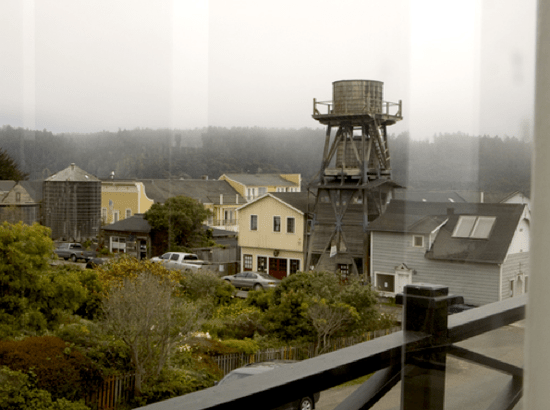
A reader writes:
I haven’t submitted in quite a while, since it is so easy to get sucked in and spend hours combing the Internet. So I am going to put a time restriction on myself, and submit my best answer that I can provide in five minutes. This week, we are obviously in the U.S., if the pickups didn’t give it away, the U.S. flag did. Looks coastal, northern, so I’m going to go with a “Downeast” Maine fishing village.
Another:
I’m guessing Maine. The cars parked on the right side, including the two heavy-duty trucks, make me think America and not Europe. Foliage looks East Coast. Vinyl siding is American, too. Colonial architecture. Makes me think New England. Maine has a ton of alternative energy, which makes me think those weird wood structures are mills of some kind.
Another:
I know it’s in the United States given the flag. Also, I bet it’s in the Northeast somewhere, given the vegetation and climate. But after that, I’m at a loss. But it sure sparked an obsession for me! I dare you to go to Google’s image search and look for wooden water towers and not get completely mesmerized by their strange beauty and variety. Then search for wooden water towers and find out why New York City has all those water towers atop their buildings (hint: it’s the pressure). I then found out about the water tower crochet cozy created by Robin Love (video here). Of course, part of this obsession could be because I’m a little stoned.
Another nails it:
This one was waaay too easy for me, a frequent visitor to the historic logging village of Mendocino, on the spectacular Northern California coast, some 3 hours’ drive from San Francisco. The village is dotted with these old wooden water-towers, some of which have been adapted to other uses, in this case a gift shop. The photo was taken from the top floor of this handsome building, on the southwest corner of Ukiah and Kasten Streets:
The last time I was in Mendocino, a couple of years ago, the building was empty – there used to be a terrific art gallery on both floors.

Another:
For nearly 40 years, the Odd Fellows Hall housed the William Zimmer Gallery but now it is privately owned and available for special shows and events. It was the favorite gallery for our family and kids to visit in Mendocino because of its eclectic collections of art in many types of media (from furniture to jewelry and sculpture and all kinds of framed art). Mendocino has been an artist colony since the 1950s and now is a favorite weekend getaway for folks from the Bay Area and California’s inland towns and cities. In the late ’60s, it became a frequent destination for many alternative-lifestyle young people who settled there and have contributed to its amazing diversity and talents. The Mendocino Coast has wonderful restaurants and wineries and rugged coastal scenery, etc.
Another sends an aerial view:
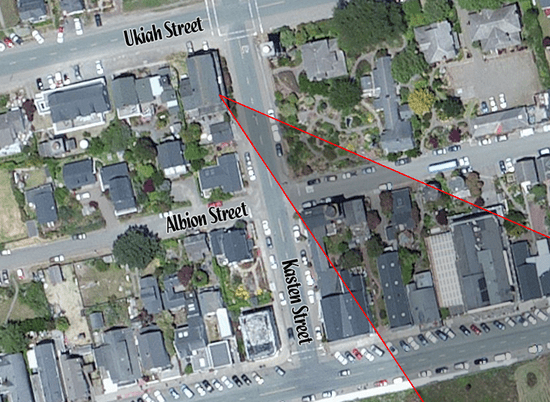
Another does some reporting:
After narrowing down the possibilities based on the balcony railing, I googled around for tenants of the Odd Fellows Hall, and *gasp* phoned one of them. I just had a delightful 15 minute conversation with a woman named Janet who belongs to a non-profit community organization called FLOCKworks. After I told her a quick story about the Dish, and guided her to the VFYW post, she was kind enough to walk upstairs and determine the precise location of the photograph. She told me that it was the third upright of the railing from the southeast corner, and if the photo was taken recently, then it might have been just a few days ago, judging by the weather. Live, on-the-ground confirmation! I might actually win this one, huh?
Another:
I’m looking forward to reading the background information on the Odd Fellows and all the water towers in Mendocino from your other readers. This VFYW surfaced a memory from my high school German class, in the early 1970s. Our teacher used music to engage our interest, and one of the most memorable songs was Michael Holm’s German adaptation of “Mendocino” (fair warning: don’t click on this if you don’t want the song going through your head for the next few days):
Another:
I was just in Mendocino recently, and one funny thing I noticed is that they have pot dispensaries open to the (viewing) public, and if you order $200 worth of product, you get a free pizza delivered to your hotel!
Another:
Thanks for this View From Your Window. It brought back some great memories of a trip to California, including Mendocino, in 2005. During this part of the trip we stayed at a ocean-front B&B in Elk, and had taken a trip to Mendocino on the day that Katrina hit New Orleans (that memory, clearly, was not-so-great). The water tower building in the center of the view is a gallery called “The World of Suzi Long,” Mendocino. Here’s a photo of Suzi (who’s probably getting barraged with phone calls today).
Another:
I know I have tough competition this week because this particular photo on Panoramio received 184 views over the weekend after averaging less than one view a day for the previous month. Thanks for a fun, easy contest to come home to after spending the holiday weekend out of town.
We actually received more than 300 entries for this week’s contest, the vast majority of them Mendocino. Of the dozen or so correct guessers of previous difficult contests, one of them stood out as having entered dozens of contests over the past few years without securing the prize. So she wins this week:
When the VFYW contest started, I spent way too many Saturdays (and sometimes Sundays) searching, and had to cut myself off. I decided to look every week and satisfy my obsession by guessing and waiting for the answer each Tuesday – I’d pursue a
location only if I knew what it was. A short while ago, I was embarrassed when an intersection very close to where I live in Los Angeles was featured and I guessed the Mediterranean. Since we have similar climates, my guess was understandable – but still cringe-inducing. My excuse: it was taken from a tall building I drive past but have never been in, which looks over second-story tennis courts. (I grew up in New York City, where elevated vistas are the norm. In many parts of Los Angeles they are breathtaking exceptions.) Last week I was sure we were in one of the small towns dotting the Northern Californian coast, but was too busy meeting a deadline to go traveling.
When I saw today’s contest image, I recognized Mendocino, CA immediately. I could smell the ocean and feel the chill of fog – I have visited close relations who live in the
area, for decades. Intrigued the Dish has offered up two West Coast locales in as many weeks, I dusted off my VFYW skills and went Googling. The search was a bit more challenging than expected mainly because the fuzziness of the close-up satellite view made identifying a round roof opposite a garden difficult. I stumbled on the shot below in Google Images. It almost has the same POV, but the photographer misidentified the street as Lansing. A real estate listing led to the corner of Kasten and Main Streets (the white building on the far left nearest to the water) and I walked up from there to Albion.
My answer: The VFYW photo looks onto a stretch of Albion Street, just east of the intersection of Albion and Kasten Streets. It was taken from the second floor of the Odd Fellows Hall – 10480 Kasten Street. According to the Mendocino Beacon, it is “historic…(1878) and also known as the William Zimmer Gallery (1960’s-2000). Now privately owned and loaned to community art groups for special shows and events.” The photo below shows the back end of the hall, or the end furthest away from and facing the water.
I have guessed correctly in the past and was always excited to see near-misses published in the Dish. I hope I win, but if I don’t at least I’ve had the pleasure of engaging in the hunt and visiting one of my favorite parts of the West Coast – without losing all of Saturday.
Exact details from the submitter:
The image was taken from the Odd Fellow’s Hall on the corner of Kasten and Ukiah St in Mendocino CA. I was on the second floor over looking Ukiah Street, towards Albion and further out, Main. The garden in the center belongs to the MacCallum House, a very nice upscale bed and breakfast place. The water tower is a signature of the village. There are many around, as water is scarce, even though the town sits on the ocean. Some of the towers were converted to living spaces, I don’t believe that there is any working. This tower is the home to Suzi Marquess Long Gallery at 611 Albion Street Watertower, Mendocino.
The Odd Fellow’s Hall use to be the Zimmer Gallery, but now it’s more a public art space. I’ve enclosed an image from the Library of Congress database that I marked up as to which window I was standing in when I took this photo:
Mendocino was founded by New Englanders who built homes in the style of fishing villages from that area in the late 1800s and early 1900s. Many of the fine Gothic style homes have been converted into bed and breakfasts. The city boasts some great restaurants, shopping, galleries and just plain sightseeing. You can go out the headlands (literally across the street) and watch for whales during the annual migration. The town boasts of having one of the oldest houses of worship for Chinese in the US, as well one of the oldest continuously-used Protestant churches in California.
Mendocino has also been used extensively as a backdrop for movies, starting with “East of Eden” with James Dean. More recently, it was used as the home of Jessica Fletcher for the “Murder She Wrote” series and for the Mel Gibson movie “Forever Young”. However, my favorite movie was “The Russians are Coming” with Alan Arkin – 1965.
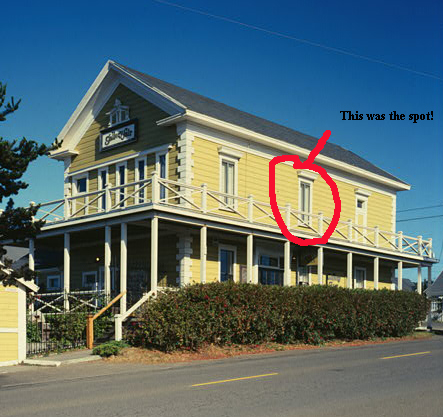
(Archive)
The Ron Paul Revolution
Not over yet. By a long shot.
Why Are American Idol Winners Usually Southerners?
Harry Enten believes it's because "there is greater untapped southern talent for American Idol to showcase":
It will come as no shock to anyone living on the coasts that there are many record labels in California and New York. California has about 2,500 record labels or 1 record label for every 15,000 residents, while New York has about 1,500 record labels or about 1 record label for every 13,000 residents. It's fairly easy for a talented musician to get noticed fairly quickly in these regions.
Southerners just don't have as many opportunities. The southern hub of Georgia has only 293 record labels or about 1 record label for every 33,500 residents, while Texas has only 559 record labels or about 1 record label for every 46,000 residents.
 The Dish