
How Obama Can Win

145247279

It's clear enough by now that this election will be a nail-bitingly close one; and that any early triumphalism among the Obamaites is preposterous. Of course he can lose. In that context, John Heilemann's deeply-reported piece on Obama re-election efforts is worth reading in full. Big picture:

[The 2012 campaign] will bear about as much resemblance to 2008 as Romney does to Nicki Minaj. In the campaign prior, any mention of Wright caused a collective coronary in Chicago; this time, it provokes high-fives. In the campaign prior, Team Obama boldly bid to expand the map; this time, it is playing defense. In the campaign prior, the candidate himself sought support from the widest possible universe of voters; this time, instead of trying to broaden his coalition, he is laboring to deepen it. Indeed, 2012 is shaping up to be an election that looks more like 2004 than 2008: a race propelled by the mobilization of party fundamentalists rather than the courtship of the center.

The question to me becomes: does the electoral strategy shift the positive message and the unifying brand? I can see the governing logic: if Obama gets a solid re-election, he is in a much stronger position to negotiate a grand bargain on debt, taxes and spending with the GOP on Bowles-Simpson lines. A clear victory for him would sober up the GOP. It would recapitalize the president to negotiate our way out of debt and sluggish growth. But if that's the case, it seems to me that that should be the message.

Here's how I'd summarize the argument I think works best for Obama:

"I inherited a financial and economic disaster and two wars that did not end in victory. I have prevented a second Great Depression, restored job growth, saved our auto industry, restored financial stability, ended one war and wound down another, but we need more. We need investments in infrastructure, reform of immigration, and continuation of my education reforms. And we need a sensible approach to debt elimination. My policy is to cut entitlements, cut defense and slash tax loopholes and deductions so we can get higher revenues from those who have done extremely well these past three decades. My opponent refuses to tax the extremely wealthy at the same rates as ordinary folk, and wants to cut the debt solely by cutting entitlements for the old and sick, while increasing defense spending and cutting taxes even further. We all know we are going to have to retrench. Would you rather do it with me guarding the core of the welfare state or with Romney-Ryan who want to end it with a solution that Newt Gingrich called 'right wing social engineering'"?

I think you have to have this positive contrast to balance the brutal attacks on Romney in advertizing, or risk losing that critical ingredient that made Obama Obama: a sane reminder of the actual policy choices we face, and a reasoned centrist approach to solving them. Alas, after the heat of a brutal partisan pushback from the GOP from Day One, that positive vision is not so present this time around. It needs to be brought back.

On the back of an envelope, I'd jot three key arguments a la Carville:

Would you rather cut the debt by slashing entitlements alone – or do you favor a balanced approach, with increased taxes on the wealthy, retrenchment of defense and reform of entitlements?

Would you rather a president who wants to launch a war against Iran or a president who will do all he can to avoid it?

Do you want repeal of a healthcare law that guarantees available private insurance even to those with pre-existing conditions? If you are under 26, and on your parents' health insurance, do you want to lose it?

If those questions dominate the campaign, Obama will win. Waiting for better economic numbers and pummeling Romney's favorables is not, in my view, a superior strategy.

(Supporters listen to US President Barack Obama speaking during a campaign event at the Paul R. Knapp Animal Learning Center in Des Moines, Iowa, on May 24, 2012. By Jewel Samad/AFP/GettyImages.)
The Spending Debate We Aren’t Having

Ezra Klein reframes last week's backandforth on Obama's spending record:

The real debate here is what spending should have been in 2010 and 2011. The Obama administration wanted it to be higher. After all, unemployment rose through 2010, and remains high today. It has proposed a raft of additional stimulus bills since 2009. Republicans in Congress, however, refused to pass most of their plans. Properly understood, the fact that inflation-adjusted spending has fallen since fiscal year 2009 is the result of Republican obstruction in Congress. That Democrats are now crowing about these numbers — the DNC is e-mailing them around — and that Republicans are now viciously disputing them is an embarrassment to both sides.

You could as easily imagine Democrats lamenting these numbers as evidence of our failed policies and Republicans celebrating them as evidence of their congressional successes. But Republicans don’t want to admit that they bear substantial responsibility for the economic policy of the last few years. If they did, then it would be hard to argue that the economy’s performance in 2010 and 2011 is all Obama’s fault. And the Obama administration doesn’t want to clearly say that we should have been spending more in recent years, even if that’s what they believe, and what they proposed, because it polls poorly.

Today In Euro Doom

Peter Boone and Simon Johnson urge "Germany itself to leave the euro, forcing other nations to scramble and follow suit." The alternative:

A disorderly break-up of the euro area will be far more damaging to global financial markets than the crisis of 2008.   In fall 2008 the decision was whether or how governments should provide a back-stop to big banks and the creditors to those banks.  Now some European governments face insolvency themselves.  The European economy accounts for almost 1/3 of world GDP.  Total euro sovereign debt outstanding comprises about $11 trillion, of which at least $4 trillion must be regarded as a near term risk for restructuring.

Europe’s rich capital markets and banking system, including the market for 185 trillion dollars in outstanding euro-denominated derivative contracts, will be in turmoil and there will be large scale capital flight out of Europe into the United States and Asia.  Who can be confident that our global megabanks are truly ready to withstand the likely losses?  It is almost certain that large numbers of pensioners and households will find their savings are wiped out directly or inflation erodes what they saved all their lives.  The potential for political turmoil and human hardship is staggering.

Yglesias Award Nominee

"The question I believe we should pose to our congregations is, "Should all Americans have the same civil rights?" This is a radically different question than the one you raised with the ministers, "Does the church have the right to perform or not perform certain religious rites." There is difference between rights and rites. We should never misconstrue rights designed to protect diverse individuals in a pluralistic society versus religious rites designed by faith communities to communicate a theological or doctrinal perspective. These two questions are answered in two fundamentally different arenas. One is answered in the arena of civic debate where the Constitution is the document of authority. The other is answered in the realm of ecclesiastical councils where theology, conscience and biblical mandates are the guiding ethos. I do not believe ecclesiastical councils are equipped to shape civic legislation nor are civic representatives equipped to shape religious rituals and doctrine," – Rev. Dr. Otis Moss III, challenging his fellow black clergy on marriage equality.

Did Jesus Foresee The US Constitution?

Ww-9

Mormons believe so – and so, presumably, would a future president Romney. Here's an extract from a 1987 statement by the then-Mormon president, Ezra Taft Benson. It's worth reading the whole thing, but these passages stood out to me:

Our Father in Heaven planned the coming forth of the Founding Fathers and their form of government as the necessary great prologue leading to the restoration of the gospel. Recall what our Savior Jesus Christ said nearly two thousand years ago when He visited this promised land: “For it is wisdom in the Father that they should be established in this land, and be set up as a free people by the power of the Father, that these things might come forth” (3 Ne. 21:4). America, the land of liberty, was to be the Lord’s latter-day base of operations for His restored church…. For behold, this is a land which is choice above all other lands; wherefore he that doth possess it shall serve God or shall be swept off; for it is the everlasting decree of God. And it is not until the fulness of iniquity among the children of the land, that they are swept off…

I reverence the Constitution of the United States as a sacred document. To me its words are akin to the revelations of God, for God has placed His stamp of approval upon it. I testify that the God of heaven sent some of His choicest spirits to lay the foundation of this government, and He has now sent other choice spirits to help preserve it.

We, the blessed beneficiaries of the Constitution, face difficult days in America, “a land which is choice above all other lands” (Ether 2:10).

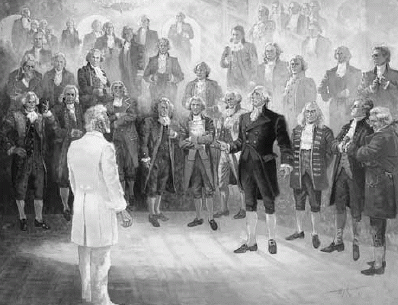
My italics. For Mormons, the Constitution was a necessary great prologue for the real endeavor: the restoration of the Gospel, i.e. the triumph of Mormonism over other forms of Christianity. The same president of the LDS church confirmed the Mormon belief that the Founding Fathers appeared as spirits in Utah's Saint George Temple to a previous president, Wilford Woodruff in 1877, and stayed for two days and nights in order to be properly saved by a Mormon baptism. Woodruff wrote of this experience:

The spirits of the dead gathered around me, wanting to know why we did not redeem them. Said they, "You have had the use of the Endowment House for a number of years, and yet nothing has ever been done for us. We laid the foundation of the government you now enjoy, and we never apostatized from it, but we remained true to it and were faithful to God." These were the signers of the Declaration of Independence, and they waited on me for two days and two nights. I thought it very singular, that notwithstanding so much work had been done, and yet nothing had been done for them … I straightway went into the baptismal font and called upon brother McCallister [sic] to baptize me for the signers of the Declaration of Independence, and fifty other eminent men, making one hundred in all, including John Wesley, Columbus, and others…

George Washington was posthumously named a high priest in the LDS church, alongside John Wesley, Benjamin Franklin, and Christopher Columbus. Yes: Ben Franklin is a Mormon High Priest now, according to Romney's faith. More significant to me is that all these figures in American history were asking to be baptized since they now knew that Mormonism was true and they needed saving. 

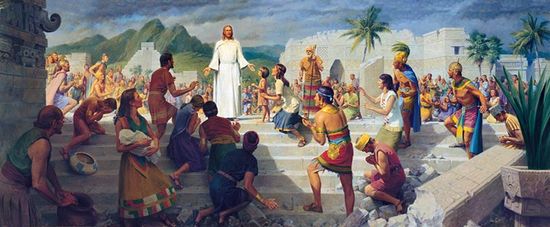
In some ways, Mormonism is the perfect form of Christianity for Christianist nationalist politics. It is the only form of Christianity that believes Jesus visited America; that the Garden of Eden was somewhere in Missouri; and the only one that, as a theological proposition, sees the US Constitution as an integral part of the divine order, and one that Jesus personally foresaw in his appearances in America two millennia ago, and blessed.

I raise this because such an understanding of America's unique and divine status among nations has profound foreign policy implications. It means that America alone has divine permission to do what it wants in the wider world, that America is subject to different standards than everyone else (because we alone are divinely blessed), and that geopolitics is about the global supremacy of the modern world's first divine nation (even if Iran and Israel might differ on which country is divinely blessed).

Jesus-christ-in-america

There's a reason, in other words, that Romney's foreign policy does not have a moderate, realist strain to it; that it is wedded to zero-sum conflict as the only way to engage the world (he regards Russia as America's number one geopolitical foe and wants a trade war with China); that its opposition to Jihadism gets perilously close to opposition to Islam as a whole; and that its core principle is that America is always, by definition, right.

I wish we had a Mormon candidate in a party that adheres to a separation of church and state and of politics and religion (like Reid or Huntsman in a different universe). Then we could regard that faith as utterly irrelevant to a candidate's capacity for running the country. But when the GOP affirmatively declares that there is no such thing as a secular decision, that there is no place and no decision and no policy which is not subject to religious and theological influence … it seems to me that we have to examine how a candidate's faith affects their politics – by the GOP's own reasoning.

Does Romney believe that America is uniquely divine among nations? How would that affect his decisions as president? Does he believe that the Constitution is also divine and a "necessary prologue" for the triumph of the LDS Church in America and across the world? Would he therefore appoint Justices who share that view? Or if the original Constitution is divine, and the Amendments are not, as Garry Wills asks, what status do the Amendments have in a Mormon president's eyes?

(Painting: the Founding Fathers appear to Mormon President Wilford Woodruff in the St George Temple in Utah in 1877. A painting rendering the Mormon view of Jesus' appearance to the Nephites in the Americas after his resurrection. )

The Labyrinth Of A Segregated Ethnocracy

A map showing how Palestinian cars are marked by differently colored number plates, and where they are allowed to go and not to go. Imagine living in a country where your race prevented you from traveling on certain roads in your own country, and where newcomers enjoy tunnels, bypasses and new roads to facilitate their travel. There are even roads which are parallel, with one being for Jews and the other for Palestinian Arabs. Jim Crow was never this extensive:

Segregated-roads-2012-05-28

Looking at maps like this, it becomes clearer to me every day that the two-state solution is a chimera for long-term Israeli occupation of the whole area with permanent segregation for the natives, and inducements for them to leave.