What Does The Flag Mean To You?

GT_FLAG_120528

A reader writes:

This post perfectly captures what I have been feeling lately but unable to pinpoint. As a church organist, I am responsible for picking all the music for any given service. Yesterday I chose "America" ("Oh beautiful, for spacious skies") for the people to sing. This is a very liberal church, and I consider myself a liberal person. Several people approached me afterwards to say they felt uncomfortable singing that hymn in church (although it's included in the Hymnal) because it was "jingoistic" or "nationalistic." I had never considered these opinions and was somewhat surprised, if not shocked. In my mind, that church wouldn't exist if it wasn't for the freedoms we have in America. I'm lucky to have traveled the world and seen a lot of countries, and appreciate more than ever what we have here.

Another writes:

Here's my story about liberals and the flag; or: "What my father taught me about patriotism." We are Jewish, from Brooklyn, and very liberal.  My parents were New Deal Democrats, and worshipped FDR, JFK, and the Great Society.  In 1968 and beyond, we opposed the war in Vietnam and supported anti-war candidates.  During the Moratoriums and other anti-war protests in 1969, Nixon (whom we all despised – rightly, as it turned out) called upon the "Silent Majority" of Americans who supported him and the War to fly the flag on the upcoming holiday (I think it was Memorial Day, actually).  Come Memorial Day, my liberal father hung out his American flag. 

"But Dad," my then-teenaged sister, brother and I protested, "How can you do that?  You're showing support for Nixon and the War!"  "Let me tell you something," my father – who immigrated from Poland in 1929 at the age of 11, and had fought for the U.S. in North Africa, Italy and France – replied: "That's MY flag, too;  and that bastard isn't going to take it away from me!"

I blame conservatives for politicising the flag.  I blame liberals for letting them.  And I credit the lesson of my father, unabashed liberal, critic – and patriot.

Another:

Your reader said, "It's just a fact that liberals are squeamish about showing their patriotism" and that liberals need to "take back" the flag.  First, I didn't know that displaying the flag made you patriotic.  That's kind of like saying wearing a cross around your neck makes you a Christian, or putting a yellow ribbon on your gas-guzzling SUV means you're concerned about the troops. 

I am a liberal and I do not display the flag. 

It isn't because I'm unpatriotic or not as patriotic as those who do display the flag.  Nor is it because I am squeamish about showing my patriotism.  I just don't believe that my patriotism is defined by my decision as to whether or not I display the flag. 

Second, I think your reader is confusing liberals' alleged squeamishness about "showing their patriotism" with their squeamishness about the worst forms of nationalism being mistaken for patriotism.  For example, I was in college when the Iraq war started.  One day a huge debate about the war broke out in my physics class (of all places).  After someone criticized the Bush administration's rush to war, one of my classmates sternly said, "Hey – if you can't root for the home team, get out of the stadium." 

And that is the difference between patriotism and nationalism.  I'm sure that woman had a flag and a yellow ribbon and considered herself to be among the most patriotic among us.  I thought she was an idiot and didn't understand the first thing about patriotism.

While I agree on some level that people on the left should "take back" the flag in much the same way I think liberal Christians should take back the cross, I also don't believe that we should fall into the trap that the flag is what defines our patriotism.  Our patriotism should be defined by our participation in government (beyond voting) and advancing our nation for the common good.  Displaying the flag might make you feel good, but it doesn't make you a patriot.

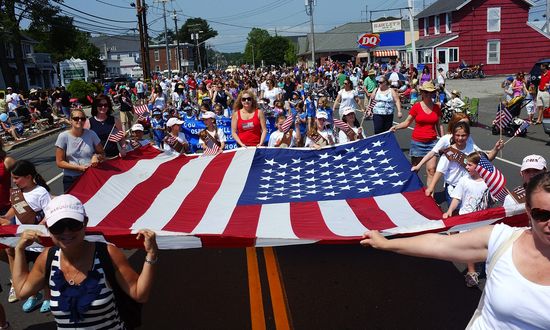
(Photo: People participate in the annual Memorial Day Parade on May 28, 2012 in Fairfield, Connecticut. Across America towns and cities will be celebrating veterans of the United States Armed Forces and the sacrifices they have made. Memorial Day is a federal holiday in America and has been celebrated since the end of the Civil War. By Spencer Platt/Getty Images)
Face Of The Day

GT_ROLLING-THUNDER-120528

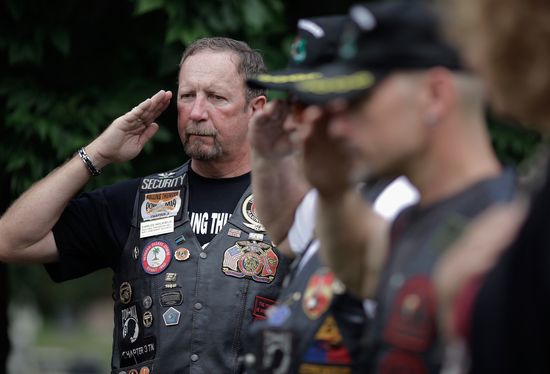
Carlos Hollifield of Knoxville, Tennessee, who served in the U.S. Marine Corps for 31 years, salutes with other veterans during a wreath-laying ceremony at the grave of an unknown Union soldier who died during the Civil War at the Congressional Cemetery on May 25, 2012 in Washington, DC. The ceremony is part of weekend events marking the 25th anniversary of the Rolling Thunder Ride for Freedom, a motorcycle rally in the nation's capital. Started in 1988 as a protest to bring more awarness to issues about POW/MIA, Rolling Thunder now has 90 chapters across the United States and expects more than 900,000 veterans and their supporters to participate in the ride. By Chip Somodevilla/Getty Images.

A Spritz Of Whale Poop

Ben Shattuck reviews Christopher Kemp's Floating Gold: A Natural (& Unnatural) History of Ambergris:

People have used ambergris (‘gray amber,’ French) for a long time — Moctezumaadded it to his tobacco, Casanova to his chocolate mousse, England’s King Charles II to his eggs; 17th-century French physicians used it to cure rabies, Florida’s American Indians as an antidote for fish poison, and today, companies like Chanel and Guerlain as fixative in their most expensive perfumes. 

So what does it smell like?

Here is a solid lump of whale feces, weathered down—oxidized by salt water, degraded by sunlight, and eroded by waves — from the tarry mass to something that smells, depending on the piece and whom you’re talking to, like musk, violets, fresh-hewn wood, tobacco, dirt, Brazil nut, fern-copse, damp woods, new-mown hay, seaweed in the sun, the wood of old churches, or pretty much any other sweet-but-earthy scent. Borne in whale guts to be crushed and dabbed on the wrists and necks of the elite.

Synthetic alternatives have been discovered but Kemp isn't convinced:

Scientists may be able to produce compounds that can mimic the fixative properties of ambergris, but the odor of the ambergris is itself indescribable, let alone replicable.

Vonnegut’s Battle

3778070228_03299dec7a_b

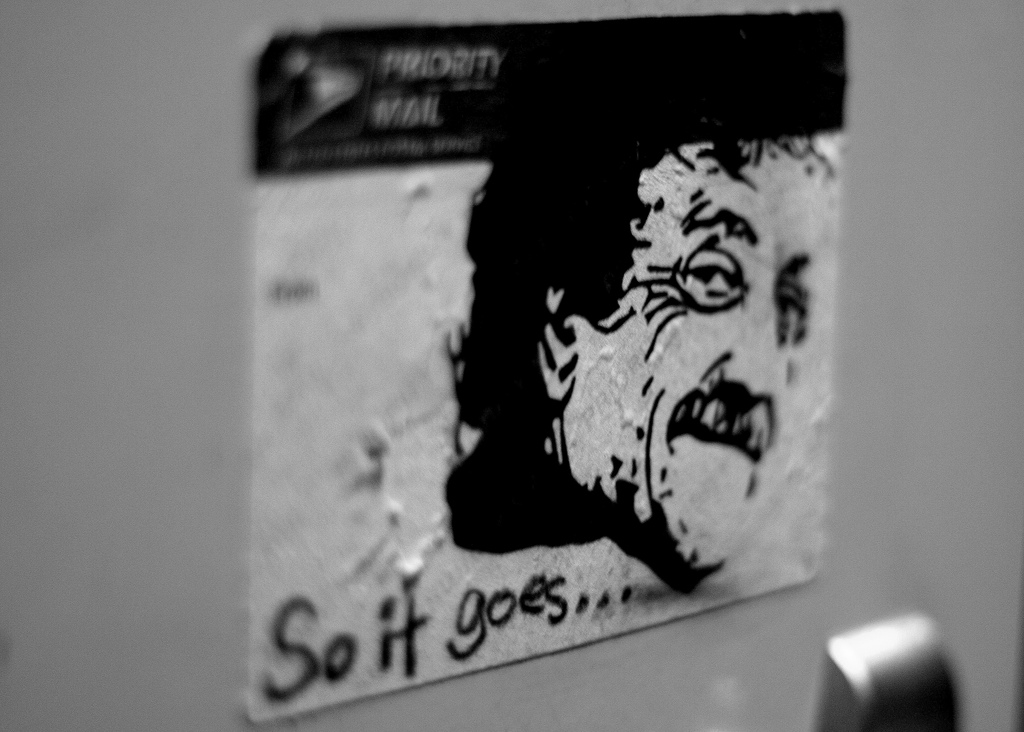
William Deresiewicz argues Slaughterhouse-Five is "not about time travel and flying saucers, it’s about PTSD":

The novel is framed by Vonnegut’s account of trying to write about Dresden—of trying to remember Dresden. But a different kind of memory became the novel’s very fabric. "He tried to remember how old he was, couldn’t." This is Billy the optometrist. "He tried to remember what year it was. He couldn’t remember that, either." For the traumatized soldier, the war is always present, and the present is always the war.

He is unstuck in time in the sense that he is stuck in time. His life is not linear, but radiates instead from a single event like the spokes of a wheel. Everything feels like a dream: a very bad dream. The novel is framed the way it is because Vonnegut, too, was traveling in time. He needed to make himself a part of the story because he already was a part of the story.

(Photo by Flickr user Seabamirum)

The Honest Bank Robber

Cord Jefferson is concerned about the rise of bank robbers who are "just trying to keep their heads above water":

In Mississippi this week, a man walked into a bank and handed a teller a note demanding money, according to broadcast news reporter Brittany Weiss. The man got away with a paltry $1,600 before proceeding to run errands around town to pay his bills and write checks to people to whom he owed money. He was hanging out with his mom when police finally found him. Three weeks before the Mississippi fiasco, a woman named Gwendolyn Cunningham robbed a bank in Fresno and fled in her car. Minutes later, police spotted Cunningham's car in front of downtown Fresno's Pacific Gas and Electric Building. Inside, she was trying to pay her gas bill.

It's less surprising when you consider the increasing difficulty of major bank robberies.

Mental Health Break

Creator Afiq Omar explains:

Ferienne is the third installment of an ongoing experimental study on fluid dynamics, magnetism and cymatics. These invisible forces of nature are then made visible through various liquids and mixtures, and they form patterns that are otherwise invisible to the naked eye.

Joe Hanson is a fan of the series:

The shapes you see here are like peering into the invisible, using the ferrofluids to reveal the shapes of unseen magnetic fields. These are forms that we could never create in any other way, and are so random that each one may never be seen again.

In Chicken We Trust

A history of the chicken examines the bird's religious significance:

Chickens were, and still are, a sacred animal in some cultures. The prodigious and ever-watchful hen was a worldwide symbol of nurturance and fertility. Eggs hung in Egyptian temples to ensure a bountiful river flood. The lusty rooster (a.k.a. cock) was a universal signifier of virility—but also, in the ancient Persian faith of Zoroastrianism, a benign spirit that crowed at dawn to herald a turning point in the cosmic struggle between darkness and light. For the Romans, the chicken’s killer app was fortunetelling, especially during wartime. Chickens accompanied Roman armies, and their behavior was carefully observed before battle; a good appetite meant victory was likely. According to the writings of Cicero, when one contingent of birds refused to eat before a sea battle in 249 B.C., an angry consul threw them overboard. History records that he was defeated.

Escaping Culture

2762486141_bc338120c8_o

Kenan Malik argues that a person's cultural past need not be his future:

‘It is in the interest of every person to be fully integrated in a cultural group’, the sociologist Joseph Raz has written. And that has become a common view in many multiculturalist claims. But what is to be fully integrated? If a Muslim woman rejects sharia law, is she demonstrating her lack of integration? What about a Jew who doesn’t believe in the legitimacy of the Jewish State? … To view humans as having to bear specific cultures [denies] a capacity for transformation.  It suggests that every human being is so shaped by a particular culture that to change or undermine that culture would be to undermine the very dignity of that individual. It suggests that the biological fact of, say, Jewish or Bangladeshi ancestry somehow make a human being incapable of living well except as a participant of Jewish or Bangladeshi culture. This would only make sense if Jews or Bangladeshis were biologically distinct – in other words if cultural identity was really about racial difference.

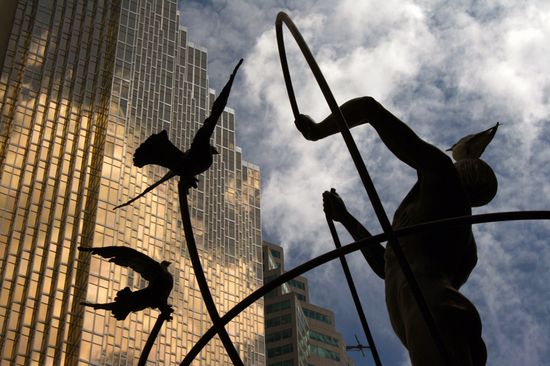
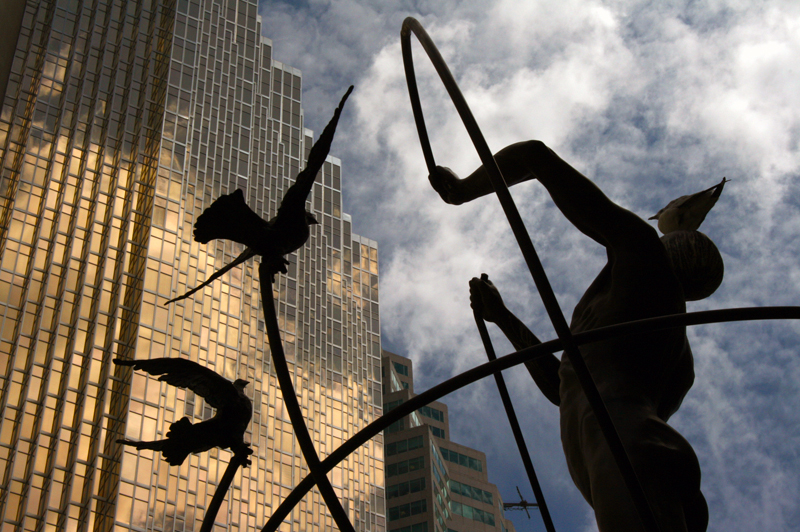
(Photo of the Ontario Monument to Multiculturalism by Flickr user Shaun Merritt)

The View From Your Window

IMG_3113

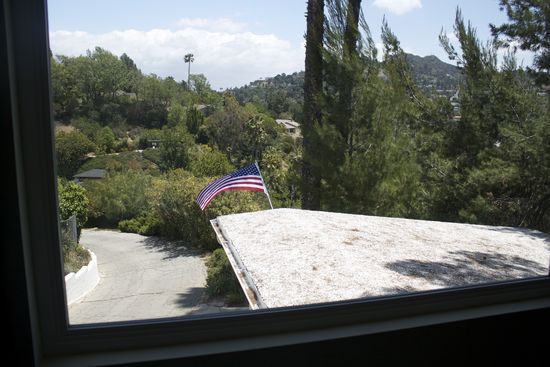
Studio City, California, 12.36 pm

Our reader writes:

This photo is kind of ordinary I know, but I live in a very blue area of the country, and it's just a fact that liberals are squeamish about showing their patriotism. This has always bothered me coming from a military family (I'm a left-leaning moderate myself). At the time of the first Obama campaign, I started festooning our vehicles and house with not only Obama signs and stickers but lots of American flags. My liberal friends asked me about this and I told them that it was a shame to let the right-wingers get away with co-opting the flag of every citizen in the country just for themselves. That we needed to "take back" our flag. They said I was right and started doing the same with flags all over the place.

Every Memorial Day, Independence Day and Veteran's Day (and September 11th), we put out all our flags. Just this morning my liberal neighbor told me how much she loved seeing the flags up and thanked me for my "beautiful patriotism." She said she would remind herself again to go out and buy a flag, we'll see … but from the bluest of the blue places, there are many of us who remember those who serve our country and salute them.

The Teen Sleep Cycle

Bora Zivkovic finds evidence that hormones force teenagers to stay up late:

No amount of bribing or threatening can make an adolescent fall asleep early. Don’t blame video games or TV. Even if you take all of these away (and you should that late at night, and replace them with books) and switch off the lights, the poor teen will toss and turn and not fall asleep until midnight or later, thus getting only about 4-6 hours of sleep until it is time to get up and go to school again.

He argues that teenagers should be going to school later in the morning:

If [teenagers] are driving themselves to school at 6 or 7am, when their circadian clocks think is it 3 or 4am, it is as if they are driving drunk.