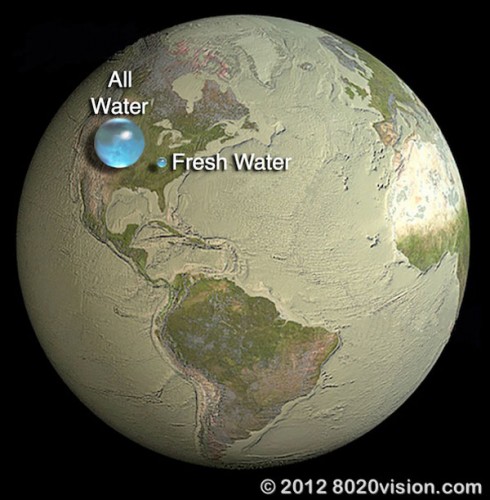
Where In The World Is All The Water??

Earthfreshwater-490x500

The sphere on the left represents all the water on the planet:

If you gathered all the world’s water—from oceans, lakes, groundwater, water vapor, everything—into a sphere, it would have a diameter of 860 miles. That’s the distance between Salt Lake City and Topeka, Kansas.

Jay Kimball graphed just how little of that is fresh – the sphere on the right. Coby Beck heightens our worry:

And don't forget that that ball of freshwater is mostly out of range of our drinking glasses and irrigation systems. A full 74.5% of that much smaller ball is locked away in ice caps and glaciers and 24.7% is groundwater (much of that out of reach). There is only .56% of the world's freshwater circulating in lakes, rivers, rainfall, soil and the biosphere.

Underearners Anonymous

Genevieve Smith checks in with the group:

Underearning, according to UA’s adherents, is more a reflection of the feeling that we’re not where we thought we’d be, whether in terms of savings, career goals, or however else we measure prosperity and success. It was this anxiety, more than my sorry bank account, that drew me to my first UA meeting. I’d come not because I was destitute (I’m not), but because I’d grown anxious that I’d ever achieve the financial security I’d always assumed was inevitable.

Given that there’s a lot of real poverty in the United States, I was sure I’d be exposed as an employed, debt-free fraud and booted from the proceedings. As it turned out, the underearners were a diverse coalition. Sure, there were those struggling with debt, eviction, and long bouts of unemployment, but there were also many people whose financial circumstances seemed enviable—one guy claimed to be bringing in more than $200,000 a year—who nevertheless felt they were underachievers.

Local Limbaughs

Ed Leibowitz profiles John Kobylt and Ken Chiampou, hosts of California's The John & Ken Show, who reach 1.2 million weekly in the key 3 pm to 7 pm drive-time slot:

Stretching from the Inland Empire to northern San Diego County, it is not only the most listened-to local radio talk show in Southern California, but in the whole country. “More stimulating talk radio” is KFI’s official slogan, and Kobylt and Chiam-pou deliver. They’ll talk about celebrity farces and tragedies, lurid murder trials, and weirdness wherever it materializes, but their main theme is the destruction of California—by public employee unions, by endless tax increases, by illegal immigrants, by corrupt and incompetent politicians, and by violent criminals coddled by the system.

The John & Ken Show is devoid of heroes. There are only traitors and bandits and their victims—the middle-class American taxpayers whom Kobylt and Chiampou speak to every weekday as their pockets are picked and their way of life is eroded by the border-crossing hordes.

The Evolution Of Swear Words

short history:

Golly! Zounds! Gadzooks! These are the kind of things Captain Marvel would say. Almost any other superhero would be too mature for such, childish silly words. And yet, during Shakespeare's time, they made him one of the more edgy writers out there.

They're not just random sounds, but contractions, meant to make absolutely shocking sentiments less outright obscene. Golly, zounds, and gadzooks were, in order, god's body, god's wounds, and god's hocks. While thinking about the Almighty's ham hock region might offend a few people, each of these words are the kind of things now deemed perfectly innocent. This shows a huge shift in social mores since the time of the Shakespeare.

Religious obscenities, when half of Europe was at war with the other half over the right way to practice Christianity, were a big deal. Referring to God in the corporeal sense was a way to scandalize people. To take the Lord's name in vain was to go against explicit Biblical instructions. These were some of the more obscene concepts of the age, but today are the most mild swear words most people can think of.

Poem For Memorial Day

It feels a Shame to be Alive –
When Men so brave – are dead –
One envies the Distinguished Dust –
Permitted – such a Head –

The Stone – that tells defending Whom
This Spartan put away
What little of Him we – possessed
In Pawn for Liberty –

The Price is great – Sublimely paid –
Do we deserve – a Thing –
That lives – like Dollars – must be piled
Before we may obtain?

Are we that wait – sufficient worth –
That such Enormous Pearl
As life – dissolved be – for Us –
In Battle's – horrid Bowl?

It may be – a Renown to live –
I think the Men who die –
Those unsustained – Saviors –
Present Divinity –

– Emily Dickinson.

Red And Blue Team Loyalty

 Illustrated:

When pollsters ask Republicans and Democrats whether the president can do anything about high gas prices, the answers reflect the usual partisan divisions in the country. About two-thirds of Republicans say the president can do something about high gas prices, and about two-thirds of Democrats say he can’t. But six years ago, with a Republican president in the White House, the numbers were reversed: Three-fourths of Democrats said President Bush could do something about high gas prices, while the majority of Republicans said gas prices were clearly outside the president’s control.

Dave Berri draws a sports analogy:

Fans of the opposite party are not against the President because he doesn’t agree with them on the issue.  They are against the President because he plays for the “wrong” team.  And unless he is willing to change teams … , he can try to “reach across the aisle” all day and he will never make the other team’s fans happy.   

Why The IDF Stands By As Palestinians Are Attacked

A former member of the border police in Hebron explains what an ethnocracy means:

After the Shamgar Committee investigation [into the massacre of Palestinians by the Zionist extremist Baruch Goldstein in 1994], the rules of engagement changed. The command to wait for a weapons jam was replaced with the direction to “instruct the shooter or person endangering life through other means to cease his actions, or to try to overpower him immediately, while using reasonable force.” In the case that the shooter is not deterred by the soldiers’ requests to cease fire, they are required, according to the IDF instructions, to carry out something similar to the “procedure for detaining a suspect”: shots in the air, shots towards the legs, and only then, shots to neutralize the danger.

This is how it is on paper. In reality, the soldier on the ground receives oral commands that preserve the order to do nothing in instances of Israeli fire towards Palestinians, and in instances of less severe violence, “to serve as a buffer.”

Soldiers on the ground are well-trained to take action when a Palestinian attacks, but not when he is the victim of settler violence. Most of the testimonies given to Breaking the Silence don’t relate to the commands given in the instance of an Israeli shooting at a Palestinian because the perception is that the IDF is in the Occupied Territories in order to protect the settlers, and this is the basis for all routine IDF activity. You don’t shoot at the ones you were sent to protect.


The Bain Of This Campaign, Ctd

Joe Klein has a must-read. Money quote:

It seems to me that Obama’s immediate point is wrong: Romney wasn’t primarily about job destruction and corporate plundering. His larger point–that Romney was not so much about job-creation as he was about profit-creation–is correct, though. But the largest point of all is this: private equity capitalism was all about short-term profits–maximizing shareholder value–rather than long-term growth. It ushered in an era of massive executive compensation and bonuses. It prospered because of tax rules that made debt more profitable than equity, and a “carried interest” tax dodge that enabled Mitt Romney to pay a lower percentage in taxes than your average construction worker. It can be a useful tool in restructuring companies and steering them toward profitability, but it is not the sort of model you’d want to apply to the entire American economy.

A President has to be about long-term growth, not short-term profits–and to the extent that Barack Obama is using the Bain ads to make this larger argument, he is not “stumbling” or attacking “free enterprise,” but he is steering the conversation toward the most important topic this year: what sort of economy do we want to have and how do we get there?

The point is that a president cannot just maximize profts for shareholders. Being a CEO is not the same as being a president. Moreover, even if you think that Romney's highly profitable adventures in private equity helped the economy more than hurt it, the rigged system in which he paid lower taxes, exploited other loopholes and made money regardless of the outcome in any specific case is not a pretty picture of real market capitalism.

The relevant analogy in this election is not Romney's time at Bain in terms of his ability to increase employment. It's his record in Massachusetts as governor – during which time, the state came in 47th out of 50 in terms of job growth. And his proposals for the future – which as I currently see them would either explode the debt or end Medicare and Medicaid as we have known them. Or, as Chait points out, give us a second stimulus of a kind he has spent the last four years condemning.