Is The Multiverse Real?

Brian Greene explores the concept:

Imagine that when the apple fell on Newton’s head, he wasn’t inspired to develop the law of gravity, but instead reasoned that some apples fall down, others fall up, and we observe the downward variety simply because the upward ones have long since departed for outer space. The example is facetious but the point serious: used indiscriminately, the multiverse can be a cop-out that diverts scientists from seeking deeper explanations. On the other hand, failure to consider the multiverse can place scientists on a Keplerian treadmill in which they furiously chase answers to unanswerable questions.

Which is all just to say that the multiverse falls squarely in the domain of high-risk science.

There are numerous developments that could weaken the motivation for considering it, from scientists finally calculating the correct dark-energy value, or confirming a version of inflationary cosmology that only yields a single universe, or discovering that string theory no longer supports a cornucopia of possible universes. And so on.

But as with all rational bets, high risk comes with the potential for high reward. During the past five centuries we’ve used the power of observation and mathematical calculation to shatter misconceptions. From a quaint, small, earth-centered universe to one filled with billions of galaxies, the journey has been both thrilling and humbling. We’ve been compelled to relinquish sacred belief in our own centrality, but with such cosmic demotion we’ve demonstrated the capacity of the human intellect to reach far beyond the confines of ordinary experience to reveal extraordinary truth. The multiverse proposal might be wrong. But it might also be the next step in this journey, unveiling a breathtaking panorama of universes populating a vast cosmic landscape. For some scientists, including me, that possibility makes the risk well worth taking.

More on Greene's theories here.

Excusing Your Self

Bruce Hood, author of The Self Illusion, argues that a lack of self isn't as depressing as it sounds: 

When we judge others, we consider them responsible for their actions. But was Mary Bale, the bank worker from Coventry who was caught on video dropping a cat into a garbage can, being true to her self? Or was Mel Gibson’s drunken anti-Semitic rant being himself or under the influence of someone else? What motivated Senator Weiner to text naked pictures of himself to women he did not know? … By rejecting the notion of a core self and considering how we are a multitude of competing urges and impulses, I think it is easier to understand why we suddenly go off the rails. It explains why we act, often unconsciously, in a way that is inconsistent with our self image – or the image of our self as we believe others see us.

In an interview with Jonah Lehrer, Hood addresses his critics:

My critics often dismiss my position as too reductionist or too materialist. Well, if the human condition it is not materialist, then an alternative good explanation must be non-materialist. Show me good evidence for souls and spirits and then I will be forced to change my view. But so far there has been no reliable evidence for souls, ghosts or supernatural entities that inhabit bodies. They are conspicuous by their absence. In contrast, we know that if you alter the physical state of the brain through a head injury, dementia or drugs, each of these changes our self. Whether it is through damage, disease or debauchery, we know that the self must be the output of the material brain.

Will Wilkinson disagrees with Hood's understanding of "illusion." Julian Sanchez covered related ground a couple years back while discussing the "illusion" of free will:

It is as if someone had told me for the first time about subatomic theory, and I mused that I nevertheless have this illusion of a solid desk chair, when after all, it is really these clouds of quarks and whatnot. And this would be silly: The parameters of “solid” and “desk chair” are given by ordinary life, and within those bounds the chair is exactly as solid as it ever was. A theory about the microstructure of the chair could not be in conflict with, or prove “illusory,” my ordinary perceptions,  because they were not perceptions of the microstructure in the first place.

Religion As Refuge

In reviewing What Money Can’t Buy by Michael Sandel and How Much is Enough? by Robert and Edward Skidelsky, Rowan Williams makes the case for faith:

A world in which every object is instantly capable of being rendered in terms of what it can be exchanged for is one in which there is nothing worth looking at for itself, a world systematically “de-realised.” And that is what we are threatened with: Sandel’s examples converge with the Skidelskys’ thesis in putting before us a possible world of absolute commodification. If we want to resist this intelligently, we need doctrine, ritual and narrative: sketches of the normative, practices that are not just functions, and stories of lives that communicate a sense of what being at home in the environment looks like—and the costs of failure as well. 

Taming The World

J.B. MacKinnon fears we've neutered Mother Nature:

Guiseppepenone1The natural world feels like a spiritual respite: a literal sanctum, where we are safe  to reconnect to what is larger than ourselves. Compared to the cosmic rhythms of mountain, sea, and sky, it is ordinary daily life—driving at rush hour, punching security codes, navigating a shape-shifting digital culture—that seems hostile.

Yet there is a serious problem with our idea of sacred nature, and that is that the idol is a false one. If we experience the natural world as a place of succor and comfort, it is in large part because we have made it so.

Only 20 percent of the earth’s terrestrial surface is still home to all the large mammals it held five hundred years ago, and even across those refugia they are drastically reduced in abundance. The seas have lost an estimated 90 percent of their biggest fish. For decades there were almost no wolves, grizzly bears, or even bald eagles in the lower 48, and modern recovery projects have brought them back to only a small fraction of their former ranges. Scientists speak of an “ecology of fear” that once guided the movements and behavior of animals that shared land- and seascapes with toothy predators—an anxiety that humans once shared. In much of what’s left of the wild, that dread no longer applies even to deer or rabbits, let alone us.

(Image from The Hidden Life Within by Guiseppe Penone, via My Modern Met)

The Pursuit Of Happiness

Can prove counterproductive:

Groundbreaking work by Iris Mauss has recently supported the counterintuitive idea that striving for happiness may actually cause more harm than good. In fact, at times, the more people pursue happiness the less they seem able to obtain it. Mauss shows that the more people strive for happiness, the more likely they will be to set a high standard for happiness—then be disappointed when that standard is not met.  This is especially true when people were in positive contexts, such as listening to an upbeat song or watching a positive film clip. It is as if the harder one tries to experience happiness, the more difficult it is to actually feel happy, even in otherwise pleasant situations.

And so modern research comes way back around to … Aristotle.

Holy Hallucinations

Alex Bellos profiles a Brazilian religion and its drug of choice:

Ayahuasca—or Daime as it is known locally—is a muddy-looking concoction made from boiling the Banisteriopsis caapi vine and the Psychotria viridis leaf. Across the Amazon, indigenous people drink it as a part of their rituals. In Brazil a century ago, however, the hallucinogen led to the birth of a new Christian movement, the religion known as Santo Daime.

How the religion started in Brazil:

The first man to use ayahuasca in a Christian context was a 6ft 6in rubber tapper called Raimundo Irineu Serra. A black man, the son of former slaves, Irineu was introduced to the shamanic brew in the 1910s and under its influence had a vision of a beautiful woman—Clara, the Forest Queen—who commanded him to go several days in the jungle without having sex and eating only saltless manioc. He obliged, and during this time he was "channelled" the doctrine of a new religion. He called it Santo Daime because in the trancelike state he repeatedly asked the drug to "daime", or "give me", qualities such as strength, love and light. Santo Daime’s literal meaning, therefore, is Saint Gimme.

Notes from a New York chapter of Santo Daime here.

A Poem For Sunday

Rob-2

"The Universal Prayer" by Alexander Pope:

Father of all! In every age,
In every clime adored,
By saint, by savage, and by sage,
Jehovah, Jove, or Lord!

Thou Great First Cause, least understood
Who all my sense confined
To know but this, that Thou art good
And that myself am blind.

The poem continues.

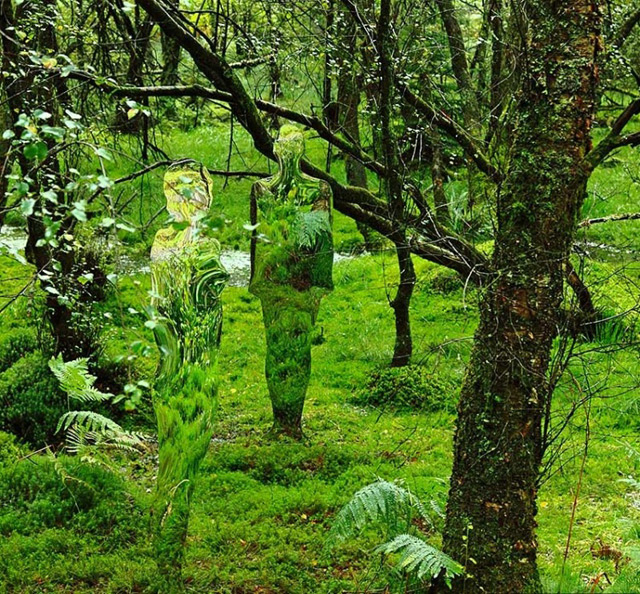
(Image: mirrored sculptures by Rob Mulholland via Colossal)