Can Science Embrace Awe?

Philip Ball insists it's not reserved for religion:

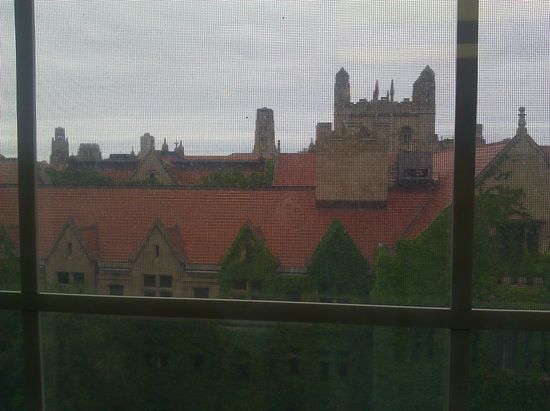
Pretending that science is performed by people who have undergone a Baconian purification of the emotions only deepens the danger that it will seem alien and odd to outsiders, something carried out by people who do not think as they do. [Lorraine] Daston believes that we have inherited a “view of intelligence as neatly detached from emotional, moral and aesthetic impulses, and a related and coeval view of scientific objectivity that brand[s] such impulses as contaminants”.

It is easy to understand the historical origins of this attitude: the need to distinguish science from credulous “enthusiasm”, to develop an authoritative voice, to strip away the pretensions of the mystical Re nais sance magus who acquired knowledge through personal revelation. We no longer need these defences, however; worse, they become a defensive reflex that exposes scientists to the caricature of the emotionally constipated boffin, hiding within thickets of jargon.

Sunday Dish

DOVEHANDSJohnMoore:Getty

Two reader responses:

It's been a long week, and between a hectic business schedule and some touristing I'm doing while out of town, I completely lost track of what day it is. Thus, as I was finishing up some errands this afternoon, I thought how nice it would be to go check out what's on the Dish when I got home. Alas, when I returned home and saw my calendar, I realized it's Sunday. And sure enough, as expected, the Dish sucks today. It's full of all that god babble that you're so fond of. Down with god babble. More real content, please?

The other:

I often feel so in step with The Dish.  It is truly therapy for me.  Your post makes my heart break as my father died just two days ago, and the experience has shaken my soul.  Never have your Sunday reflections meant so much to me.  Please pray for my father and my family.

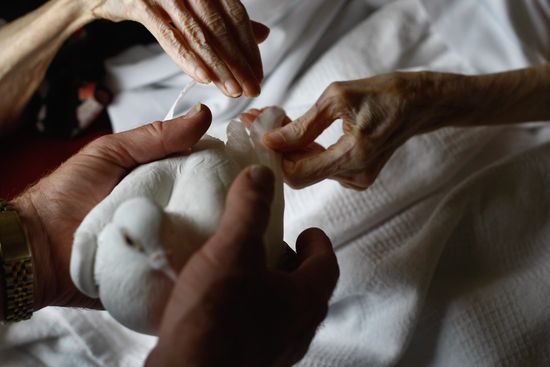
(Photo: a hospice therapy experiment with doves by John Moore/Getty.)

Sacred Conflicts

Scott Atran explores why they are so hard to resolve:

In interviews, experiments, and surveys with Palestinians, Israelis, Indonesians, Indians, Afghans, and Iranians, my research with psychologists Jeremy Ginges and Douglas Medin finds that offering people material incentives (large amounts of money, guarantees for a life free of political violence) to compromise sacred values can backfire, increasing stated willingness to use violence toward compromise.

This research, supported by the U.S. Department of Defense and the National Science Foundation, shows that backfire effects occur both for sacred values with clear religious investment (Jerusalem, Shariah law) and those with initially none (Iran’s right to nuclear capability, Palestinian refugees’ right of return).

For example, a 2010 study of attitudes toward Iran’s nuclear program found that, for most Iranians, having a nuclear program has nothing sacred about it. But it had become a sacred subject through religious rhetoric for about 13 percent of the population. This group, which tends to be close to the regime, now believes a nuclear program is bound up with the national identity and with Islam itself, so that offering material rewards or punishments to abandon the program only increases anger and support for it.

The “People’s Parson”

Religion could use more like Reverend John Lambourne. From his kind obituary:

Lambourne provided comfort to the sick and bereaved, and there were few people in the parish of Salehurst and Robertsbridge whose lives he did not touch . A major part of his ministry, however, was conducted over a pint at the local pub, where he encouraged all sorts of unlikely people to become regular churchgoers — even to attending “bring-a-bottle” confirmation classes.

Even Hitch would have approved of this:

One parishioner recalls how at one Midnight Mass, held after a convivial evening in the pub, Lambourne embarked on his sermon but soon found himself struggling with the word “vicissitude”. After three valiant attempts he gave up with a “we’ll leave it there, I think”. At the same service the following year he began his sermon with “vicissitude” and continued where he had left off.

Ah, yes, the Church of England, the greatest bulwark against religion humankind has yet constructed.

Quote For The Day

“Living in the world as a cripple allows you to see more clearly the crippled hearts of some people whose bodies are whole and sound. All of us, from time to time, suffer this crippling. Some suffer it daily and nightly; and while most of us, nearly all of us, have compassion and love in our hearts, we cannot or will not see these barely visible wounds of other human beings, and so cannot or will not pick up the telephone or travel to someone’s home or writer a note or make some other seemingly trifling gesture to give someone what only we, and God, can give: an hour’s respite, or a day’s, or a night’s; and sometimes more than respite: sometimes joy,” – Andre Dubus, “A Woman In April,” from Broken Vessels.

Our Relationship With Death

Michael Wolff's eighty-six-year-old mother "has not been able to walk, talk, or to address her most minimal needs" for the past year and a half. Wolff mediates on our efforts to evade death:

The traditional exits, of a sudden heart attack, of dying in one’s sleep, of unreasonably dropping dead in the street, of even a terminal illness, are now exotic ways of going. The longer you live the longer it will take to die. The better you have lived the worse you may die. The healthier you are—through careful diet, diligent exercise, and attentive medical scrutiny—the harder it is to die. Part of the advance in life expectancy is that we have technologically inhibited the ultimate event. We have fought natural causes to almost a draw. If you eliminate smokers, drinkers, other substance abusers, the obese, and the fatally ill, you are left with a rapidly growing demographic segment peculiarly resistant to death’s appointment—though far, far, far from healthy.

Dreher shares his own struggles. Katie J.M. Baker gets scared.

Why Believe?

GT_MCCALL_ART_120517

Christopher Page offers a series of posts on the stepping stones that led him to faith:

My journey involves things half-felt, thoughts ill-formed, impressions and sensations only partially detected. I move forward in what the anonymous 14th century mystical writer called a “cloud of unknowing.” My path is not illuminated with glaring flourescent lighting; my guide does not announce the way with the sound of a blaring voice. I move towards faith rather at the calling of a gentle whisper…

Meditation is one of his routes to belief:

At least twice a day for the past fifteen years, I have sat for twenty minutes with my eyes closed in complete silence. As I sit, I am not trying to accomplish anything; I am not trying to get anywhere. I simply intend in my sitting to surrender my thoughts and return to silence. In those years of quiet, I have found an unmistakable reality beginning to permeate the hours of my days. Mystery haunts the edges of my consciousness. My heart opens to realms of reality that are only vaguely perceptible to my consciousness. I find my life is shaped from within by a force that I perceive is not a product of my will. 

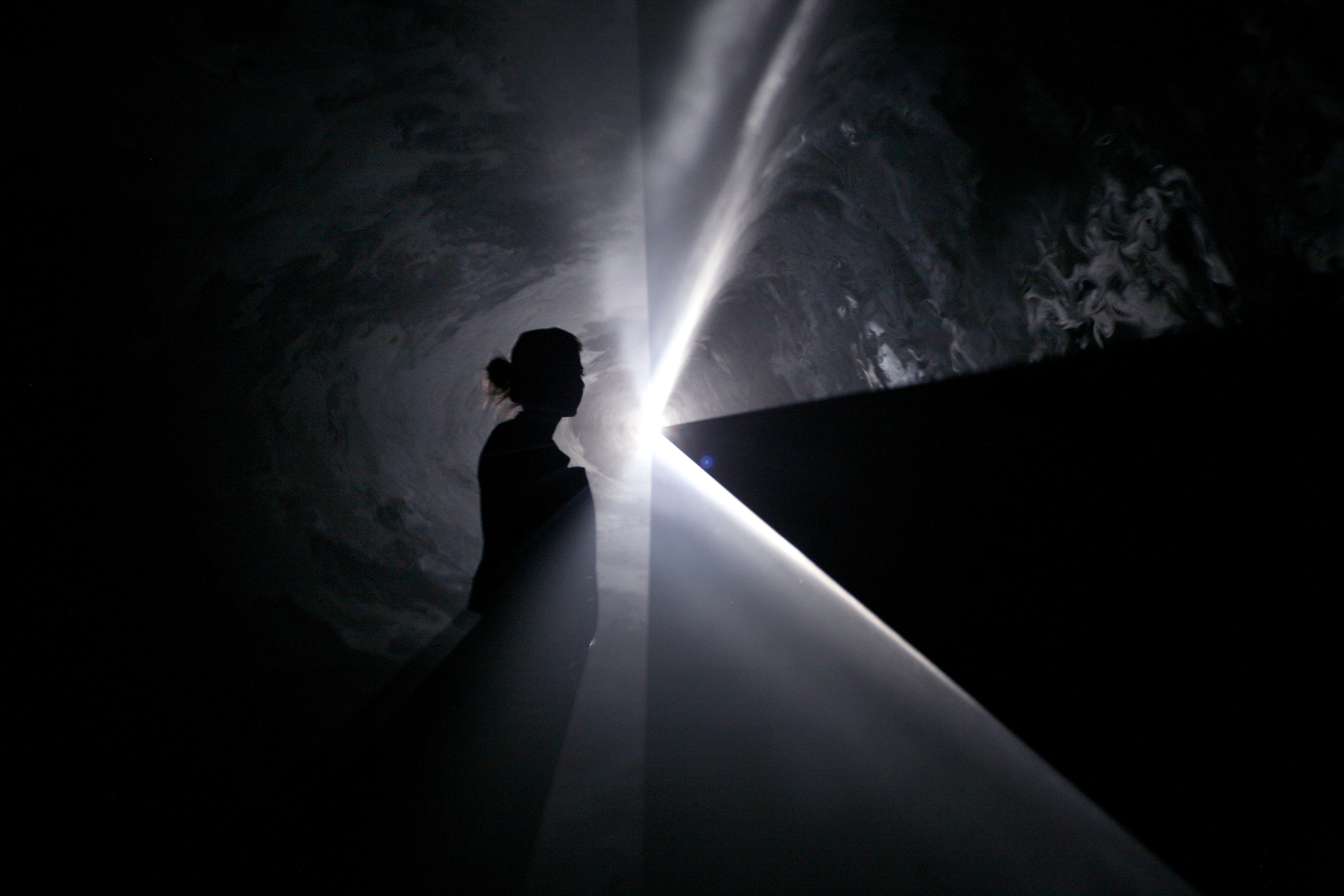
(Photo: A visitor inspects a light installation by British-born artist Anthony McCall during a preview of the exhibition 'Anthoy McCall. Five Minutes of Pure Sculpture' at the Hamburger Bahnhof museum in Berlin on April 19, 2012. The exhibition on McCall's projections, which he has been developing since the 1970s, opens its doors from April 20 to August 12, 2012. By Stephanie Pilick/AFP/Getty Images.)